

S. Okovytyy
300
To assess the effect of ring strain Gronert and co-workers have compared interaction of НО
−
with methyloxirane and corresponding acyclic analog СН 3 СН 2 ОСН 3 .
According to calculations in the case of methylethyl ether activation barrier is by
87.0 kJ/mol higher if compared to that for methyloxirane so from ~113.0 strain
energy of oxirane ring ~75 % is released at the transition state [7].
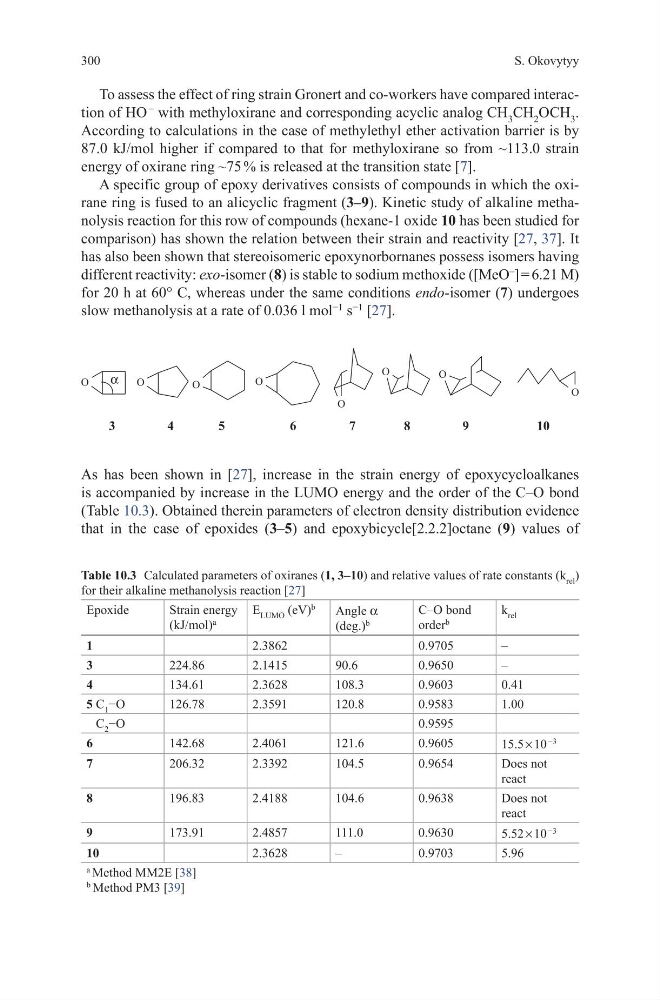
A specific group of epoxy derivatives consists of compounds in which the oxirane ring is fused to an alicyclic fragment (3–9). Kinetic study of alkaline methanolysis reaction for this row of compounds (hexane-1 oxide 10 has been studied for
comparison) has shown the relation between their strain and reactivity [27, 37]. It
has also been shown that stereoisomeric epoxynorbornanes possess isomers having
different reactivity: exo-isomer (8) is stable to sodium methoxide ([MeO
–
] = 6.21 M)
for 20 h at 60° C, whereas under the same conditions endo-isomer (7) undergoes
slow methanolysis at a rate of 0.036 l mol
−1
s
−1
[27].
2
2
2
2
2
2
2
2
α
As has been shown in [27], increase in the strain energy of epoxycycloalkanes
is accompanied by increase in the LUMO energy and the order of the C–O bond
(Table 10.3). Obtained therein parameters of electron density distribution evidence
that in the case of epoxides (3–5) and epoxybicycle[2.2.2]octane (9) values of
Table 10.3 Calculated parameters of oxiranes (1, 3–10) and relative values of rate constants (k rel )
for their alkaline methanolysis reaction [27]
Epoxide
Strain energy
(kJ/mol)
a
E LUMO (eV)
b
Angle α
(deg.)
b
С–О bond
order
b
k rel
1
2.3862
0.9705
–
3
224.86
2.1415
90.6
0.9650
–
4
134.61
2.3628
108.3
0.9603
0.41
5 С 1 −О
126.78
2.3591
120.8
0.9583
1.00
С 2 −О
0.9595
6
142.68
2.4061
121.6
0.9605
15.5 × 10
−3
7
206.32
2.3392
104.5
0.9654
Does not
react
8
196.83
2.4188
104.6
0.9638
Does not
react
9
173.91
2.4857
111.0
0.9630
5.52 × 10
−3
10
2.3628
–
0.9703
5.96
a
Method ММ2Е [38]
b
Method РМ3 [39]
300
To assess the effect of ring strain Gronert and co-workers have compared interaction of НО
−
with methyloxirane and corresponding acyclic analog СН 3 СН 2 ОСН 3 .
According to calculations in the case of methylethyl ether activation barrier is by
87.0 kJ/mol higher if compared to that for methyloxirane so from ~113.0 strain
energy of oxirane ring ~75 % is released at the transition state [7].
A specific group of epoxy derivatives consists of compounds in which the oxirane ring is fused to an alicyclic fragment (3–9). Kinetic study of alkaline methanolysis reaction for this row of compounds (hexane-1 oxide 10 has been studied for
comparison) has shown the relation between their strain and reactivity [27, 37]. It
has also been shown that stereoisomeric epoxynorbornanes possess isomers having
different reactivity: exo-isomer (8) is stable to sodium methoxide ([MeO
–
] = 6.21 M)
for 20 h at 60° C, whereas under the same conditions endo-isomer (7) undergoes
slow methanolysis at a rate of 0.036 l mol
−1
s
−1
[27].
2
2
2
2
2
2
2
2
α
As has been shown in [27], increase in the strain energy of epoxycycloalkanes
is accompanied by increase in the LUMO energy and the order of the C–O bond
(Table 10.3). Obtained therein parameters of electron density distribution evidence
that in the case of epoxides (3–5) and epoxybicycle[2.2.2]octane (9) values of
Table 10.3 Calculated parameters of oxiranes (1, 3–10) and relative values of rate constants (k rel )
for their alkaline methanolysis reaction [27]
Epoxide
Strain energy
(kJ/mol)
a
E LUMO (eV)
b
Angle α
(deg.)
b
С–О bond
order
b
k rel
1
2.3862
0.9705
–
3
224.86
2.1415
90.6
0.9650
–
4
134.61
2.3628
108.3
0.9603
0.41
5 С 1 −О
126.78
2.3591
120.8
0.9583
1.00
С 2 −О
0.9595
6
142.68
2.4061
121.6
0.9605
15.5 × 10
−3
7
206.32
2.3392
104.5
0.9654
Does not
react
8
196.83
2.4188
104.6
0.9638
Does not
react
9
173.91
2.4857
111.0
0.9630
5.52 × 10
−3
10
2.3628
–
0.9703
5.96
a
Method ММ2Е [38]
b
Method РМ3 [39]