

299
Regiochemistry of basic-catalyzed epoxide ring opening has been studied for the
case of interaction of methyloxirane with hydroxyl- [7] and formiat-anion [35], and
1S,2S-trans—2-methylstyrene oxide (tMSO) with acetate [36].
According to Krasusky rule in case of methyloxirane (2) more energetically preferable is attack of nucleophile on sterically more accessible primary carbon atom of
epoxide ring. In case of tMSO lower activation barrier corresponds to phenyl side
attack by acetate (Table 10.2).
As could be seen from Table 10.2, Hartree-Fock approach significantly (by almost 50 %) overestimates E act values if compared to that predicted by correlated approaches such as B3LYP and MP2. Forth-order Meller-Plesset perturbation theory
at MP4(SDQ) level predicts virtually the same values of activation energy [35].
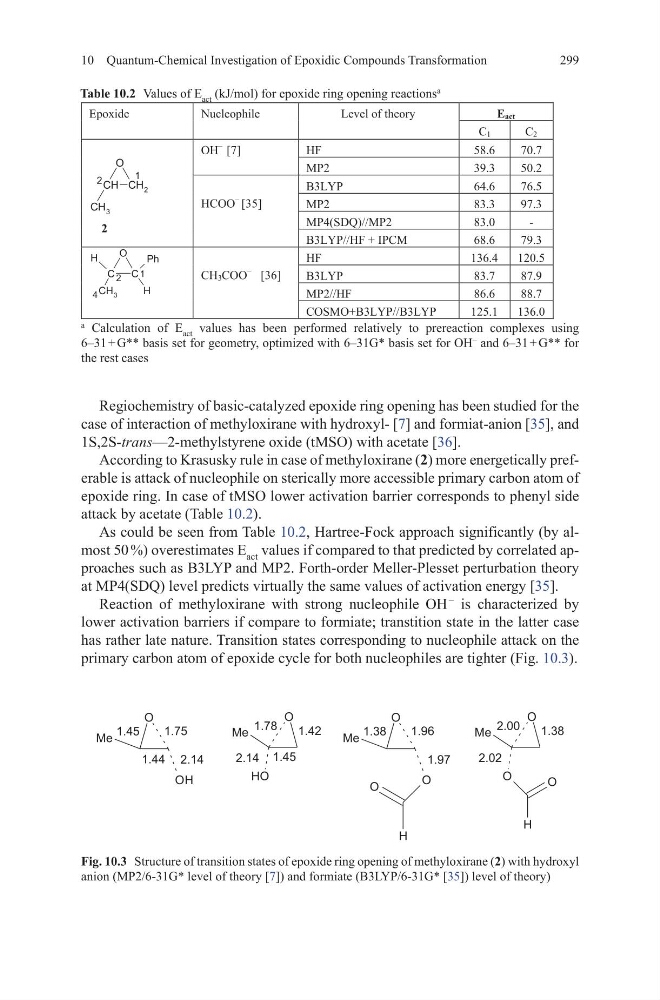
Reaction of methyloxirane with strong nucleophile ОН
−
is characterized by
lower activation barriers if compare to formiate; transtition state in the latter case
has rather late nature. Transition states corresponding to nucleophile attack on the
primary carbon atom of epoxide cycle for both nucleophiles are tighter (Fig. 10.3).
2
0H
2+
2
0H
2
+
2
0H
2
2
+
2
0H
2
2
+
Fig. 10.3 Structure of transition states of epoxide ring opening of methyloxirane (2) with hydroxyl
anion (МР2/6-31G* level of theory [7]) and formiate (B3LYP/6-31G* [35]) level of theory)
(SR[LGH
1XFOHRSKLOH
/HYHORIWKHRU\
(DFW
ɋ
ɋ
&+
&+
2
&+
Ɉɇ
± >@
+ )
03
+&22
± >@
%/<3
03
036'403
%/<3+),3&0
& &
2
&+
3K
+
+
&+&22
± >@
+)
%/<3
03+)
&2602%/<3%/<3
a
Calculation of E act values has been performed relatively to prereaction complexes using
6–31 + G** basis set for geometry, optimized with 6–31G* basis set for ОН
–
and 6–31 + G** for
the rest cases
Table 10.2 Values of E act (kJ/mol) for epoxide ring opening reactions
а
10 Quantum-Chemical Investigation of Epoxidic Compounds Transformation
Regiochemistry of basic-catalyzed epoxide ring opening has been studied for the
case of interaction of methyloxirane with hydroxyl- [7] and formiat-anion [35], and
1S,2S-trans—2-methylstyrene oxide (tMSO) with acetate [36].
According to Krasusky rule in case of methyloxirane (2) more energetically preferable is attack of nucleophile on sterically more accessible primary carbon atom of
epoxide ring. In case of tMSO lower activation barrier corresponds to phenyl side
attack by acetate (Table 10.2).
As could be seen from Table 10.2, Hartree-Fock approach significantly (by almost 50 %) overestimates E act values if compared to that predicted by correlated approaches such as B3LYP and MP2. Forth-order Meller-Plesset perturbation theory
at MP4(SDQ) level predicts virtually the same values of activation energy [35].
Reaction of methyloxirane with strong nucleophile ОН
−
is characterized by
lower activation barriers if compare to formiate; transtition state in the latter case
has rather late nature. Transition states corresponding to nucleophile attack on the
primary carbon atom of epoxide cycle for both nucleophiles are tighter (Fig. 10.3).
2
0H
2+
2
0H
2
+
2
0H
2
2
+
2
0H
2
2
+
Fig. 10.3 Structure of transition states of epoxide ring opening of methyloxirane (2) with hydroxyl
anion (МР2/6-31G* level of theory [7]) and formiate (B3LYP/6-31G* [35]) level of theory)
(SR[LGH
1XFOHRSKLOH
/HYHORIWKHRU\
(DFW
ɋ
ɋ
&+
&+
2
&+
Ɉɇ
± >@
+ )
03
+&22
± >@
%/<3
03
036'403
%/<3+),3&0
& &
2
&+
3K
+
+
&+&22
± >@
+)
%/<3
03+)
&2602%/<3%/<3
a
Calculation of E act values has been performed relatively to prereaction complexes using
6–31 + G** basis set for geometry, optimized with 6–31G* basis set for ОН
–
and 6–31 + G** for
the rest cases
Table 10.2 Values of E act (kJ/mol) for epoxide ring opening reactions
а
10 Quantum-Chemical Investigation of Epoxidic Compounds Transformation