

301
E LUMO and С–О bond orders are in a good agreement with the kinetic study [27],
which reveals the following order of reactivity changes:5 > 4 > 8 > 9. At the same
time, results of calculation of bond orders and values of E LUMO do not reflect any
particularities for methanolysis of hexane-1 oxide (10) and steroisomeric epoxynorbornanes (7, 8). In fact, for epoxide (10), which is characterized by the highest reactivity, calculations predict the highest values of breaking С–О bond order (0.9703).
For epoxides (7, 8) this parameter is equal to 0.9654 and 0.9638 correspondingly.
Using semiempirical method PM3 transition states and corresponding prereaction complexes have been localized for interaction of epoxides (1, 3–10) with
methoxy-anion modeling gas-phase conditions and taking into account solvent effects using macroscopic and supermolecular approach with explicit consideration
of solvent (methanol) molecules [30]. Activation barriers calculated for reaction in
vacuo (Table 10.4) are in a good agreement with such characteristics of epoxides as
strain energy and the C–O bond orders: increasing strain in the alicyclic fragment is
accompanied by increase in the enthalpy of activation.
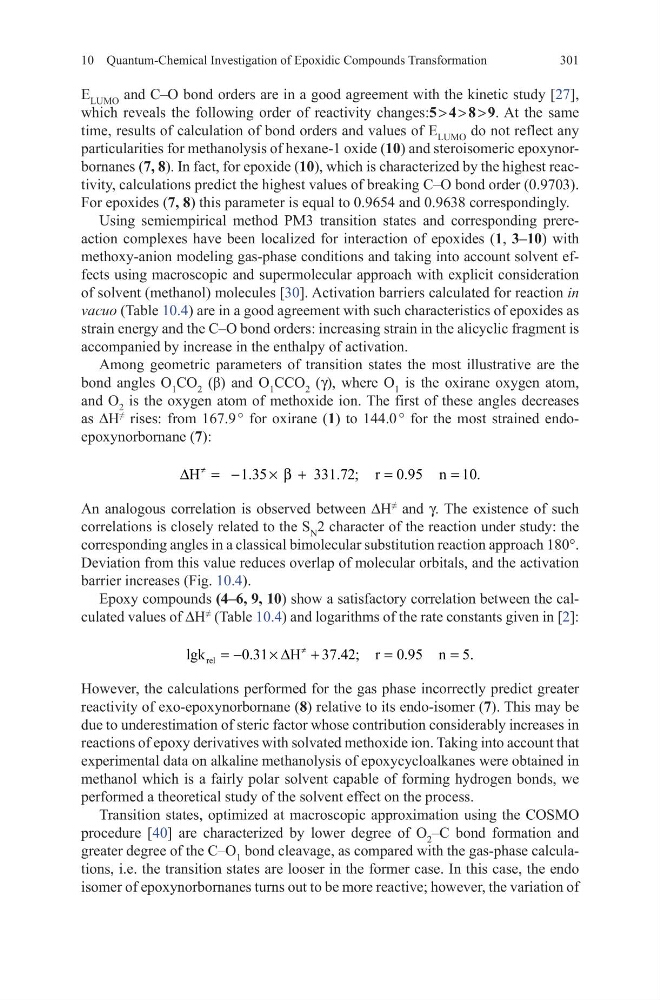
Among geometric parameters of transition states the most illustrative are the
bond angles O 1 CO 2 (β) and O 1 CCO 2 (γ), where O 1 is the oxirane oxygen atom,
and O 2 is the oxygen atom of methoxide ion. The first of these angles decreases
as ∆H
≠
rises: from 167.9 ° for oxirane (1) to 144.0 ° for the most strained endoepoxynorbornane (7):
An analogous correlation is observed between ∆Н
≠
and γ. The existence of such
correlations is closely related to the S N 2 character of the reaction under study: the
corresponding angles in a classical bimolecular substitution reaction approach 180°.
Deviation from this value reduces overlap of molecular orbitals, and the activation
barrier increases (Fig. 10.4).
Epoxy compounds (4–6, 9, 10) show a satisfactory correlation between the calculated values of ∆H
≠
(Table 10.4) and logarithms of the rate constants given in [2]:
However, the calculations performed for the gas phase incorrectly predict greater
reactivity of exo-epoxynorbornane (8) relative to its endo-isomer (7). This may be
due to underestimation of steric factor whose contribution considerably increases in
reactions of epoxy derivatives with solvated methoxide ion. Taking into account that
experimental data on alkaline methanolysis of epoxycycloalkanes were obtained in
methanol which is a fairly polar solvent capable of forming hydrogen bonds, we
performed a theoretical study of the solvent effect on the process.
Transition states, optimized at macroscopic approximation using the COSMO
procedure [40] are characterized by lower degree of O 2 –C bond formation and
greater degree of the C–O 1 bond cleavage, as compared with the gas-phase calculations, i.e. the transition states are looser in the former case. In this case, the endo
isomer of epoxynorbornanes turns out to be more reactive; however, the variation of
H
1.35
331.72; r 0.95 n 10.
≠
∆ = -
× β +
=
=
rel
lgk
0.31 H 37.42; r 0.95 n 5.
≠
= -
× ∆ +
=
=
10 Quantum-Chemical Investigation of Epoxidic Compounds Transformation
E LUMO and С–О bond orders are in a good agreement with the kinetic study [27],
which reveals the following order of reactivity changes:5 > 4 > 8 > 9. At the same
time, results of calculation of bond orders and values of E LUMO do not reflect any
particularities for methanolysis of hexane-1 oxide (10) and steroisomeric epoxynorbornanes (7, 8). In fact, for epoxide (10), which is characterized by the highest reactivity, calculations predict the highest values of breaking С–О bond order (0.9703).
For epoxides (7, 8) this parameter is equal to 0.9654 and 0.9638 correspondingly.
Using semiempirical method PM3 transition states and corresponding prereaction complexes have been localized for interaction of epoxides (1, 3–10) with
methoxy-anion modeling gas-phase conditions and taking into account solvent effects using macroscopic and supermolecular approach with explicit consideration
of solvent (methanol) molecules [30]. Activation barriers calculated for reaction in
vacuo (Table 10.4) are in a good agreement with such characteristics of epoxides as
strain energy and the C–O bond orders: increasing strain in the alicyclic fragment is
accompanied by increase in the enthalpy of activation.
Among geometric parameters of transition states the most illustrative are the
bond angles O 1 CO 2 (β) and O 1 CCO 2 (γ), where O 1 is the oxirane oxygen atom,
and O 2 is the oxygen atom of methoxide ion. The first of these angles decreases
as ∆H
≠
rises: from 167.9 ° for oxirane (1) to 144.0 ° for the most strained endoepoxynorbornane (7):
An analogous correlation is observed between ∆Н
≠
and γ. The existence of such
correlations is closely related to the S N 2 character of the reaction under study: the
corresponding angles in a classical bimolecular substitution reaction approach 180°.
Deviation from this value reduces overlap of molecular orbitals, and the activation
barrier increases (Fig. 10.4).
Epoxy compounds (4–6, 9, 10) show a satisfactory correlation between the calculated values of ∆H
≠
(Table 10.4) and logarithms of the rate constants given in [2]:
However, the calculations performed for the gas phase incorrectly predict greater
reactivity of exo-epoxynorbornane (8) relative to its endo-isomer (7). This may be
due to underestimation of steric factor whose contribution considerably increases in
reactions of epoxy derivatives with solvated methoxide ion. Taking into account that
experimental data on alkaline methanolysis of epoxycycloalkanes were obtained in
methanol which is a fairly polar solvent capable of forming hydrogen bonds, we
performed a theoretical study of the solvent effect on the process.
Transition states, optimized at macroscopic approximation using the COSMO
procedure [40] are characterized by lower degree of O 2 –C bond formation and
greater degree of the C–O 1 bond cleavage, as compared with the gas-phase calculations, i.e. the transition states are looser in the former case. In this case, the endo
isomer of epoxynorbornanes turns out to be more reactive; however, the variation of
H
1.35
331.72; r 0.95 n 10.
≠
∆ = -
× β +
=
=
rel
lgk
0.31 H 37.42; r 0.95 n 5.
≠
= -
× ∆ +
=
=
10 Quantum-Chemical Investigation of Epoxidic Compounds Transformation