

277
9 Polyphenol Glycosides as Potential Remedies in Kidney …
One of the first historical confirmations of the structure of the carbohydrate complex with metals was the X-ray study of the crystal structure of sucrose NaBr · 2H 2 O.
It has to be mentioned that sucrose does not form the complex in the solution [24].
In 1972 crystal structure of sugar and calcium was determined for d-mannose CaCl 2 · 2H 2 O. Calcium in this case is coordinated to O1, O2, and O3 of one
β-furanose ring and to O5 and O6 of the another mannose molecule [25].
The structure of the sugar unit in complexed and uncomplexed inositol is the
same since inositol presents three axial hydroxyl groups in a manner ready for interactions with calcium ion [26]. The only slight change is observed in the distance
between syn-axial oxygen atoms (2.82 Å in comparison to 2.96 Å in uncomplexed
molecule). This reduction in the gauche or syn-axial interactions between participating oxygen atoms seems to be generally true, providing the driving force toward
the complex formation [18].
In 1988 calcium complexes with d-glucose in the solution and in crystal form
were investigated by Tajmir-Riahi [27]. He pointed out that there are strong interactions in calcium–d-glucose complexes in the solid and in the non-aqueous solution,
while water, as a solvent, causes significant decreasing of these interactions. He also
observed that calcium ion complexes in solid state can form two kind of complexes
with 1:1 and 1:2 calcium–sugar ratio. In the first one calcium is coordinated by
seven oxygen atoms (three oxygen atoms from sugar and four oxygen atoms from
water molecules). In the 1:2 complex the calcium atom is coordinated by eight
oxygen atoms: four oxygen atoms from water molecules and two hydroxyl oxygen
from each d-glucose molecule.
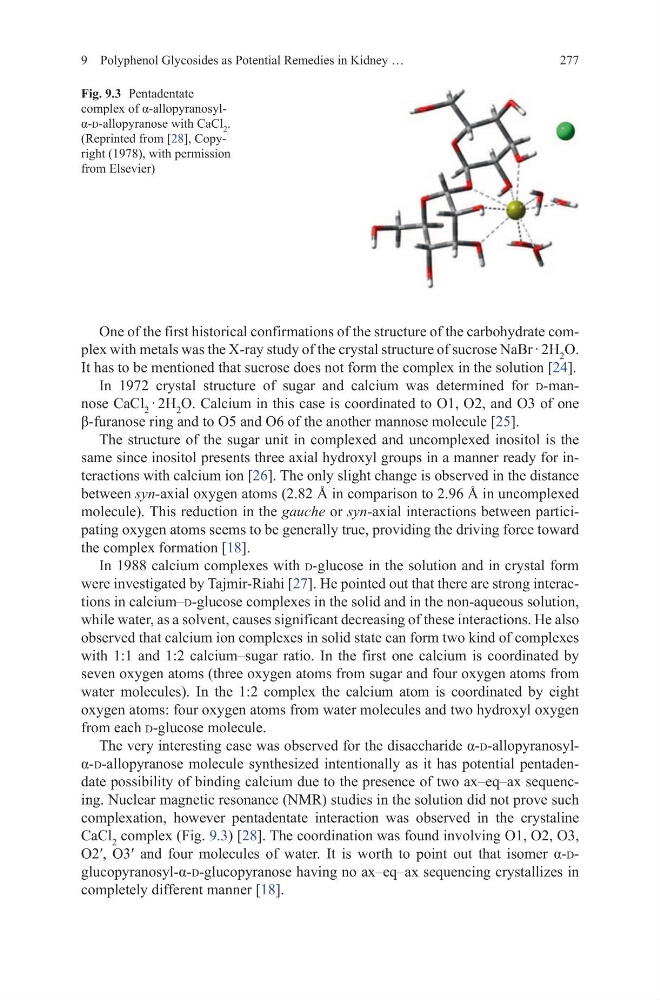
The very interesting case was observed for the disaccharide α-d-allopyranosylα-d-allopyranose molecule synthesized intentionally as it has potential pentadendate possibility of binding calcium due to the presence of two ax–eq–ax sequencing. Nuclear magnetic resonance (NMR) studies in the solution did not prove such
complexation, however pentadentate interaction was observed in the crystaline
CaCl 2 complex (Fig. 9.3) [28]. The coordination was found involving O1, O2, O3,
O2′, O3′ and four molecules of water. It is worth to point out that isomer α-dglucopyranosyl-α-d-glucopyranose having no ax–eq–ax sequencing crystallizes in
completely different manner [18].
Fig. 9.3 Pentadentate
complex of α-allopyranosylα-d-allopyranose with CaCl 2 .
(Reprinted from [28], Copyright (1978), with permission
from Elsevier)
9 Polyphenol Glycosides as Potential Remedies in Kidney …
One of the first historical confirmations of the structure of the carbohydrate complex with metals was the X-ray study of the crystal structure of sucrose NaBr · 2H 2 O.
It has to be mentioned that sucrose does not form the complex in the solution [24].
In 1972 crystal structure of sugar and calcium was determined for d-mannose CaCl 2 · 2H 2 O. Calcium in this case is coordinated to O1, O2, and O3 of one
β-furanose ring and to O5 and O6 of the another mannose molecule [25].
The structure of the sugar unit in complexed and uncomplexed inositol is the
same since inositol presents three axial hydroxyl groups in a manner ready for interactions with calcium ion [26]. The only slight change is observed in the distance
between syn-axial oxygen atoms (2.82 Å in comparison to 2.96 Å in uncomplexed
molecule). This reduction in the gauche or syn-axial interactions between participating oxygen atoms seems to be generally true, providing the driving force toward
the complex formation [18].
In 1988 calcium complexes with d-glucose in the solution and in crystal form
were investigated by Tajmir-Riahi [27]. He pointed out that there are strong interactions in calcium–d-glucose complexes in the solid and in the non-aqueous solution,
while water, as a solvent, causes significant decreasing of these interactions. He also
observed that calcium ion complexes in solid state can form two kind of complexes
with 1:1 and 1:2 calcium–sugar ratio. In the first one calcium is coordinated by
seven oxygen atoms (three oxygen atoms from sugar and four oxygen atoms from
water molecules). In the 1:2 complex the calcium atom is coordinated by eight
oxygen atoms: four oxygen atoms from water molecules and two hydroxyl oxygen
from each d-glucose molecule.
The very interesting case was observed for the disaccharide α-d-allopyranosylα-d-allopyranose molecule synthesized intentionally as it has potential pentadendate possibility of binding calcium due to the presence of two ax–eq–ax sequencing. Nuclear magnetic resonance (NMR) studies in the solution did not prove such
complexation, however pentadentate interaction was observed in the crystaline
CaCl 2 complex (Fig. 9.3) [28]. The coordination was found involving O1, O2, O3,
O2′, O3′ and four molecules of water. It is worth to point out that isomer α-dglucopyranosyl-α-d-glucopyranose having no ax–eq–ax sequencing crystallizes in
completely different manner [18].
Fig. 9.3 Pentadentate
complex of α-allopyranosylα-d-allopyranose with CaCl 2 .
(Reprinted from [28], Copyright (1978), with permission
from Elsevier)