

276
D. Toczek et al.
drate complexes. Due to variety of coordination numbers, calcium cations shapes
are characterized by the great diversity of shapes of its complexes. The majority of
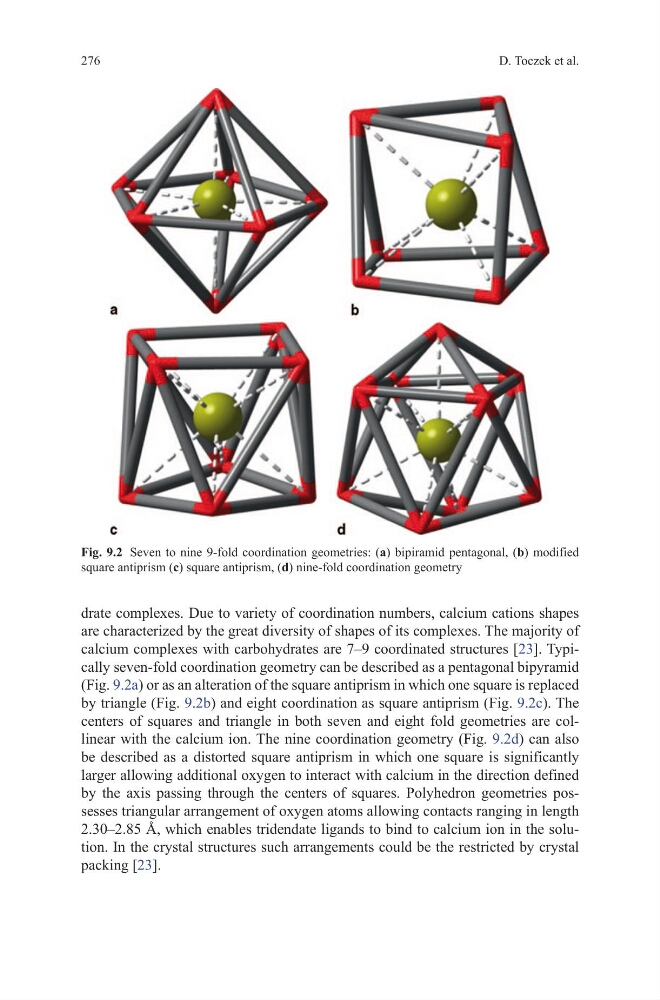
calcium complexes with carbohydrates are 7–9 coordinated structures [23]. Typically seven-fold coordination geometry can be described as a pentagonal bipyramid
(Fig. 9.2a) or as an alteration of the square antiprism in which one square is replaced
by triangle (Fig. 9.2b) and eight coordination as square antiprism (Fig. 9.2c). The
centers of squares and triangle in both seven and eight fold geometries are collinear with the calcium ion. The nine coordination geometry (Fig. 9.2d) can also
be described as a distorted square antiprism in which one square is significantly
larger allowing additional oxygen to interact with calcium in the direction defined
by the axis passing through the centers of squares. Polyhedron geometries possesses triangular arrangement of oxygen atoms allowing contacts ranging in length
2.30–2.85 Å, which enables tridendate ligands to bind to calcium ion in the solution. In the crystal structures such arrangements could be the restricted by crystal
packing [23].
Fig. 9.2 Seven to nine 9-fold coordination geometries: (a) bipiramid pentagonal, (b) modified
square antiprism (c) square antiprism, (d) nine-fold coordination geometry
D. Toczek et al.
drate complexes. Due to variety of coordination numbers, calcium cations shapes
are characterized by the great diversity of shapes of its complexes. The majority of
calcium complexes with carbohydrates are 7–9 coordinated structures [23]. Typically seven-fold coordination geometry can be described as a pentagonal bipyramid
(Fig. 9.2a) or as an alteration of the square antiprism in which one square is replaced
by triangle (Fig. 9.2b) and eight coordination as square antiprism (Fig. 9.2c). The
centers of squares and triangle in both seven and eight fold geometries are collinear with the calcium ion. The nine coordination geometry (Fig. 9.2d) can also
be described as a distorted square antiprism in which one square is significantly
larger allowing additional oxygen to interact with calcium in the direction defined
by the axis passing through the centers of squares. Polyhedron geometries possesses triangular arrangement of oxygen atoms allowing contacts ranging in length
2.30–2.85 Å, which enables tridendate ligands to bind to calcium ion in the solution. In the crystal structures such arrangements could be the restricted by crystal
packing [23].
Fig. 9.2 Seven to nine 9-fold coordination geometries: (a) bipiramid pentagonal, (b) modified
square antiprism (c) square antiprism, (d) nine-fold coordination geometry