

15
1 Hybrid QM/MM Methods: Treating Electronic Phenomena …
Up to now the examples we have presented were obtained considering vertical
transitions from the equilibrium geometry in the framework of the Franck–Condon
principle. Indeed biological macromolecules such as nucleic acids are quite flexible and can explore important regions of the configuration space. The inclusion of
dynamic and vibrational effects, as well as its coupling with the solvent and with
environment motion can be straightforwardly tackled by using classical molecular
dynamics (MD) techniques [61]. Indeed one can run a sufficiently long MD trajectory (usually some nanoseconds) and extract statistically independent snapshots.
The excitation spectrum can be calculated at QM/MM level for each snapshot
and the resulting final absorption spectrum will be composed by the convolution
of all the individual snapshots. This technique has also the advantage to take into
account the vibrational structure of the spectrum and can therefore recover the
asymmetry of the absorption band or the shifts induced by vibronic coupling.
An example of a system for which such a treatment is compulsory is the one
of a β-carboline, harmane, whose cation interacts with DNA via minor groovebinding or intercalation (Fig. 1.7) [61]. Due to the important out of plane vibration of the fused ring, and to its coupling with the electronic transition energy, the
static approach from equilibrium geometry, gave a shift of more than 50 nm on the
absorption maximum. On the other hand when considering the convolution from
a MD trajectory one gets the exact experimental value, as can be seen in Fig. 1.7.
Note also that MD proved that the two interaction modes where stable and almost
degenerate in terms of interaction energy, they also gave rise to a practically undistinguishable absorption spectrum.
1.7 Conclusions
In this contribution we have presented the advantages and flaws of general QM/
MM philosophies. Whatever the chosen method, if well parametrized, one can get
reliable results and insights on very large molecular systems still unreachable by
standard QM methods. However, we think that the LSCF approach is the only one
that doesn’t need specific parameters to be applied on any kind of (covalent) systems. In that sense, it can be qualified to be “universal”.
QP
QP
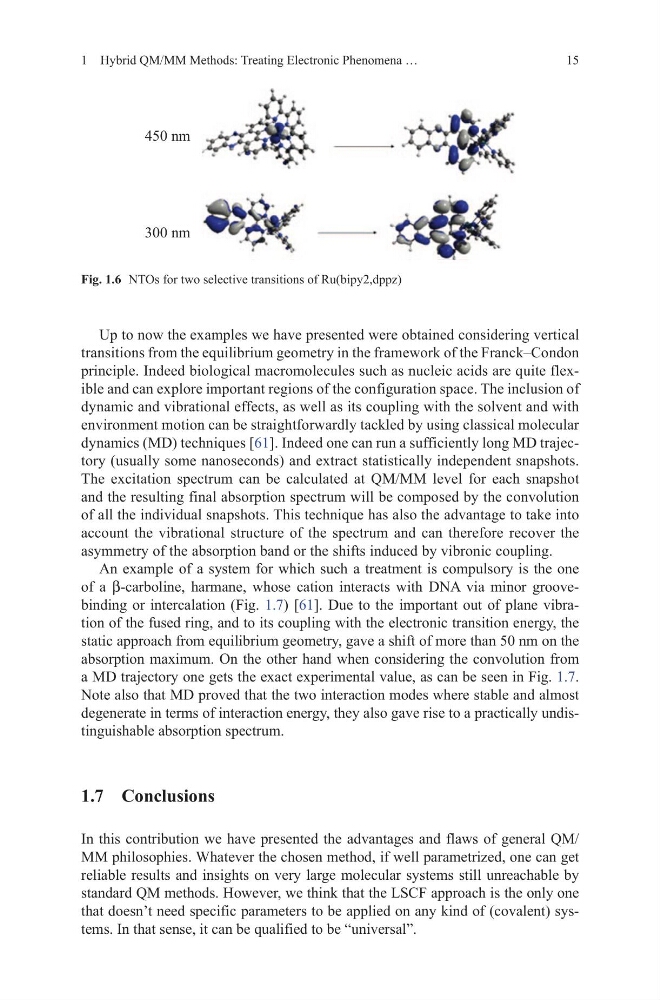
Fig. 1.6 NTOs for two selective transitions of Ru(bipy2,dppz)
1 Hybrid QM/MM Methods: Treating Electronic Phenomena …
Up to now the examples we have presented were obtained considering vertical
transitions from the equilibrium geometry in the framework of the Franck–Condon
principle. Indeed biological macromolecules such as nucleic acids are quite flexible and can explore important regions of the configuration space. The inclusion of
dynamic and vibrational effects, as well as its coupling with the solvent and with
environment motion can be straightforwardly tackled by using classical molecular
dynamics (MD) techniques [61]. Indeed one can run a sufficiently long MD trajectory (usually some nanoseconds) and extract statistically independent snapshots.
The excitation spectrum can be calculated at QM/MM level for each snapshot
and the resulting final absorption spectrum will be composed by the convolution
of all the individual snapshots. This technique has also the advantage to take into
account the vibrational structure of the spectrum and can therefore recover the
asymmetry of the absorption band or the shifts induced by vibronic coupling.
An example of a system for which such a treatment is compulsory is the one
of a β-carboline, harmane, whose cation interacts with DNA via minor groovebinding or intercalation (Fig. 1.7) [61]. Due to the important out of plane vibration of the fused ring, and to its coupling with the electronic transition energy, the
static approach from equilibrium geometry, gave a shift of more than 50 nm on the
absorption maximum. On the other hand when considering the convolution from
a MD trajectory one gets the exact experimental value, as can be seen in Fig. 1.7.
Note also that MD proved that the two interaction modes where stable and almost
degenerate in terms of interaction energy, they also gave rise to a practically undistinguishable absorption spectrum.
1.7 Conclusions
In this contribution we have presented the advantages and flaws of general QM/
MM philosophies. Whatever the chosen method, if well parametrized, one can get
reliable results and insights on very large molecular systems still unreachable by
standard QM methods. However, we think that the LSCF approach is the only one
that doesn’t need specific parameters to be applied on any kind of (covalent) systems. In that sense, it can be qualified to be “universal”.
QP
QP
Fig. 1.6 NTOs for two selective transitions of Ru(bipy2,dppz)