

16
A. Monari and X. Assfeld
Many factors can be of tremendous importance for large anisotropic biomolecular systems, like the sampling of the conformational space, the mutual polarization
of both subsystems and so on. One must be aware that these effects are system
dependent and for every study special care has to be taken. Hybrid methods are not
yet black-boxes. Let’s hope it will stay so for a long time.
We are really convinced that the most important feature of QM/MM methods is
to give insights, and more importantly to give correct trends, on systems on which
obtaining absolute number has no meaning.
The applications we have chosen to present here are just few examples of what
these methods are able to tackle. However, one has to bear in mind that one can only
study systems in which the electronic phenomenon is localized in a small portion of
the total space. This is perhaps the area where linear scaling methods will find their
most exciting applications.
References
1. Koerner T, Brown RS, Gainsforth JL, Klobulowski M (1998) Electrophilic bromination of
ethylene and ethylene-d4: a combined experimental and theoretical study. J Am Chem Soc
120:5628–5636
2. Benkovic SJ, Hammes-Schiffer S (2003) A perspective on enzyme catalysis. Nature 5637:1196–
1202
3. Polli D, Altoé P, Weingart O, Spillane KM, Manzoni C, Brida D, Tomasello G, Orlandi G,
Kukura P, Mathies RA, Garavelli M, Cerullo G (2010) Rhodopsin isomerization probed in the
visible spectral range. Nature 467:440–443
4. Gozem S, Schapiro I, Ferré N, Olivucci M (2012) The molecular mechanism of thermal noise
in rod photoreceptors. Science 337:1225–1228
5. Dolmans DE, Fukumura D, Jain RK (2003) Photodynamic therapy for cancer Nature Rev.
Cancer 3:380–387
6. Metcalfe C, Thomas JA (2003) Kinetically inert transition metal complexes that reversibly
bind to DNA. Chem. Soc Rev 32(2):15–224
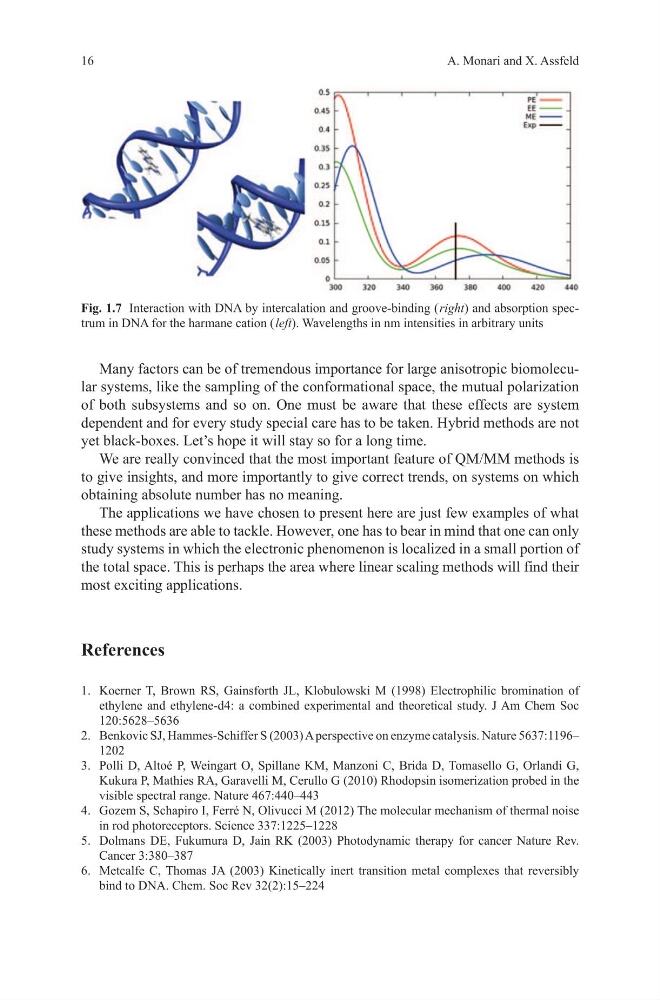
Fig. 1.7 Interaction with DNA by intercalation and groove-binding ( right) and absorption spectrum in DNA for the harmane cation ( left). Wavelengths in nm intensities in arbitrary units
A. Monari and X. Assfeld
Many factors can be of tremendous importance for large anisotropic biomolecular systems, like the sampling of the conformational space, the mutual polarization
of both subsystems and so on. One must be aware that these effects are system
dependent and for every study special care has to be taken. Hybrid methods are not
yet black-boxes. Let’s hope it will stay so for a long time.
We are really convinced that the most important feature of QM/MM methods is
to give insights, and more importantly to give correct trends, on systems on which
obtaining absolute number has no meaning.
The applications we have chosen to present here are just few examples of what
these methods are able to tackle. However, one has to bear in mind that one can only
study systems in which the electronic phenomenon is localized in a small portion of
the total space. This is perhaps the area where linear scaling methods will find their
most exciting applications.
References
1. Koerner T, Brown RS, Gainsforth JL, Klobulowski M (1998) Electrophilic bromination of
ethylene and ethylene-d4: a combined experimental and theoretical study. J Am Chem Soc
120:5628–5636
2. Benkovic SJ, Hammes-Schiffer S (2003) A perspective on enzyme catalysis. Nature 5637:1196–
1202
3. Polli D, Altoé P, Weingart O, Spillane KM, Manzoni C, Brida D, Tomasello G, Orlandi G,
Kukura P, Mathies RA, Garavelli M, Cerullo G (2010) Rhodopsin isomerization probed in the
visible spectral range. Nature 467:440–443
4. Gozem S, Schapiro I, Ferré N, Olivucci M (2012) The molecular mechanism of thermal noise
in rod photoreceptors. Science 337:1225–1228
5. Dolmans DE, Fukumura D, Jain RK (2003) Photodynamic therapy for cancer Nature Rev.
Cancer 3:380–387
6. Metcalfe C, Thomas JA (2003) Kinetically inert transition metal complexes that reversibly
bind to DNA. Chem. Soc Rev 32(2):15–224
Fig. 1.7 Interaction with DNA by intercalation and groove-binding ( right) and absorption spectrum in DNA for the harmane cation ( left). Wavelengths in nm intensities in arbitrary units