

232
A. B. Rozhenko
7.2.17 Lipase B
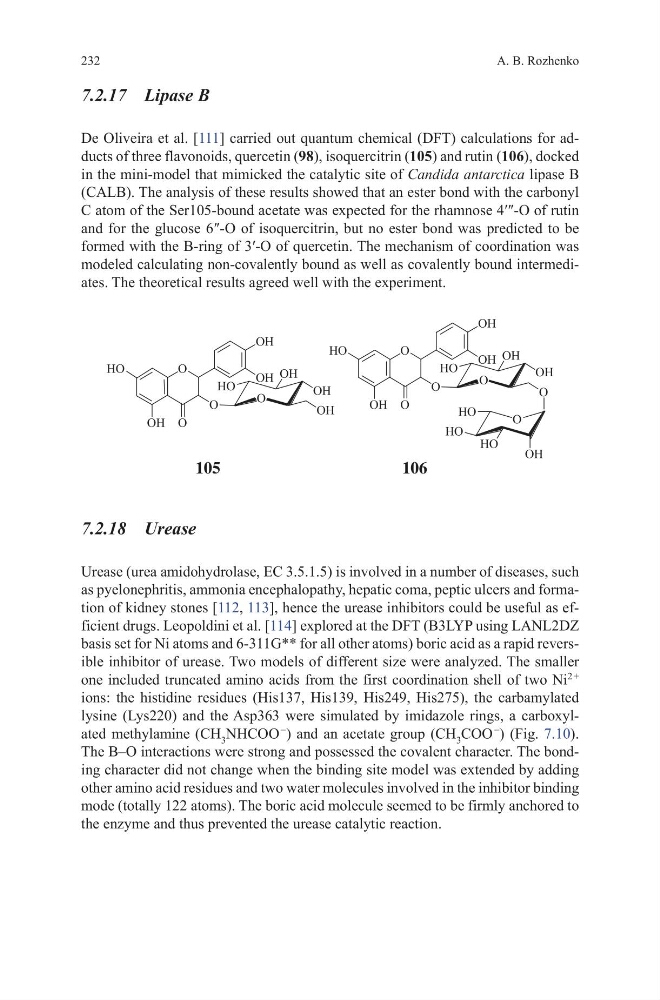
De Oliveira et al. [111] carried out quantum chemical (DFT) calculations for adducts of three flavonoids, quercetin (98), isoquercitrin (105) and rutin (106), docked
in the mini-model that mimicked the catalytic site of Candida antarctica lipase B
(CALB). The analysis of these results showed that an ester bond with the carbonyl
C atom of the Ser105-bound acetate was expected for the rhamnose 4′″-O of rutin
and for the glucose 6″-O of isoquercitrin, but no ester bond was predicted to be
formed with the B-ring of 3′-O of quercetin. The mechanism of coordination was
modeled calculating non-covalently bound as well as covalently bound intermediates. The theoretical results agreed well with the experiment.
2
2+
+2
2
2+
2+
2
2
2+
2+
2
2+
+2
2
2+
2+
2
2
2+
2
2
2+
+2
+2
+2
+2
+2
2+
2+
105
106
7.2.18 Urease
Urease (urea amidohydrolase, EC 3.5.1.5) is involved in a number of diseases, such
as pyelonephritis, ammonia encephalopathy, hepatic coma, peptic ulcers and formation of kidney stones [112, 113], hence the urease inhibitors could be useful as efficient drugs. Leopoldini et al. [114] explored at the DFT (B3LYP using LANL2DZ
basis set for Ni atoms and 6-311G** for all other atoms) boric acid as a rapid reversible inhibitor of urease. Two models of different size were analyzed. The smaller
one included truncated amino acids from the first coordination shell of two Ni
2 +
ions: the histidine residues (His137, His139, His249, His275), the carbamylated
lysine (Lys220) and the Asp363 were simulated by imidazole rings, a carboxylated methylamine (CH 3 NHCOO
−
) and an acetate group (CH 3 COO
−
) (Fig. 7.10).
The B–O interactions were strong and possessed the covalent character. The bonding character did not change when the binding site model was extended by adding
other amino acid residues and two water molecules involved in the inhibitor binding
mode (totally 122 atoms). The boric acid molecule seemed to be firmly anchored to
the enzyme and thus prevented the urease catalytic reaction.
A. B. Rozhenko
7.2.17 Lipase B
De Oliveira et al. [111] carried out quantum chemical (DFT) calculations for adducts of three flavonoids, quercetin (98), isoquercitrin (105) and rutin (106), docked
in the mini-model that mimicked the catalytic site of Candida antarctica lipase B
(CALB). The analysis of these results showed that an ester bond with the carbonyl
C atom of the Ser105-bound acetate was expected for the rhamnose 4′″-O of rutin
and for the glucose 6″-O of isoquercitrin, but no ester bond was predicted to be
formed with the B-ring of 3′-O of quercetin. The mechanism of coordination was
modeled calculating non-covalently bound as well as covalently bound intermediates. The theoretical results agreed well with the experiment.
2
2+
+2
2
2+
2+
2
2
2+
2+
2
2+
+2
2
2+
2+
2
2
2+
2
2
2+
+2
+2
+2
+2
+2
2+
2+
105
106
7.2.18 Urease
Urease (urea amidohydrolase, EC 3.5.1.5) is involved in a number of diseases, such
as pyelonephritis, ammonia encephalopathy, hepatic coma, peptic ulcers and formation of kidney stones [112, 113], hence the urease inhibitors could be useful as efficient drugs. Leopoldini et al. [114] explored at the DFT (B3LYP using LANL2DZ
basis set for Ni atoms and 6-311G** for all other atoms) boric acid as a rapid reversible inhibitor of urease. Two models of different size were analyzed. The smaller
one included truncated amino acids from the first coordination shell of two Ni
2 +
ions: the histidine residues (His137, His139, His249, His275), the carbamylated
lysine (Lys220) and the Asp363 were simulated by imidazole rings, a carboxylated methylamine (CH 3 NHCOO
−
) and an acetate group (CH 3 COO
−
) (Fig. 7.10).
The B–O interactions were strong and possessed the covalent character. The bonding character did not change when the binding site model was extended by adding
other amino acid residues and two water molecules involved in the inhibitor binding
mode (totally 122 atoms). The boric acid molecule seemed to be firmly anchored to
the enzyme and thus prevented the urease catalytic reaction.