

233
7.2.19 Other Results
Several 1,3-bisphospho-d-glyceric acid analogs were studied theoretically (using
QM/MM molecular dynamics and DFT-based EPS) as potential inhibitors of glyceraldehyde-3-phosphate dehydrogenase, and as new drugs against Chagas disease
[15]. The first detailed QM/MM study on the possible mechanisms for the reaction
of proteasome with a representative peptide inhibitor, Epoxomicin was reported
[115]. The obtained novel mechanistic insights should be valuable for a future rational design of more efficient proteasome inhibitors.
7.3 Conclusions and Prospects
The DFT approach is widely used nowadays in the pure form or in combination
with other, less computationally demanding approaches for modeling enzyme–ligand adducts towards understanding mechanisms of enzyme catalyzed reactions
and constructing novel drugs based on enzyme–inhibitor interactions. The recently
developed efficient linear-scaling techniques like the Resolution of the Identity (RI)
provide a new quantum chemical methodology for modeling ligand–protein interactions. Recently, the novel efficient linear-scaling methods have also been proposed
for the hybrid functionals, such as the popular B3LYP [116, 117]. The frontiers
of using DFT for modeling the enzyme–inhibitor interactions exceed now several
hundreds atoms. This makes it possible to increase significantly the size of the DFTcalculated enzyme binding site fragments for the virtual ( in silico) construction
of the enzyme–inhibitor adducts. For example, the RI-DFT molecular dynamics
7 Density Functional Theory Calculations of Enzyme–Inhibitor …
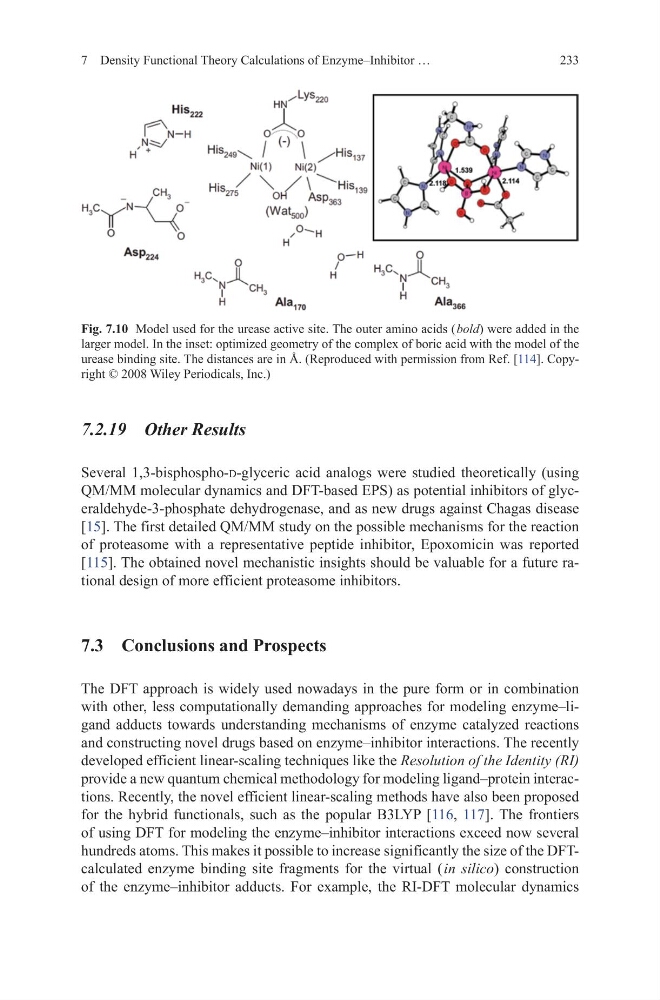
Fig. 7.10 Model used for the urease active site. The outer amino acids ( bold) were added in the
larger model. In the inset: optimized geometry of the complex of boric acid with the model of the
urease binding site. The distances are in Å. (Reproduced with permission from Ref. [114]. Copyright © 2008 Wiley Periodicals, Inc.)
7.2.19 Other Results
Several 1,3-bisphospho-d-glyceric acid analogs were studied theoretically (using
QM/MM molecular dynamics and DFT-based EPS) as potential inhibitors of glyceraldehyde-3-phosphate dehydrogenase, and as new drugs against Chagas disease
[15]. The first detailed QM/MM study on the possible mechanisms for the reaction
of proteasome with a representative peptide inhibitor, Epoxomicin was reported
[115]. The obtained novel mechanistic insights should be valuable for a future rational design of more efficient proteasome inhibitors.
7.3 Conclusions and Prospects
The DFT approach is widely used nowadays in the pure form or in combination
with other, less computationally demanding approaches for modeling enzyme–ligand adducts towards understanding mechanisms of enzyme catalyzed reactions
and constructing novel drugs based on enzyme–inhibitor interactions. The recently
developed efficient linear-scaling techniques like the Resolution of the Identity (RI)
provide a new quantum chemical methodology for modeling ligand–protein interactions. Recently, the novel efficient linear-scaling methods have also been proposed
for the hybrid functionals, such as the popular B3LYP [116, 117]. The frontiers
of using DFT for modeling the enzyme–inhibitor interactions exceed now several
hundreds atoms. This makes it possible to increase significantly the size of the DFTcalculated enzyme binding site fragments for the virtual ( in silico) construction
of the enzyme–inhibitor adducts. For example, the RI-DFT molecular dynamics
7 Density Functional Theory Calculations of Enzyme–Inhibitor …
Fig. 7.10 Model used for the urease active site. The outer amino acids ( bold) were added in the
larger model. In the inset: optimized geometry of the complex of boric acid with the model of the
urease binding site. The distances are in Å. (Reproduced with permission from Ref. [114]. Copyright © 2008 Wiley Periodicals, Inc.)