

231
the positive wound-healing process, but also such diseases as myocardial infarction,
pulmonary embolism and stroke [109]. Understanding the binding mechanism of
the known inhibitors to thrombin would provide a valuable information for a discovery of new more efficient and selective inhibitors.
2
2
5
5
5
5
5
5
5
5
2+
2+
+2
2
2
+2
+2
2
25
2+
2
2
2+
+2
2+
5 +
5
555
5
+555
5
2+555
5
5
+555
2+55
5
5
5
5
+55 2+55
5
5
+5555
2+55
5
5
5
+555 2+55
+5555
5
5
2+55
5
+5
555
5
2+55
5
+5555
5
2+
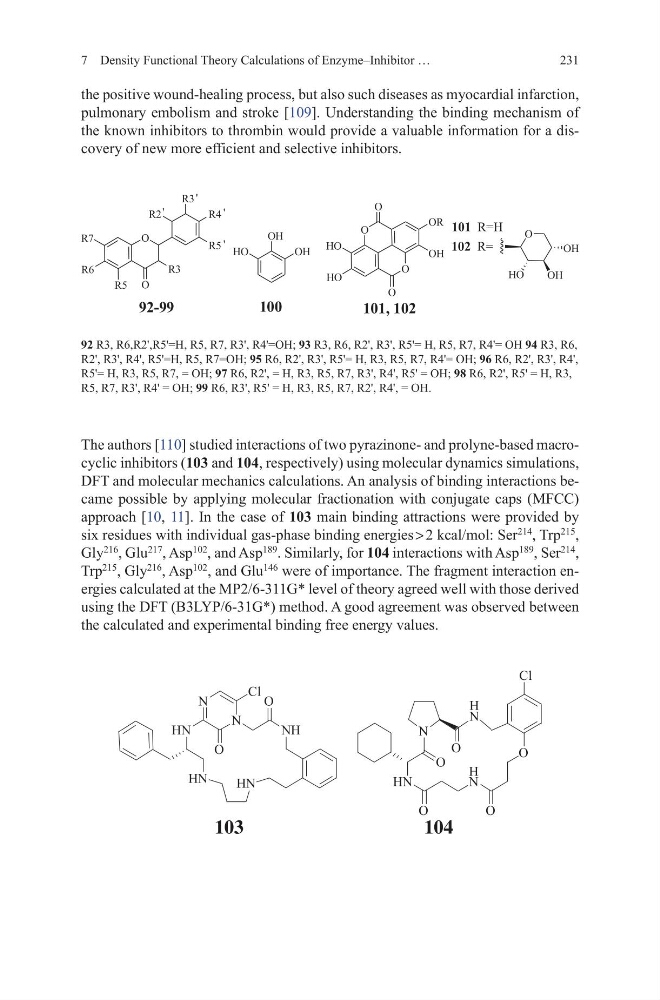
The authors [110] studied interactions of two pyrazinone- and prolyne-based macrocyclic inhibitors (103 and 104, respectively) using molecular dynamics simulations,
DFT and molecular mechanics calculations. An analysis of binding interactions became possible by applying molecular fractionation with conjugate caps (MFCC)
approach [10, 11]. In the case of 103 main binding attractions were provided by
six residues with individual gas-phase binding energies > 2 kcal/mol: Ser
214
, Trp
215
,
Gly
216
, Glu
217
, Asp
102
, and Asp
189
. Similarly, for 104 interactions with Asp
189
, Ser
214
,
Trp
215
, Gly
216
, Asp
102
, and Glu
146
were of importance. The fragment interaction energies calculated at the MP2/6-311G* level of theory agreed well with those derived
using the DFT (B3LYP/6-31G*) method. A good agreement was observed between
the calculated and experimental binding free energy values.
+1
1
1
2
&O
+1
+1
1+
2
2
2
+
1
2
+1
2
1
+
1
2
&O
103
104
7 Density Functional Theory Calculations of Enzyme–Inhibitor …
the positive wound-healing process, but also such diseases as myocardial infarction,
pulmonary embolism and stroke [109]. Understanding the binding mechanism of
the known inhibitors to thrombin would provide a valuable information for a discovery of new more efficient and selective inhibitors.
2
2
5
5
5
5
5
5
5
5
2+
2+
+2
2
2
+2
+2
2
25
2+
2
2
2+
+2
2+
5 +
5
555
5
+555
5
2+555
5
5
+555
2+55
5
5
5
5
+55 2+55
5
5
+5555
2+55
5
5
5
+555 2+55
+5555
5
5
2+55
5
+5
555
5
2+55
5
+5555
5
2+
The authors [110] studied interactions of two pyrazinone- and prolyne-based macrocyclic inhibitors (103 and 104, respectively) using molecular dynamics simulations,
DFT and molecular mechanics calculations. An analysis of binding interactions became possible by applying molecular fractionation with conjugate caps (MFCC)
approach [10, 11]. In the case of 103 main binding attractions were provided by
six residues with individual gas-phase binding energies > 2 kcal/mol: Ser
214
, Trp
215
,
Gly
216
, Glu
217
, Asp
102
, and Asp
189
. Similarly, for 104 interactions with Asp
189
, Ser
214
,
Trp
215
, Gly
216
, Asp
102
, and Glu
146
were of importance. The fragment interaction energies calculated at the MP2/6-311G* level of theory agreed well with those derived
using the DFT (B3LYP/6-31G*) method. A good agreement was observed between
the calculated and experimental binding free energy values.
+1
1
1
2
&O
+1
+1
1+
2
2
2
+
1
2
+1
2
1
+
1
2
&O
103
104
7 Density Functional Theory Calculations of Enzyme–Inhibitor …