

230
A. B. Rozhenko
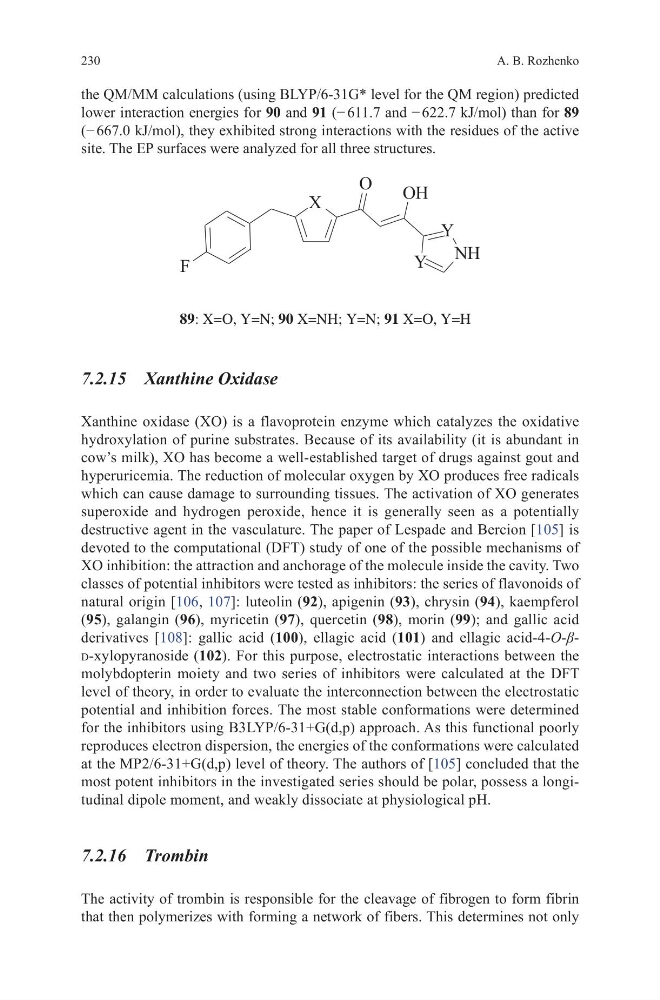
the QM/MM calculations (using BLYP/6-31G* level for the QM region) predicted
lower interaction energies for 90 and 91 (− 611.7 and − 622.7 kJ/mol) than for 89
(− 667.0 kJ/mol), they exhibited strong interactions with the residues of the active
site. The EP surfaces were analyzed for all three structures.
2+
<
1+
<
2
;
)
89: X=O, Y=N; 90 X=NH; Y=N; 91 X=O, Y=H
7.2.15 Xanthine Oxidase
Xanthine oxidase (XO) is a flavoprotein enzyme which catalyzes the oxidative
hydroxylation of purine substrates. Because of its availability (it is abundant in
cow’s milk), XO has become a well-established target of drugs against gout and
hyperuricemia. The reduction of molecular oxygen by XO produces free radicals
which can cause damage to surrounding tissues. The activation of XO generates
superoxide and hydrogen peroxide, hence it is generally seen as a potentially
destructive agent in the vasculature. The paper of Lespade and Bercion [105] is
devoted to the computational (DFT) study of one of the possible mechanisms of
XO inhibition: the attraction and anchorage of the molecule inside the cavity. Two
classes of potential inhibitors were tested as inhibitors: the series of flavonoids of
natural origin [106, 107]: luteolin (92), apigenin (93), chrysin (94), kaempferol
(95), galangin (96), myricetin (97), quercetin (98), morin (99); and gallic acid
derivatives [108]: gallic acid (100), ellagic acid (101) and ellagic acid-4-O-βd-xylopyranoside (102). For this purpose, electrostatic interactions between the
molybdopterin moiety and two series of inhibitors were calculated at the DFT
level of theory, in order to evaluate the interconnection between the electrostatic
potential and inhibition forces. The most stable conformations were determined
for the inhibitors using B3LYP/6-31+G(d,p) approach. As this functional poorly
reproduces electron dispersion, the energies of the conformations were calculated
at the MP2/6-31+G(d,p) level of theory. The authors of [105] concluded that the
most potent inhibitors in the investigated series should be polar, possess a longitudinal dipole moment, and weakly dissociate at physiological pH.
7.2.16 Trombin
The activity of trombin is responsible for the cleavage of fibrogen to form fibrin
that then polymerizes with forming a network of fibers. This determines not only
A. B. Rozhenko
the QM/MM calculations (using BLYP/6-31G* level for the QM region) predicted
lower interaction energies for 90 and 91 (− 611.7 and − 622.7 kJ/mol) than for 89
(− 667.0 kJ/mol), they exhibited strong interactions with the residues of the active
site. The EP surfaces were analyzed for all three structures.
2+
<
1+
<
2
;
)
89: X=O, Y=N; 90 X=NH; Y=N; 91 X=O, Y=H
7.2.15 Xanthine Oxidase
Xanthine oxidase (XO) is a flavoprotein enzyme which catalyzes the oxidative
hydroxylation of purine substrates. Because of its availability (it is abundant in
cow’s milk), XO has become a well-established target of drugs against gout and
hyperuricemia. The reduction of molecular oxygen by XO produces free radicals
which can cause damage to surrounding tissues. The activation of XO generates
superoxide and hydrogen peroxide, hence it is generally seen as a potentially
destructive agent in the vasculature. The paper of Lespade and Bercion [105] is
devoted to the computational (DFT) study of one of the possible mechanisms of
XO inhibition: the attraction and anchorage of the molecule inside the cavity. Two
classes of potential inhibitors were tested as inhibitors: the series of flavonoids of
natural origin [106, 107]: luteolin (92), apigenin (93), chrysin (94), kaempferol
(95), galangin (96), myricetin (97), quercetin (98), morin (99); and gallic acid
derivatives [108]: gallic acid (100), ellagic acid (101) and ellagic acid-4-O-βd-xylopyranoside (102). For this purpose, electrostatic interactions between the
molybdopterin moiety and two series of inhibitors were calculated at the DFT
level of theory, in order to evaluate the interconnection between the electrostatic
potential and inhibition forces. The most stable conformations were determined
for the inhibitors using B3LYP/6-31+G(d,p) approach. As this functional poorly
reproduces electron dispersion, the energies of the conformations were calculated
at the MP2/6-31+G(d,p) level of theory. The authors of [105] concluded that the
most potent inhibitors in the investigated series should be polar, possess a longitudinal dipole moment, and weakly dissociate at physiological pH.
7.2.16 Trombin
The activity of trombin is responsible for the cleavage of fibrogen to form fibrin
that then polymerizes with forming a network of fibers. This determines not only