

229
non-charged state is similar, but in contrast to the protonated form, both lysine
residues are non-protonated.
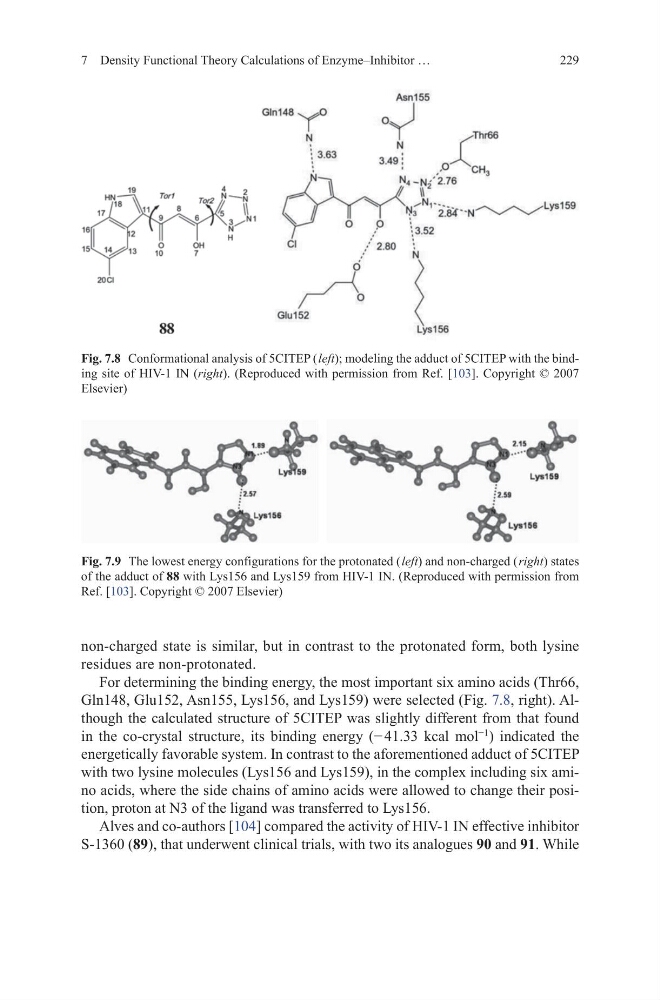
For determining the binding energy, the most important six amino acids (Thr66,
Gln148, Glu152, Asn155, Lys156, and Lys159) were selected (Fig. 7.8, right). Although the calculated structure of 5CITEP was slightly different from that found
in the co-crystal structure, its binding energy (− 41.33 kcal mol
−1
) indicated the
energetically favorable system. In contrast to the aforementioned adduct of 5CITEP
with two lysine molecules (Lys156 and Lys159), in the complex including six amino acids, where the side chains of amino acids were allowed to change their position, proton at N3 of the ligand was transferred to Lys156.
Alves and co-authors [104] compared the activity of HIV-1 IN effective inhibitor
S-1360 (89), that underwent clinical trials, with two its analogues 90 and 91. While
7 Density Functional Theory Calculations of Enzyme–Inhibitor …
Fig. 7.8 Conformational analysis of 5CITEP ( left); modeling the adduct of 5CITEP with the binding site of HIV-1 IN (right). (Reproduced with permission from Ref. [103]. Copyright © 2007
Elsevier)
Fig. 7.9 The lowest energy configurations for the protonated ( left) and non-charged ( right) states
of the adduct of 88 with Lys156 and Lys159 from HIV-1 IN. (Reproduced with permission from
Ref. [103]. Copyright © 2007 Elsevier)
non-charged state is similar, but in contrast to the protonated form, both lysine
residues are non-protonated.
For determining the binding energy, the most important six amino acids (Thr66,
Gln148, Glu152, Asn155, Lys156, and Lys159) were selected (Fig. 7.8, right). Although the calculated structure of 5CITEP was slightly different from that found
in the co-crystal structure, its binding energy (− 41.33 kcal mol
−1
) indicated the
energetically favorable system. In contrast to the aforementioned adduct of 5CITEP
with two lysine molecules (Lys156 and Lys159), in the complex including six amino acids, where the side chains of amino acids were allowed to change their position, proton at N3 of the ligand was transferred to Lys156.
Alves and co-authors [104] compared the activity of HIV-1 IN effective inhibitor
S-1360 (89), that underwent clinical trials, with two its analogues 90 and 91. While
7 Density Functional Theory Calculations of Enzyme–Inhibitor …
Fig. 7.8 Conformational analysis of 5CITEP ( left); modeling the adduct of 5CITEP with the binding site of HIV-1 IN (right). (Reproduced with permission from Ref. [103]. Copyright © 2007
Elsevier)
Fig. 7.9 The lowest energy configurations for the protonated ( left) and non-charged ( right) states
of the adduct of 88 with Lys156 and Lys159 from HIV-1 IN. (Reproduced with permission from
Ref. [103]. Copyright © 2007 Elsevier)