

222
A. B. Rozhenko
7.2.9 Phospholipases
The phospholipases A 2 (PLA 2 ) enzymes are responsible for the hydrolysis of membrane phospholipids that release arachidonic acid. The latter serves as substrate for
pro-inflammatory mediators, such as prostaglandins and leucotriens. Inhibition of
the enzymatic activity and edema induction by (PLA 2 ), extracted from the venom
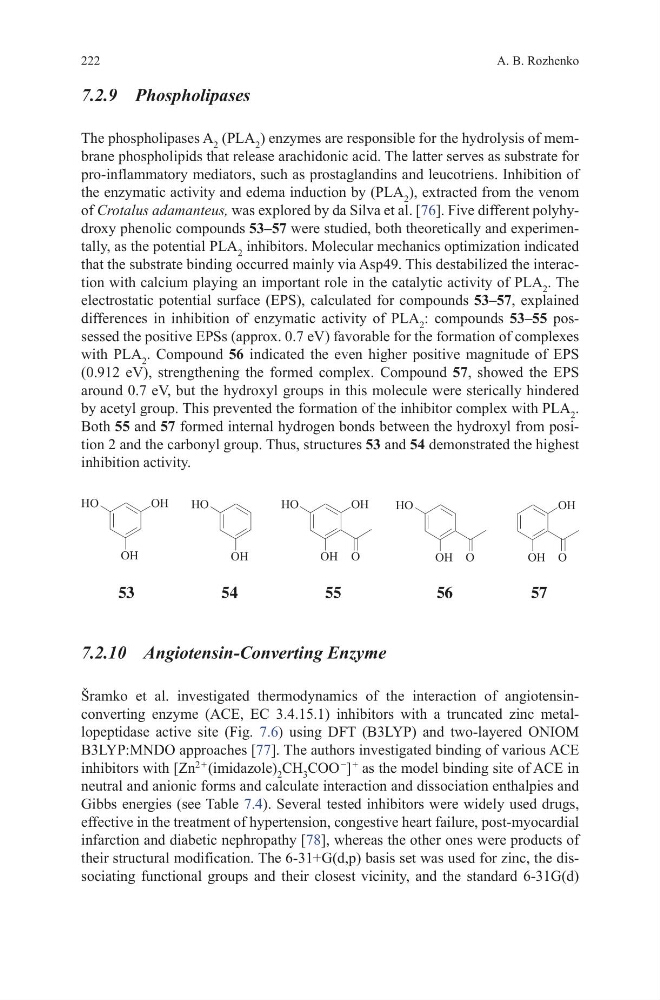
of Crotalus adamanteus, was explored by da Silva et al. [76]. Five different polyhydroxy phenolic compounds 53–57 were studied, both theoretically and experimentally, as the potential PLA 2 inhibitors. Molecular mechanics optimization indicated
that the substrate binding occurred mainly via Asp49. This destabilized the interaction with calcium playing an important role in the catalytic activity of PLA 2 . The
electrostatic potential surface (EPS), calculated for compounds 53–57, explained
differences in inhibition of enzymatic activity of PLA 2 : compounds 53–55 possessed the positive EPSs (approx. 0.7 eV) favorable for the formation of complexes
with PLA 2 . Compound 56 indicated the even higher positive magnitude of EPS
(0.912 eV), strengthening the formed complex. Compound 57, showed the EPS
around 0.7 eV, but the hydroxyl groups in this molecule were sterically hindered
by acetyl group. This prevented the formation of the inhibitor complex with PLA 2 .
Both 55 and 57 formed internal hydrogen bonds between the hydroxyl from position 2 and the carbonyl group. Thus, structures 53 and 54 demonstrated the highest
inhibition activity.
2+
+2
2+
+2
2+
2+
+2
2+ 2
+2
2+ 2
2+
2+ 2
53
54
55
56
57
7.2.10 Angiotensin-Converting Enzyme
Šramko et al. investigated thermodynamics of the interaction of angiotensinconverting enzyme (ACE, EC 3.4.15.1) inhibitors with a truncated zinc metallopeptidase active site (Fig. 7.6) using DFT (B3LYP) and two-layered ONIOM
B3LYP:MNDO approaches [77]. The authors investigated binding of various ACE
inhibitors with [Zn
2 +
(imidazole) 2 CH 3 COO
−
]
+
as the model binding site of ACE in
neutral and anionic forms and calculate interaction and dissociation enthalpies and
Gibbs energies (see Table 7.4). Several tested inhibitors were widely used drugs,
effective in the treatment of hypertension, congestive heart failure, post-myocardial
infarction and diabetic nephropathy [78], whereas the other ones were products of
their structural modification. The 6-31+G(d,p) basis set was used for zinc, the dissociating functional groups and their closest vicinity, and the standard 6-31G(d)
A. B. Rozhenko
7.2.9 Phospholipases
The phospholipases A 2 (PLA 2 ) enzymes are responsible for the hydrolysis of membrane phospholipids that release arachidonic acid. The latter serves as substrate for
pro-inflammatory mediators, such as prostaglandins and leucotriens. Inhibition of
the enzymatic activity and edema induction by (PLA 2 ), extracted from the venom
of Crotalus adamanteus, was explored by da Silva et al. [76]. Five different polyhydroxy phenolic compounds 53–57 were studied, both theoretically and experimentally, as the potential PLA 2 inhibitors. Molecular mechanics optimization indicated
that the substrate binding occurred mainly via Asp49. This destabilized the interaction with calcium playing an important role in the catalytic activity of PLA 2 . The
electrostatic potential surface (EPS), calculated for compounds 53–57, explained
differences in inhibition of enzymatic activity of PLA 2 : compounds 53–55 possessed the positive EPSs (approx. 0.7 eV) favorable for the formation of complexes
with PLA 2 . Compound 56 indicated the even higher positive magnitude of EPS
(0.912 eV), strengthening the formed complex. Compound 57, showed the EPS
around 0.7 eV, but the hydroxyl groups in this molecule were sterically hindered
by acetyl group. This prevented the formation of the inhibitor complex with PLA 2 .
Both 55 and 57 formed internal hydrogen bonds between the hydroxyl from position 2 and the carbonyl group. Thus, structures 53 and 54 demonstrated the highest
inhibition activity.
2+
+2
2+
+2
2+
2+
+2
2+ 2
+2
2+ 2
2+
2+ 2
53
54
55
56
57
7.2.10 Angiotensin-Converting Enzyme
Šramko et al. investigated thermodynamics of the interaction of angiotensinconverting enzyme (ACE, EC 3.4.15.1) inhibitors with a truncated zinc metallopeptidase active site (Fig. 7.6) using DFT (B3LYP) and two-layered ONIOM
B3LYP:MNDO approaches [77]. The authors investigated binding of various ACE
inhibitors with [Zn
2 +
(imidazole) 2 CH 3 COO
−
]
+
as the model binding site of ACE in
neutral and anionic forms and calculate interaction and dissociation enthalpies and
Gibbs energies (see Table 7.4). Several tested inhibitors were widely used drugs,
effective in the treatment of hypertension, congestive heart failure, post-myocardial
infarction and diabetic nephropathy [78], whereas the other ones were products of
their structural modification. The 6-31+G(d,p) basis set was used for zinc, the dissociating functional groups and their closest vicinity, and the standard 6-31G(d)