

221
experimentally derived IC 50 values for 51 and 52 (2.57 and 1.01 µM, respectively).
The determined binding affinities with MMP-3 were found to be significantly lower
(− 52.37 and − 74.56 kcal/mol, respectively), whereas the corresponding IC 50 magnitudes were essentially higher (12.47 and 4.18 µM, respectively). Thus, 52 indicated better potency on both MMP-1 and MMP-3 than pyrogallic acid. The authors
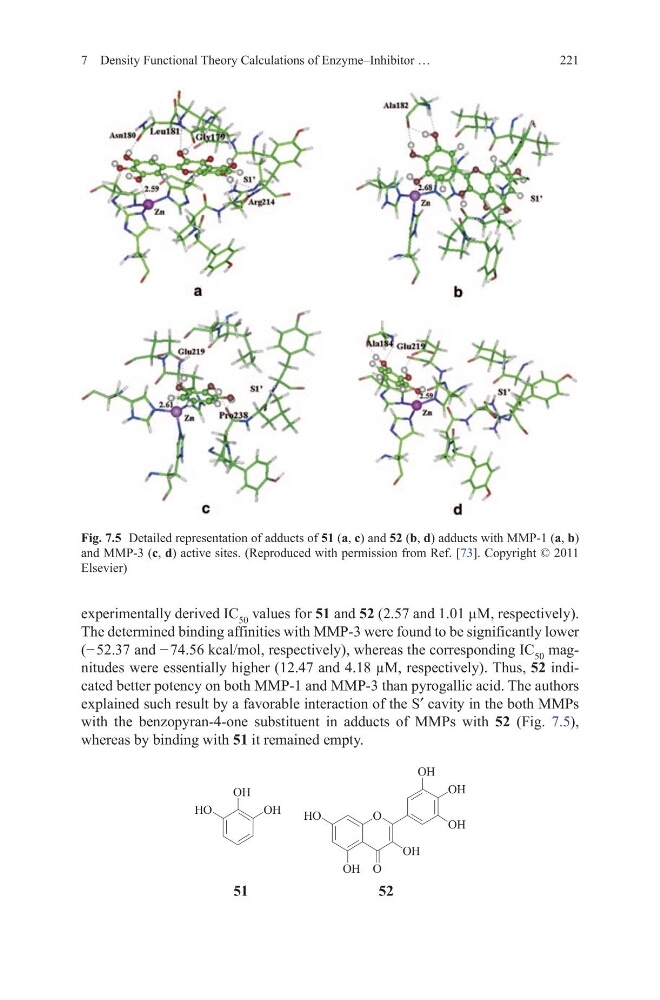
explained such result by a favorable interaction of the S′ cavity in the both MMPs
with the benzopyran-4-one substituent in adducts of MMPs with 52 (Fig. 7.5),
whereas by binding with 51 it remained empty.
+2
2+
2+
2
2
2+
2+
2+
2+
2+
+2
7 Density Functional Theory Calculations of Enzyme–Inhibitor …
Fig. 7.5 Detailed representation of adducts of 51 (a, c) and 52 (b, d) adducts with MMP-1 (a, b)
and MMP-3 (c, d) active sites. (Reproduced with permission from Ref. [73]. Copyright © 2011
Elsevier)
experimentally derived IC 50 values for 51 and 52 (2.57 and 1.01 µM, respectively).
The determined binding affinities with MMP-3 were found to be significantly lower
(− 52.37 and − 74.56 kcal/mol, respectively), whereas the corresponding IC 50 magnitudes were essentially higher (12.47 and 4.18 µM, respectively). Thus, 52 indicated better potency on both MMP-1 and MMP-3 than pyrogallic acid. The authors
explained such result by a favorable interaction of the S′ cavity in the both MMPs
with the benzopyran-4-one substituent in adducts of MMPs with 52 (Fig. 7.5),
whereas by binding with 51 it remained empty.
+2
2+
2+
2
2
2+
2+
2+
2+
2+
+2
7 Density Functional Theory Calculations of Enzyme–Inhibitor …
Fig. 7.5 Detailed representation of adducts of 51 (a, c) and 52 (b, d) adducts with MMP-1 (a, b)
and MMP-3 (c, d) active sites. (Reproduced with permission from Ref. [73]. Copyright © 2011
Elsevier)