

220
A. B. Rozhenko
6
+
1
5
2 2
1
+
2
+2 1
+
2
6
+
1
3K
2 2
2+
2
40-48
49
50
R: 40 Me; 41 Ph; 42 4-MeC 6 H 4 ; 43 4-PhC 6 H 4 ; 44 4-PhOC 6 H 4 ; 45 4-FC 6 H 4 ; 46 3-NO 2 C 6 H 4 ; 47 2NO 2 C 6 H 4 ; 48 2,4,6-(i-Pr) 3 C 6 H 2
The authors [74] evaluated the zinc-binding ability of ligands in an enzyme active
site model composed of a Zn
2 +
ion using the DFT level of theory. Three main types
of Zn–ligand interactions were found in the series of complexes studied. Type I
corresponded to a bidentate zinc coordination involving the oxygen of the carbonyl
group and the sulfonamide nitrogen atom. Type II resulted from an additional interaction with one of the sulfonyl oxygen atoms. As three 4-methylimidazole ligands were attached, the sulfamide nitrogen atom did not participate anymore in
the complexation (the corresponding Zn–N distances were ~ 3.35 Å). Similar, but
even more stable complexes were formed with a deprotonated form of the ligands.
A subsequent docking study resulted in the different coordination ability of 40–
50 towards enzymes MM-1, MMP-2, MMP-9, MMP-12 and MMP-14 and demonstrated that these species can be used for the drug design as the efficient and
selective MMP inhibitors.
Zhang and co-authors studied theoretically pyrogallic acid (51) and myricetin
(52) as the potential non-peptide inhibitors of MMP-1 and MMP-3 [75]. The corresponding docked complexes with the model active sites were optimized at the
B3LYP/6-31G* level of theory. Total calculated interaction energies for MMP-1
with 51 and 52 are − 77.07 and − 108.39 kcal/mol, respectively). Therefore, myricetin bound to MMP-1 more tightly than pyrogallic acid, which agreed with the
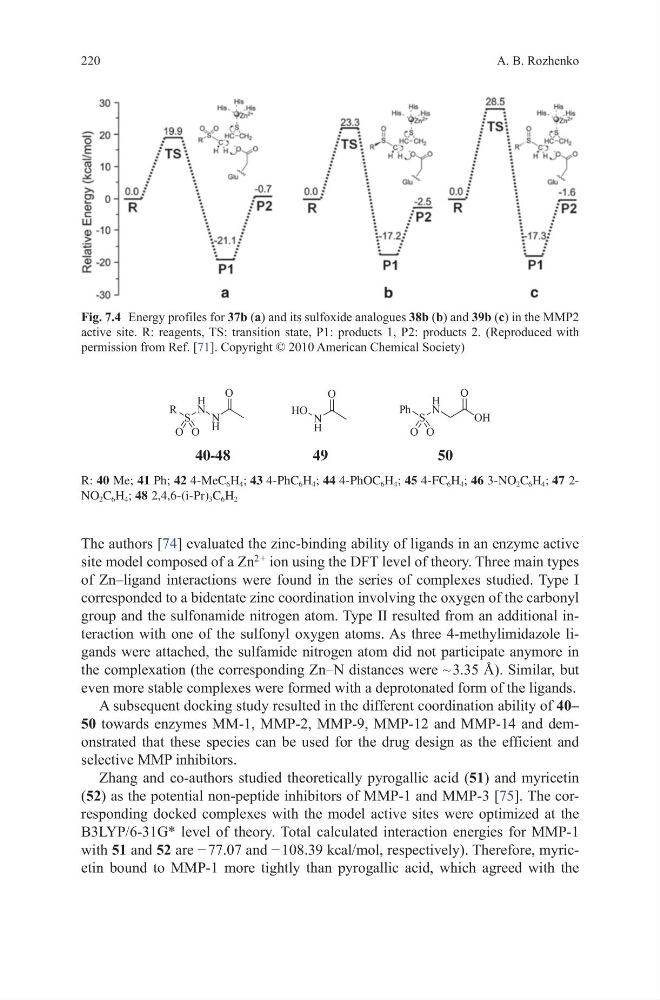
Fig. 7.4 Energy profiles for 37b (a) and its sulfoxide analogues 38b (b) and 39b (c) in the MMP2
active site. R: reagents, TS: transition state, P1: products 1, P2: products 2. (Reproduced with
permission from Ref. [71]. Copyright © 2010 American Chemical Society)
A. B. Rozhenko
6
+
1
5
2 2
1
+
2
+2 1
+
2
6
+
1
3K
2 2
2+
2
40-48
49
50
R: 40 Me; 41 Ph; 42 4-MeC 6 H 4 ; 43 4-PhC 6 H 4 ; 44 4-PhOC 6 H 4 ; 45 4-FC 6 H 4 ; 46 3-NO 2 C 6 H 4 ; 47 2NO 2 C 6 H 4 ; 48 2,4,6-(i-Pr) 3 C 6 H 2
The authors [74] evaluated the zinc-binding ability of ligands in an enzyme active
site model composed of a Zn
2 +
ion using the DFT level of theory. Three main types
of Zn–ligand interactions were found in the series of complexes studied. Type I
corresponded to a bidentate zinc coordination involving the oxygen of the carbonyl
group and the sulfonamide nitrogen atom. Type II resulted from an additional interaction with one of the sulfonyl oxygen atoms. As three 4-methylimidazole ligands were attached, the sulfamide nitrogen atom did not participate anymore in
the complexation (the corresponding Zn–N distances were ~ 3.35 Å). Similar, but
even more stable complexes were formed with a deprotonated form of the ligands.
A subsequent docking study resulted in the different coordination ability of 40–
50 towards enzymes MM-1, MMP-2, MMP-9, MMP-12 and MMP-14 and demonstrated that these species can be used for the drug design as the efficient and
selective MMP inhibitors.
Zhang and co-authors studied theoretically pyrogallic acid (51) and myricetin
(52) as the potential non-peptide inhibitors of MMP-1 and MMP-3 [75]. The corresponding docked complexes with the model active sites were optimized at the
B3LYP/6-31G* level of theory. Total calculated interaction energies for MMP-1
with 51 and 52 are − 77.07 and − 108.39 kcal/mol, respectively). Therefore, myricetin bound to MMP-1 more tightly than pyrogallic acid, which agreed with the
Fig. 7.4 Energy profiles for 37b (a) and its sulfoxide analogues 38b (b) and 39b (c) in the MMP2
active site. R: reagents, TS: transition state, P1: products 1, P2: products 2. (Reproduced with
permission from Ref. [71]. Copyright © 2010 American Chemical Society)