

219
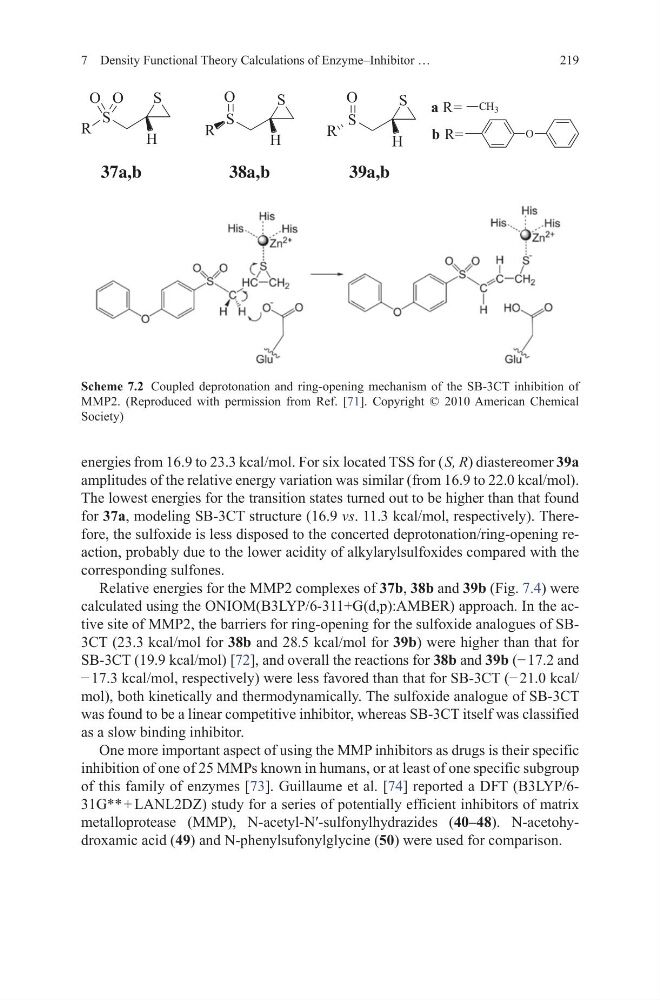
energies from 16.9 to 23.3 kcal/mol. For six located TSS for ( S, R) diastereomer 39a
amplitudes of the relative energy variation was similar (from 16.9 to 22.0 kcal/mol).
The lowest energies for the transition states turned out to be higher than that found
for 37a, modeling SB-3CT structure (16.9 vs. 11.3 kcal/mol, respectively). Therefore, the sulfoxide is less disposed to the concerted deprotonation/ring-opening reaction, probably due to the lower acidity of alkylarylsulfoxides compared with the
corresponding sulfones.
Relative energies for the MMP2 complexes of 37b, 38b and 39b (Fig. 7.4) were
calculated using the ONIOM(B3LYP/6-311+G(d,p):AMBER) approach. In the active site of MMP2, the barriers for ring-opening for the sulfoxide analogues of SB3CT (23.3 kcal/mol for 38b and 28.5 kcal/mol for 39b) were higher than that for
SB-3CT (19.9 kcal/mol) [72], and overall the reactions for 38b and 39b (− 17.2 and
− 17.3 kcal/mol, respectively) were less favored than that for SB-3CT (− 21.0 kcal/
mol), both kinetically and thermodynamically. The sulfoxide analogue of SB-3CT
was found to be a linear competitive inhibitor, whereas SB-3CT itself was classified
as a slow binding inhibitor.
One more important aspect of using the MMP inhibitors as drugs is their specific
inhibition of one of 25 MMPs known in humans, or at least of one specific subgroup
of this family of enzymes [73]. Guillaume et al. [74] reported a DFT (B3LYP/631G** + LANL2DZ) study for a series of potentially efficient inhibitors of matrix
metalloprotease (MMP), N-acetyl-N′-sulfonylhydrazides (40–48). N-acetohydroxamic acid (49) and N-phenylsufonylglycine (50) were used for comparison.
5
6
2 2
6
+
5
6
6
+
2
5
6
6
+
2
&+
2
D 5
E 5
37a,b
38a,b
39a,b
Scheme 7.2 Coupled deprotonation and ring-opening mechanism of the SB-3CT inhibition of
MMP2. (Reproduced with permission from Ref. [71]. Copyright © 2010 American Chemical
Society)
7 Density Functional Theory Calculations of Enzyme–Inhibitor …
energies from 16.9 to 23.3 kcal/mol. For six located TSS for ( S, R) diastereomer 39a
amplitudes of the relative energy variation was similar (from 16.9 to 22.0 kcal/mol).
The lowest energies for the transition states turned out to be higher than that found
for 37a, modeling SB-3CT structure (16.9 vs. 11.3 kcal/mol, respectively). Therefore, the sulfoxide is less disposed to the concerted deprotonation/ring-opening reaction, probably due to the lower acidity of alkylarylsulfoxides compared with the
corresponding sulfones.
Relative energies for the MMP2 complexes of 37b, 38b and 39b (Fig. 7.4) were
calculated using the ONIOM(B3LYP/6-311+G(d,p):AMBER) approach. In the active site of MMP2, the barriers for ring-opening for the sulfoxide analogues of SB3CT (23.3 kcal/mol for 38b and 28.5 kcal/mol for 39b) were higher than that for
SB-3CT (19.9 kcal/mol) [72], and overall the reactions for 38b and 39b (− 17.2 and
− 17.3 kcal/mol, respectively) were less favored than that for SB-3CT (− 21.0 kcal/
mol), both kinetically and thermodynamically. The sulfoxide analogue of SB-3CT
was found to be a linear competitive inhibitor, whereas SB-3CT itself was classified
as a slow binding inhibitor.
One more important aspect of using the MMP inhibitors as drugs is their specific
inhibition of one of 25 MMPs known in humans, or at least of one specific subgroup
of this family of enzymes [73]. Guillaume et al. [74] reported a DFT (B3LYP/631G** + LANL2DZ) study for a series of potentially efficient inhibitors of matrix
metalloprotease (MMP), N-acetyl-N′-sulfonylhydrazides (40–48). N-acetohydroxamic acid (49) and N-phenylsufonylglycine (50) were used for comparison.
5
6
2 2
6
+
5
6
6
+
2
5
6
6
+
2
&+
2
D 5
E 5
37a,b
38a,b
39a,b
Scheme 7.2 Coupled deprotonation and ring-opening mechanism of the SB-3CT inhibition of
MMP2. (Reproduced with permission from Ref. [71]. Copyright © 2010 American Chemical
Society)
7 Density Functional Theory Calculations of Enzyme–Inhibitor …