

218
A. B. Rozhenko
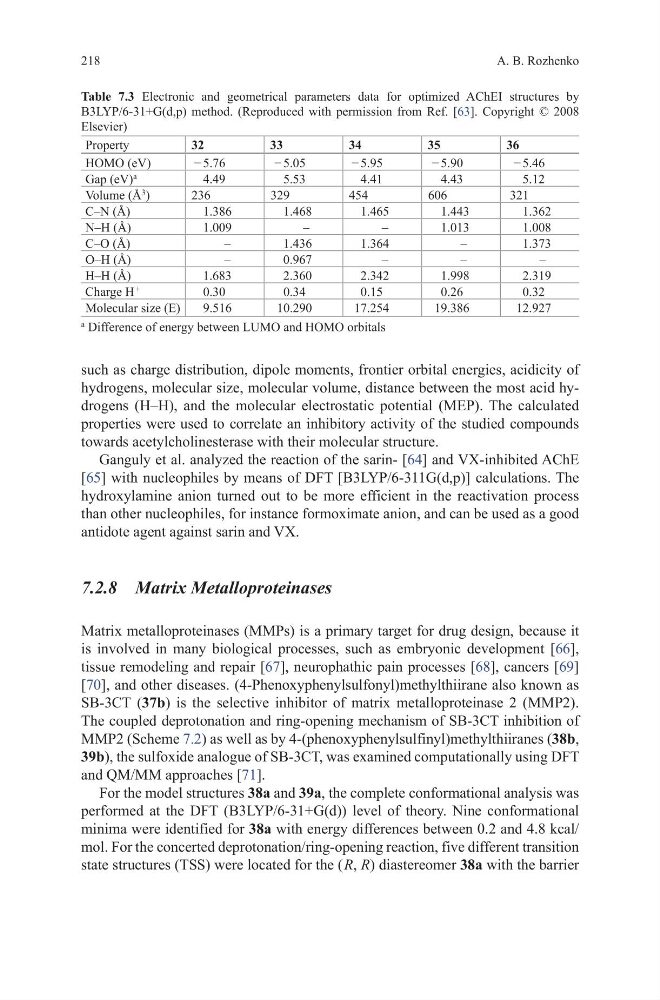
such as charge distribution, dipole moments, frontier orbital energies, acidicity of
hydrogens, molecular size, molecular volume, distance between the most acid hydrogens (H–H), and the molecular electrostatic potential (MEP). The calculated
properties were used to correlate an inhibitory activity of the studied compounds
towards acetylcholinesterase with their molecular structure.
Ganguly et al. analyzed the reaction of the sarin- [64] and VX-inhibited AChE
[65] with nucleophiles by means of DFT [B3LYP/6-311G(d,p)] calculations. The
hydroxylamine anion turned out to be more efficient in the reactivation process
than other nucleophiles, for instance formoximate anion, and can be used as a good
antidote agent against sarin and VX.
7.2.8 Matrix Metalloproteinases
Matrix metalloproteinases (MMPs) is a primary target for drug design, because it
is involved in many biological processes, such as embryonic development [66],
tissue remodeling and repair [67], neurophathic pain processes [68], cancers [69]
[70], and other diseases. (4-Phenoxyphenylsulfonyl)methylthiirane also known as
SB-3CT (37b) is the selective inhibitor of matrix metalloproteinase 2 (MMP2).
The coupled deprotonation and ring-opening mechanism of SB-3CT inhibition of
MMP2 (Scheme 7.2) as well as by 4-(phenoxyphenylsulfinyl)methylthiiranes (38b,
39b), the sulfoxide analogue of SB-3CT, was examined computationally using DFT
and QM/MM approaches [71].
For the model structures 38a and 39a, the complete conformational analysis was
performed at the DFT (B3LYP/6-31+G(d)) level of theory. Nine conformational
minima were identified for 38a with energy differences between 0.2 and 4.8 kcal/
mol. For the concerted deprotonation/ring-opening reaction, five different transition
state structures (TSS) were located for the ( R, R) diastereomer 38a with the barrier
Table 7.3 Electronic and geometrical parameters data for optimized AChEI structures by
B3LYP/6-31+G(d,p) method. (Reproduced with permission from Ref. [63]. Copyright © 2008
Elsevier)
Property
32
33
34
35
36
HOMO (eV)
− 5.76
− 5.05
− 5.95
− 5.90
− 5.46
Gap (eV)
a
4.49
5.53
4.41
4.43
5.12
Volume (Å
3
)
236
329
454
606
321
C–N (Å)
1.386
1.468
1.465
1.443
1.362
N–H (Å)
1.009
–
–
1.013
1.008
C–O (Å)
–
1.436
1.364
–
1.373
O–H (Å)
–
0.967
–
–
–
H–H (Å)
1.683
2.360
2.342
1.998
2.319
Charge H
+
0.30
0.34
0.15
0.26
0.32
Molecular size (Е)
9.516
10.290
17.254
19.386
12.927
a
Difference of energy between LUMO and HOMO orbitals
A. B. Rozhenko
such as charge distribution, dipole moments, frontier orbital energies, acidicity of
hydrogens, molecular size, molecular volume, distance between the most acid hydrogens (H–H), and the molecular electrostatic potential (MEP). The calculated
properties were used to correlate an inhibitory activity of the studied compounds
towards acetylcholinesterase with their molecular structure.
Ganguly et al. analyzed the reaction of the sarin- [64] and VX-inhibited AChE
[65] with nucleophiles by means of DFT [B3LYP/6-311G(d,p)] calculations. The
hydroxylamine anion turned out to be more efficient in the reactivation process
than other nucleophiles, for instance formoximate anion, and can be used as a good
antidote agent against sarin and VX.
7.2.8 Matrix Metalloproteinases
Matrix metalloproteinases (MMPs) is a primary target for drug design, because it
is involved in many biological processes, such as embryonic development [66],
tissue remodeling and repair [67], neurophathic pain processes [68], cancers [69]
[70], and other diseases. (4-Phenoxyphenylsulfonyl)methylthiirane also known as
SB-3CT (37b) is the selective inhibitor of matrix metalloproteinase 2 (MMP2).
The coupled deprotonation and ring-opening mechanism of SB-3CT inhibition of
MMP2 (Scheme 7.2) as well as by 4-(phenoxyphenylsulfinyl)methylthiiranes (38b,
39b), the sulfoxide analogue of SB-3CT, was examined computationally using DFT
and QM/MM approaches [71].
For the model structures 38a and 39a, the complete conformational analysis was
performed at the DFT (B3LYP/6-31+G(d)) level of theory. Nine conformational
minima were identified for 38a with energy differences between 0.2 and 4.8 kcal/
mol. For the concerted deprotonation/ring-opening reaction, five different transition
state structures (TSS) were located for the ( R, R) diastereomer 38a with the barrier
Table 7.3 Electronic and geometrical parameters data for optimized AChEI structures by
B3LYP/6-31+G(d,p) method. (Reproduced with permission from Ref. [63]. Copyright © 2008
Elsevier)
Property
32
33
34
35
36
HOMO (eV)
− 5.76
− 5.05
− 5.95
− 5.90
− 5.46
Gap (eV)
a
4.49
5.53
4.41
4.43
5.12
Volume (Å
3
)
236
329
454
606
321
C–N (Å)
1.386
1.468
1.465
1.443
1.362
N–H (Å)
1.009
–
–
1.013
1.008
C–O (Å)
–
1.436
1.364
–
1.373
O–H (Å)
–
0.967
–
–
–
H–H (Å)
1.683
2.360
2.342
1.998
2.319
Charge H
+
0.30
0.34
0.15
0.26
0.32
Molecular size (Е)
9.516
10.290
17.254
19.386
12.927
a
Difference of energy between LUMO and HOMO orbitals