

217
The calculations predicted for some compounds thermodynamically favorable
binding (negative ∆G values), whereas the inactive compounds were characterized
by slightly positive binding free energy values. Thus, in contrast to Ru(II), Os(II) or
Ru(III) complexes, the Rh(III) and Ir(III) compounds possessed a weak inhibition
activity toward cat B, probably because the corresponding M–S bonds formed by
these metal ions. They were characterized by ca. 20–30 kJ mol
− 1
lower bond energies than the more active complexes.
Shokhen et al. [56] analyzed possible mechanisms for the reversible formation
of the complex between papain, a prototype enzyme of cysteine proteases, and peptidyl aldehyde inhibitors, using the quantum mechanical (DFT)/self consistent reaction field (virtual solvent) approach.
7.2.7 Acetylcholinesterase
Inhibitors of the acetylcholinesterase (AChE, E.C. 3.1.1.7) and butyrylcholinesterase (BChE, E.C. 3.1.1.8) activity demonstrate good results in the treatment of Alzheimer’s disease (AD) [57, 58]. In the last years, the pathogenesis of AD has been
associated with both cholinesterases, resulting in several studies that have targeted
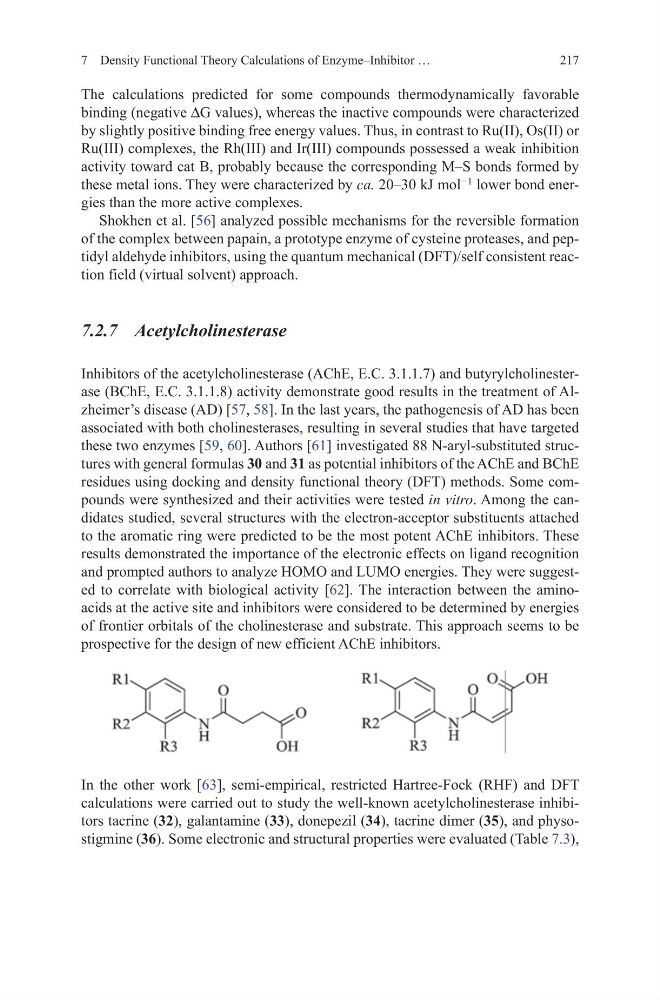
these two enzymes [59, 60]. Authors [61] investigated 88 N-aryl-substituted structures with general formulas 30 and 31 as potential inhibitors of the AChE and BChE
residues using docking and density functional theory (DFT) methods. Some compounds were synthesized and their activities were tested in vitro. Among the candidates studied, several structures with the electron-acceptor substituents attached
to the aromatic ring were predicted to be the most potent AChE inhibitors. These
results demonstrated the importance of the electronic effects on ligand recognition
and prompted authors to analyze HOMO and LUMO energies. They were suggested to correlate with biological activity [62]. The interaction between the aminoacids at the active site and inhibitors were considered to be determined by energies
of frontier orbitals of the cholinesterase and substrate. This approach seems to be
prospective for the design of new efficient AChE inhibitors.
In the other work [63], semi-empirical, restricted Hartree-Fock (RHF) and DFT
calculations were carried out to study the well-known acetylcholinesterase inhibitors tacrine (32), galantamine (33), donepezil (34), tacrine dimer (35), and physostigmine (36). Some electronic and structural properties were evaluated (Table 7.3),
7 Density Functional Theory Calculations of Enzyme–Inhibitor …
The calculations predicted for some compounds thermodynamically favorable
binding (negative ∆G values), whereas the inactive compounds were characterized
by slightly positive binding free energy values. Thus, in contrast to Ru(II), Os(II) or
Ru(III) complexes, the Rh(III) and Ir(III) compounds possessed a weak inhibition
activity toward cat B, probably because the corresponding M–S bonds formed by
these metal ions. They were characterized by ca. 20–30 kJ mol
− 1
lower bond energies than the more active complexes.
Shokhen et al. [56] analyzed possible mechanisms for the reversible formation
of the complex between papain, a prototype enzyme of cysteine proteases, and peptidyl aldehyde inhibitors, using the quantum mechanical (DFT)/self consistent reaction field (virtual solvent) approach.
7.2.7 Acetylcholinesterase
Inhibitors of the acetylcholinesterase (AChE, E.C. 3.1.1.7) and butyrylcholinesterase (BChE, E.C. 3.1.1.8) activity demonstrate good results in the treatment of Alzheimer’s disease (AD) [57, 58]. In the last years, the pathogenesis of AD has been
associated with both cholinesterases, resulting in several studies that have targeted
these two enzymes [59, 60]. Authors [61] investigated 88 N-aryl-substituted structures with general formulas 30 and 31 as potential inhibitors of the AChE and BChE
residues using docking and density functional theory (DFT) methods. Some compounds were synthesized and their activities were tested in vitro. Among the candidates studied, several structures with the electron-acceptor substituents attached
to the aromatic ring were predicted to be the most potent AChE inhibitors. These
results demonstrated the importance of the electronic effects on ligand recognition
and prompted authors to analyze HOMO and LUMO energies. They were suggested to correlate with biological activity [62]. The interaction between the aminoacids at the active site and inhibitors were considered to be determined by energies
of frontier orbitals of the cholinesterase and substrate. This approach seems to be
prospective for the design of new efficient AChE inhibitors.
In the other work [63], semi-empirical, restricted Hartree-Fock (RHF) and DFT
calculations were carried out to study the well-known acetylcholinesterase inhibitors tacrine (32), galantamine (33), donepezil (34), tacrine dimer (35), and physostigmine (36). Some electronic and structural properties were evaluated (Table 7.3),
7 Density Functional Theory Calculations of Enzyme–Inhibitor …