

216
A. B. Rozhenko
complexes, but the experimentally found trend of topoisomerase II inhibition activity was somewhat different from the DNA binding ability.
7.2.6 Cathepsin B Cysteine Protease
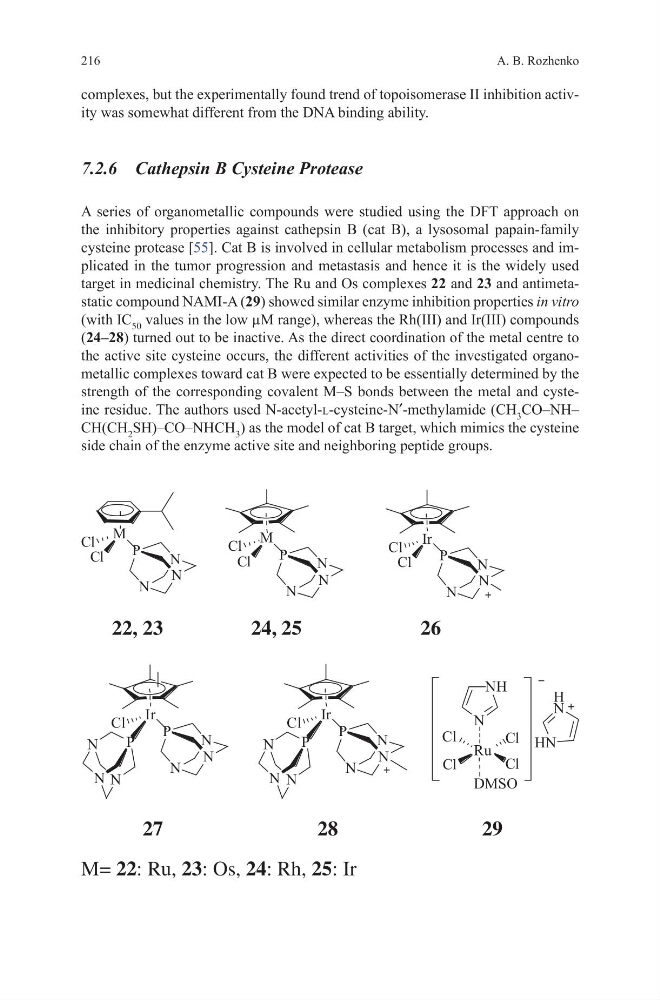
A series of organometallic compounds were studied using the DFT approach on
the inhibitory properties against cathepsin B (cat B), a lysosomal papain-family
cysteine protease [55]. Cat B is involved in cellular metabolism processes and implicated in the tumor progression and metastasis and hence it is the widely used
target in medicinal chemistry. The Ru and Os complexes 22 and 23 and antimetastatic compound NAMI-A (29) showed similar enzyme inhibition properties in vitro
(with IC 50 values in the low µM range), whereas the Rh(III) and Ir(III) compounds
(24–28) turned out to be inactive. As the direct coordination of the metal centre to
the active site cysteine occurs, the different activities of the investigated organometallic complexes toward cat B were expected to be essentially determined by the
strength of the corresponding covalent M–S bonds between the metal and cysteine residue. The authors used N-acetyl-l-cysteine-N′-methylamide (CH 3 CO–NH–
CH(CH 2 SH)–CO–NHCH 3 ) as the model of cat B target, which mimics the cysteine
side chain of the enzyme active site and neighboring peptide groups.
0
1
1
1
3
&O
&O
0
1
1
1
3
&O
&O
,U
1
1
1
3
&O
&O
22, 23
24, 25
26
1
1 1
3
,U
1
1
1
3
&O
5X
&O
&O
&O
&O
1
1+
'062
+
1
+1
1
1 1
3
,U
1
1
1
3
&O
27
28
29
M= 22: Ru, 23: Os, 24: Rh, 25: Ir
A. B. Rozhenko
complexes, but the experimentally found trend of topoisomerase II inhibition activity was somewhat different from the DNA binding ability.
7.2.6 Cathepsin B Cysteine Protease
A series of organometallic compounds were studied using the DFT approach on
the inhibitory properties against cathepsin B (cat B), a lysosomal papain-family
cysteine protease [55]. Cat B is involved in cellular metabolism processes and implicated in the tumor progression and metastasis and hence it is the widely used
target in medicinal chemistry. The Ru and Os complexes 22 and 23 and antimetastatic compound NAMI-A (29) showed similar enzyme inhibition properties in vitro
(with IC 50 values in the low µM range), whereas the Rh(III) and Ir(III) compounds
(24–28) turned out to be inactive. As the direct coordination of the metal centre to
the active site cysteine occurs, the different activities of the investigated organometallic complexes toward cat B were expected to be essentially determined by the
strength of the corresponding covalent M–S bonds between the metal and cysteine residue. The authors used N-acetyl-l-cysteine-N′-methylamide (CH 3 CO–NH–
CH(CH 2 SH)–CO–NHCH 3 ) as the model of cat B target, which mimics the cysteine
side chain of the enzyme active site and neighboring peptide groups.
0
1
1
1
3
&O
&O
0
1
1
1
3
&O
&O
,U
1
1
1
3
&O
&O
22, 23
24, 25
26
1
1 1
3
,U
1
1
1
3
&O
5X
&O
&O
&O
&O
1
1+
'062
+
1
+1
1
1 1
3
,U
1
1
1
3
&O
27
28
29
M= 22: Ru, 23: Os, 24: Rh, 25: Ir