

215
7.2.4 Metallo-β-lactamase
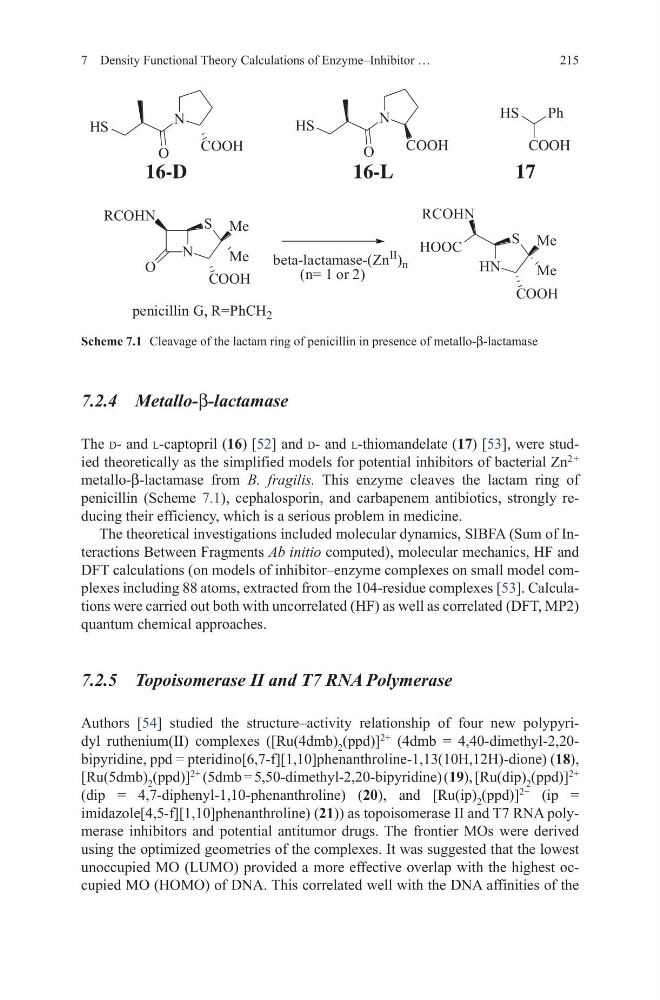
The d- and l-captopril (16) [52] and d- and l-thiomandelate (17) [53], were studied theoretically as the simplified models for potential inhibitors of bacterial Zn
2 +
metallo-β-lactamase from B. fragilis. This enzyme cleaves the lactam ring of
penicillin (Scheme 7.1), cephalosporin, and carbapenem antibiotics, strongly reducing their efficiency, which is a serious problem in medicine.
The theoretical investigations included molecular dynamics, SIBFA (Sum of Interactions Between Fragments Ab initio computed), molecular mechanics, HF and
DFT calculations (on models of inhibitor–enzyme complexes on small model complexes including 88 atoms, extracted from the 104-residue complexes [53]. Calculations were carried out both with uncorrelated (HF) as well as correlated (DFT, MP2)
quantum chemical approaches.
7.2.5 Topoisomerase II and T7 RNA Polymerase
Authors [54] studied the structure–activity relationship of four new polypyridyl ruthenium(II) complexes ([Ru(4dmb) 2 (ppd)]
2+
(4dmb = 4,40-dimethyl-2,20bipyridine, ppd = pteridino[6,7-f][1,10]phenanthroline-1,13(10H,12H)-dione) (18),
[Ru(5dmb) 2 (ppd)]
2+
(5dmb = 5,50-dimethyl-2,20-bipyridine) (19), [Ru(dip) 2 (ppd)]
2+
(dip = 4,7-diphenyl-1,10-phenanthroline) (20), and [Ru(ip) 2 (ppd)]
2+
(ip =
imidazole[4,5-f][1,10]phenanthroline) (21)) as topoisomerase II and T7 RNA polymerase inhibitors and potential antitumor drugs. The frontier MOs were derived
using the optimized geometries of the complexes. It was suggested that the lowest
unoccupied MO (LUMO) provided a more effective overlap with the highest occupied MO (HOMO) of DNA. This correlated well with the DNA affinities of the
1
2
+6
&22+
1
2
+6
&22+
3K
+6
&22+
16-D
1 6-L
1 7
1
6
5&2+1
0H
0H
&22+
2
SHQLFLOOLQ * 5 3K&+
+1
6
5&2+1
0H
0H
&22+
+22&
EHWDODFWDPDVH=Q ,, Q
Q RU
Scheme 7.1 Cleavage of the lactam ring of penicillin in presence of metallo-β-lactamase
7 Density Functional Theory Calculations of Enzyme–Inhibitor …
7.2.4 Metallo-β-lactamase
The d- and l-captopril (16) [52] and d- and l-thiomandelate (17) [53], were studied theoretically as the simplified models for potential inhibitors of bacterial Zn
2 +
metallo-β-lactamase from B. fragilis. This enzyme cleaves the lactam ring of
penicillin (Scheme 7.1), cephalosporin, and carbapenem antibiotics, strongly reducing their efficiency, which is a serious problem in medicine.
The theoretical investigations included molecular dynamics, SIBFA (Sum of Interactions Between Fragments Ab initio computed), molecular mechanics, HF and
DFT calculations (on models of inhibitor–enzyme complexes on small model complexes including 88 atoms, extracted from the 104-residue complexes [53]. Calculations were carried out both with uncorrelated (HF) as well as correlated (DFT, MP2)
quantum chemical approaches.
7.2.5 Topoisomerase II and T7 RNA Polymerase
Authors [54] studied the structure–activity relationship of four new polypyridyl ruthenium(II) complexes ([Ru(4dmb) 2 (ppd)]
2+
(4dmb = 4,40-dimethyl-2,20bipyridine, ppd = pteridino[6,7-f][1,10]phenanthroline-1,13(10H,12H)-dione) (18),
[Ru(5dmb) 2 (ppd)]
2+
(5dmb = 5,50-dimethyl-2,20-bipyridine) (19), [Ru(dip) 2 (ppd)]
2+
(dip = 4,7-diphenyl-1,10-phenanthroline) (20), and [Ru(ip) 2 (ppd)]
2+
(ip =
imidazole[4,5-f][1,10]phenanthroline) (21)) as topoisomerase II and T7 RNA polymerase inhibitors and potential antitumor drugs. The frontier MOs were derived
using the optimized geometries of the complexes. It was suggested that the lowest
unoccupied MO (LUMO) provided a more effective overlap with the highest occupied MO (HOMO) of DNA. This correlated well with the DNA affinities of the
1
2
+6
&22+
1
2
+6
&22+
3K
+6
&22+
16-D
1 6-L
1 7
1
6
5&2+1
0H
0H
&22+
2
SHQLFLOOLQ * 5 3K&+
+1
6
5&2+1
0H
0H
&22+
+22&
EHWDODFWDPDVH=Q ,, Q
Q RU
Scheme 7.1 Cleavage of the lactam ring of penicillin in presence of metallo-β-lactamase
7 Density Functional Theory Calculations of Enzyme–Inhibitor …