

211
site. After a short molecular dynamics simulation the structures were optimized at
the semiempirical level of theory. The optimized structures were used for singlepoint energy calculations with the M062X [44] and X3LYP DFT functional [45],
which account for London dispersion forces, proper hydrogen-bonding and van der
Waals complexes; alternatively the MP2 level of theory was employed. The active
site cavity was separated into individual fragments to isolate each residue energy
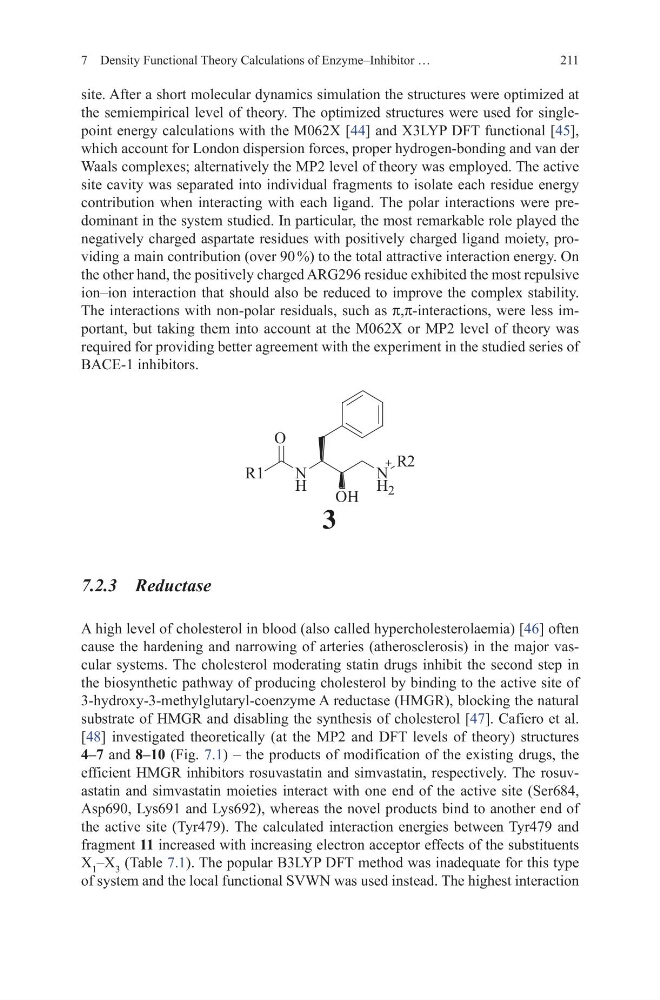
contribution when interacting with each ligand. The polar interactions were predominant in the system studied. In particular, the most remarkable role played the
negatively charged aspartate residues with positively charged ligand moiety, providing a main contribution (over 90 %) to the total attractive interaction energy. On
the other hand, the positively charged ARG296 residue exhibited the most repulsive
ion–ion interaction that should also be reduced to improve the complex stability.
The interactions with non-polar residuals, such as π,π-interactions, were less important, but taking them into account at the M062X or MP2 level of theory was
required for providing better agreement with the experiment in the studied series of
BACE-1 inhibitors.
1
+
2+
1
+
5
5
2
3
7.2.3 Reductase
A high level of cholesterol in blood (also called hypercholesterolaemia) [46] often
cause the hardening and narrowing of arteries (atherosclerosis) in the major vascular systems. The cholesterol moderating statin drugs inhibit the second step in
the biosynthetic pathway of producing cholesterol by binding to the active site of
3-hydroxy-3-methylglutaryl-coenzyme A reductase (HMGR), blocking the natural
substrate of HMGR and disabling the synthesis of cholesterol [47]. Cafiero et al.
[48] investigated theoretically (at the MP2 and DFT levels of theory) structures
4–7 and 8–10 (Fig. 7.1) – the products of modification of the existing drugs, the
efficient HMGR inhibitors rosuvastatin and simvastatin, respectively. The rosuvastatin and simvastatin moieties interact with one end of the active site (Ser684,
Asp690, Lys691 and Lys692), whereas the novel products bind to another end of
the active site (Tyr479). The calculated interaction energies between Tyr479 and
fragment 11 increased with increasing electron acceptor effects of the substituents
X 1 –X 3 (Table 7.1). The popular B3LYP DFT method was inadequate for this type
of system and the local functional SVWN was used instead. The highest interaction
7 Density Functional Theory Calculations of Enzyme–Inhibitor …
site. After a short molecular dynamics simulation the structures were optimized at
the semiempirical level of theory. The optimized structures were used for singlepoint energy calculations with the M062X [44] and X3LYP DFT functional [45],
which account for London dispersion forces, proper hydrogen-bonding and van der
Waals complexes; alternatively the MP2 level of theory was employed. The active
site cavity was separated into individual fragments to isolate each residue energy
contribution when interacting with each ligand. The polar interactions were predominant in the system studied. In particular, the most remarkable role played the
negatively charged aspartate residues with positively charged ligand moiety, providing a main contribution (over 90 %) to the total attractive interaction energy. On
the other hand, the positively charged ARG296 residue exhibited the most repulsive
ion–ion interaction that should also be reduced to improve the complex stability.
The interactions with non-polar residuals, such as π,π-interactions, were less important, but taking them into account at the M062X or MP2 level of theory was
required for providing better agreement with the experiment in the studied series of
BACE-1 inhibitors.
1
+
2+
1
+
5
5
2
3
7.2.3 Reductase
A high level of cholesterol in blood (also called hypercholesterolaemia) [46] often
cause the hardening and narrowing of arteries (atherosclerosis) in the major vascular systems. The cholesterol moderating statin drugs inhibit the second step in
the biosynthetic pathway of producing cholesterol by binding to the active site of
3-hydroxy-3-methylglutaryl-coenzyme A reductase (HMGR), blocking the natural
substrate of HMGR and disabling the synthesis of cholesterol [47]. Cafiero et al.
[48] investigated theoretically (at the MP2 and DFT levels of theory) structures
4–7 and 8–10 (Fig. 7.1) – the products of modification of the existing drugs, the
efficient HMGR inhibitors rosuvastatin and simvastatin, respectively. The rosuvastatin and simvastatin moieties interact with one end of the active site (Ser684,
Asp690, Lys691 and Lys692), whereas the novel products bind to another end of
the active site (Tyr479). The calculated interaction energies between Tyr479 and
fragment 11 increased with increasing electron acceptor effects of the substituents
X 1 –X 3 (Table 7.1). The popular B3LYP DFT method was inadequate for this type
of system and the local functional SVWN was used instead. The highest interaction
7 Density Functional Theory Calculations of Enzyme–Inhibitor …