

210
A. B. Rozhenko
The current short review is not exhaustive in the field. It covers mainly the last
five years and gives examples of successful using the DFT methods for elaborating
new drugs based on enzyme–inhibitor interactions.
7.2 Enzyme–Substrate Interaction Modelling
Using DFT Methods
7.2.1 Hydrolase
Fatty acid amide hydrolase (FAAH) catalyzes hydrolysis of several fatty acid amides, in particular, transforms arachidonoylethanolamide to arachidonic acid and
ethanolamine. The FAAH inhibition has an attractive therapeutic effect for the treatment of several central nervous system disorders. The inhibition mechanisms for
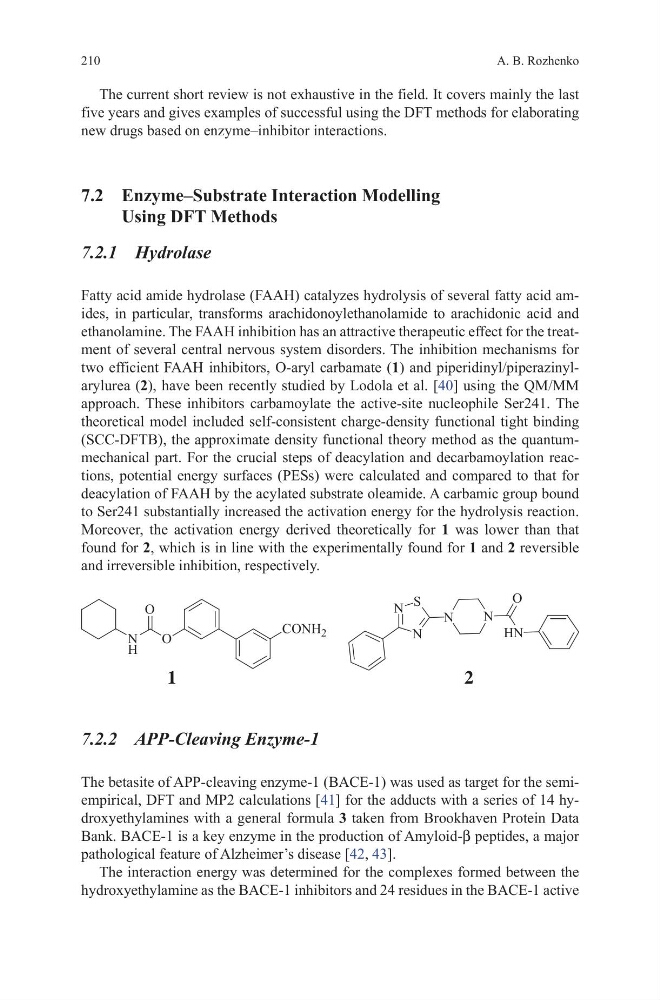
two efficient FAAH inhibitors, O-aryl carbamate (1) and piperidinyl/piperazinylarylurea (2), have been recently studied by Lodola et al. [40] using the QM/MM
approach. These inhibitors carbamoylate the active-site nucleophile Ser241. The
theoretical model included self-consistent charge-density functional tight binding
(SCC-DFTB), the approximate density functional theory method as the quantummechanical part. For the crucial steps of deacylation and decarbamoylation reactions, potential energy surfaces (PESs) were calculated and compared to that for
deacylation of FAAH by the acylated substrate oleamide. A carbamic group bound
to Ser241 substantially increased the activation energy for the hydrolysis reaction.
Moreover, the activation energy derived theoretically for 1 was lower than that
found for 2, which is in line with the experimentally found for 1 and 2 reversible
and irreversible inhibition, respectively.
2
1
+
2
&21+
1
1
+1
2
6
1
1
1
2
7.2.2 APP-Cleaving Enzyme-1
The betasite of APP-cleaving enzyme-1 (BACE-1) was used as target for the semiempirical, DFT and MP2 calculations [41] for the adducts with a series of 14 hydroxyethylamines with a general formula 3 taken from Brookhaven Protein Data
Bank. BACE-1 is a key enzyme in the production of Amyloid-β peptides, a major
pathological feature of Alzheimer’s disease [42, 43].
The interaction energy was determined for the complexes formed between the
hydroxyethylamine as the BACE-1 inhibitors and 24 residues in the BACE-1 active
A. B. Rozhenko
The current short review is not exhaustive in the field. It covers mainly the last
five years and gives examples of successful using the DFT methods for elaborating
new drugs based on enzyme–inhibitor interactions.
7.2 Enzyme–Substrate Interaction Modelling
Using DFT Methods
7.2.1 Hydrolase
Fatty acid amide hydrolase (FAAH) catalyzes hydrolysis of several fatty acid amides, in particular, transforms arachidonoylethanolamide to arachidonic acid and
ethanolamine. The FAAH inhibition has an attractive therapeutic effect for the treatment of several central nervous system disorders. The inhibition mechanisms for
two efficient FAAH inhibitors, O-aryl carbamate (1) and piperidinyl/piperazinylarylurea (2), have been recently studied by Lodola et al. [40] using the QM/MM
approach. These inhibitors carbamoylate the active-site nucleophile Ser241. The
theoretical model included self-consistent charge-density functional tight binding
(SCC-DFTB), the approximate density functional theory method as the quantummechanical part. For the crucial steps of deacylation and decarbamoylation reactions, potential energy surfaces (PESs) were calculated and compared to that for
deacylation of FAAH by the acylated substrate oleamide. A carbamic group bound
to Ser241 substantially increased the activation energy for the hydrolysis reaction.
Moreover, the activation energy derived theoretically for 1 was lower than that
found for 2, which is in line with the experimentally found for 1 and 2 reversible
and irreversible inhibition, respectively.
2
1
+
2
&21+
1
1
+1
2
6
1
1
1
2
7.2.2 APP-Cleaving Enzyme-1
The betasite of APP-cleaving enzyme-1 (BACE-1) was used as target for the semiempirical, DFT and MP2 calculations [41] for the adducts with a series of 14 hydroxyethylamines with a general formula 3 taken from Brookhaven Protein Data
Bank. BACE-1 is a key enzyme in the production of Amyloid-β peptides, a major
pathological feature of Alzheimer’s disease [42, 43].
The interaction energy was determined for the complexes formed between the
hydroxyethylamine as the BACE-1 inhibitors and 24 residues in the BACE-1 active