

172
T. A. Zubatiuk et al.
Interestingly, analysis of published data showed that the carbon atom C8 is the
most preferred for bonding with various chemical agents, particularly in the oxidation reactions [101, 102]. The process of oxidative damage of DNA chain is one of
the most likely causes of mutagenesis and carcinogenesis [103]. That is why the
activation of C8 carbon molecules in adenine is a negative factor for the functioning of the DNA chain. Taking into account the high-performance system of DNA
repairing, one can assume that the protonation of the nitrogen atom N7 at nucleotide
mAMP should lead to some deformation of the geometry of the molecule to avoid
the formation of a strong hydrogen bond C8–H…O, in order to deactivate the carbon atom C8.
Rotation of nucleobase around the glycosidic bond is one of the easiest ways
to deactivation. Ab initio molecular dynamics Car-Parrinello (CPMD) studies show
that the tautomer mAMP-H7 is stable during the first 3.5 ps of simulation [74]. This
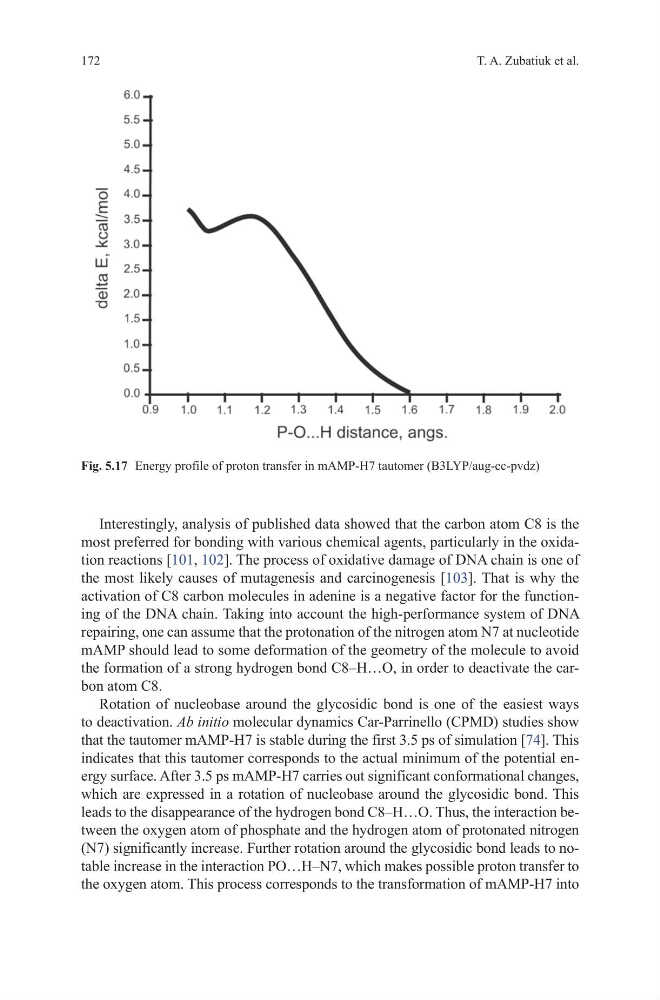
indicates that this tautomer corresponds to the actual minimum of the potential energy surface. After 3.5 ps mAMP-H7 carries out significant conformational changes,
which are expressed in a rotation of nucleobase around the glycosidic bond. This
leads to the disappearance of the hydrogen bond C8–H…O. Thus, the interaction between the oxygen atom of phosphate and the hydrogen atom of protonated nitrogen
(N7) significantly increase. Further rotation around the glycosidic bond leads to notable increase in the interaction PO…H–N7, which makes possible proton transfer to
the oxygen atom. This process corresponds to the transformation of mAMP-H7 into
Fig. 5.17 Energy profile of proton transfer in mAMP-H7 tautomer (B3LYP/aug-cc-pvdz)
T. A. Zubatiuk et al.
Interestingly, analysis of published data showed that the carbon atom C8 is the
most preferred for bonding with various chemical agents, particularly in the oxidation reactions [101, 102]. The process of oxidative damage of DNA chain is one of
the most likely causes of mutagenesis and carcinogenesis [103]. That is why the
activation of C8 carbon molecules in adenine is a negative factor for the functioning of the DNA chain. Taking into account the high-performance system of DNA
repairing, one can assume that the protonation of the nitrogen atom N7 at nucleotide
mAMP should lead to some deformation of the geometry of the molecule to avoid
the formation of a strong hydrogen bond C8–H…O, in order to deactivate the carbon atom C8.
Rotation of nucleobase around the glycosidic bond is one of the easiest ways
to deactivation. Ab initio molecular dynamics Car-Parrinello (CPMD) studies show
that the tautomer mAMP-H7 is stable during the first 3.5 ps of simulation [74]. This
indicates that this tautomer corresponds to the actual minimum of the potential energy surface. After 3.5 ps mAMP-H7 carries out significant conformational changes,
which are expressed in a rotation of nucleobase around the glycosidic bond. This
leads to the disappearance of the hydrogen bond C8–H…O. Thus, the interaction between the oxygen atom of phosphate and the hydrogen atom of protonated nitrogen
(N7) significantly increase. Further rotation around the glycosidic bond leads to notable increase in the interaction PO…H–N7, which makes possible proton transfer to
the oxygen atom. This process corresponds to the transformation of mAMP-H7 into
Fig. 5.17 Energy profile of proton transfer in mAMP-H7 tautomer (B3LYP/aug-cc-pvdz)