

171
5 Molecular Structures, Relative Stability, and Proton Affinities of Nucleotides
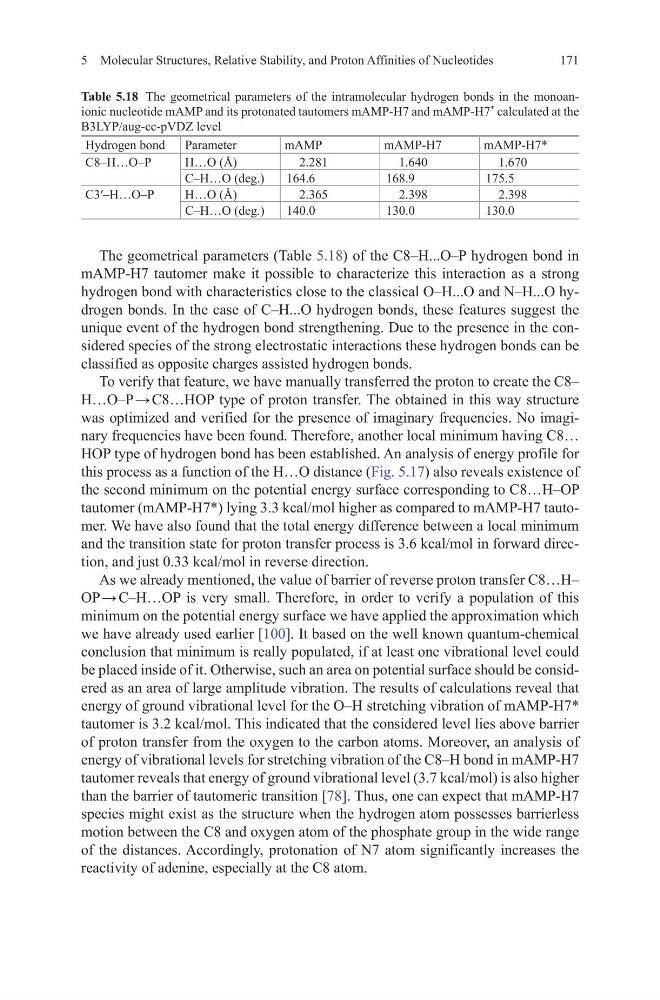
The geometrical parameters (Table 5.18) of the C8–H...O–P hydrogen bond in
mAMP-H7 tautomer make it possible to characterize this interaction as a strong
hydrogen bond with characteristics close to the classical O–H...O and N–H...O hydrogen bonds. In the case of C–H...O hydrogen bonds, these features suggest the
unique event of the hydrogen bond strengthening. Due to the presence in the considered species of the strong electrostatic interactions these hydrogen bonds can be
classified as opposite charges assisted hydrogen bonds.
To verify that feature, we have manually transferred the proton to create the C8–
H…O–P → C8…HOP type of proton transfer. The obtained in this way structure
was optimized and verified for the presence of imaginary frequencies. No imaginary frequencies have been found. Therefore, another local minimum having C8…
HOP type of hydrogen bond has been established. An analysis of energy profile for
this process as a function of the H…O distance (Fig. 5.17) also reveals existence of
the second minimum on the potential energy surface corresponding to C8…H–OP
tautomer (mAMP-H7*) lying 3.3 kcal/mol higher as compared to mAMP-H7 tautomer. We have also found that the total energy difference between a local minimum
and the transition state for proton transfer process is 3.6 kcal/mol in forward direction, and just 0.33 kcal/mol in reverse direction.
As we already mentioned, the value of barrier of reverse proton transfer C8…H–
OP → C–H…OP is very small. Therefore, in order to verify a population of this
minimum on the potential energy surface we have applied the approximation which
we have already used earlier [100]. It based on the well known quantum-chemical
conclusion that minimum is really populated, if at least one vibrational level could
be placed inside of it. Otherwise, such an area on potential surface should be considered as an area of large amplitude vibration. The results of calculations reveal that
energy of ground vibrational level for the O–H stretching vibration of mAMP-H7*
tautomer is 3.2 kcal/mol. This indicated that the considered level lies above barrier
of proton transfer from the oxygen to the carbon atoms. Moreover, an analysis of
energy of vibrational levels for stretching vibration of the C8–H bond in mAMP-H7
tautomer reveals that energy of ground vibrational level (3.7 kcal/mol) is also higher
than the barrier of tautomeric transition [78]. Thus, one can expect that mAMP-H7
species might exist as the structure when the hydrogen atom possesses barrierless
motion between the C8 and oxygen atom of the phosphate group in the wide range
of the distances. Accordingly, protonation of N7 atom significantly increases the
reactivity of adenine, especially at the C8 atom.
Table 5.18 The geometrical parameters of the intramolecular hydrogen bonds in the monoanionic nucleotide mAMP and its protonated tautomers mAMP-H7 and mAMP-H7
*
calculated at the
B3LYP/aug-cc-pVDZ level
Hydrogen bond
Parameter
mAMP
mAMP-H7
mAMP-H7*
C8–H…O–P
H…O (Å)
2.281
1.640
1.670
C–H…O (deg.)
164.6
168.9
175.5
C3′–H…O–P
H…O (Å)
2.365
2.398
2.398
C–H…O (deg.)
140.0
130.0
130.0
5 Molecular Structures, Relative Stability, and Proton Affinities of Nucleotides
The geometrical parameters (Table 5.18) of the C8–H...O–P hydrogen bond in
mAMP-H7 tautomer make it possible to characterize this interaction as a strong
hydrogen bond with characteristics close to the classical O–H...O and N–H...O hydrogen bonds. In the case of C–H...O hydrogen bonds, these features suggest the
unique event of the hydrogen bond strengthening. Due to the presence in the considered species of the strong electrostatic interactions these hydrogen bonds can be
classified as opposite charges assisted hydrogen bonds.
To verify that feature, we have manually transferred the proton to create the C8–
H…O–P → C8…HOP type of proton transfer. The obtained in this way structure
was optimized and verified for the presence of imaginary frequencies. No imaginary frequencies have been found. Therefore, another local minimum having C8…
HOP type of hydrogen bond has been established. An analysis of energy profile for
this process as a function of the H…O distance (Fig. 5.17) also reveals existence of
the second minimum on the potential energy surface corresponding to C8…H–OP
tautomer (mAMP-H7*) lying 3.3 kcal/mol higher as compared to mAMP-H7 tautomer. We have also found that the total energy difference between a local minimum
and the transition state for proton transfer process is 3.6 kcal/mol in forward direction, and just 0.33 kcal/mol in reverse direction.
As we already mentioned, the value of barrier of reverse proton transfer C8…H–
OP → C–H…OP is very small. Therefore, in order to verify a population of this
minimum on the potential energy surface we have applied the approximation which
we have already used earlier [100]. It based on the well known quantum-chemical
conclusion that minimum is really populated, if at least one vibrational level could
be placed inside of it. Otherwise, such an area on potential surface should be considered as an area of large amplitude vibration. The results of calculations reveal that
energy of ground vibrational level for the O–H stretching vibration of mAMP-H7*
tautomer is 3.2 kcal/mol. This indicated that the considered level lies above barrier
of proton transfer from the oxygen to the carbon atoms. Moreover, an analysis of
energy of vibrational levels for stretching vibration of the C8–H bond in mAMP-H7
tautomer reveals that energy of ground vibrational level (3.7 kcal/mol) is also higher
than the barrier of tautomeric transition [78]. Thus, one can expect that mAMP-H7
species might exist as the structure when the hydrogen atom possesses barrierless
motion between the C8 and oxygen atom of the phosphate group in the wide range
of the distances. Accordingly, protonation of N7 atom significantly increases the
reactivity of adenine, especially at the C8 atom.
Table 5.18 The geometrical parameters of the intramolecular hydrogen bonds in the monoanionic nucleotide mAMP and its protonated tautomers mAMP-H7 and mAMP-H7
*
calculated at the
B3LYP/aug-cc-pVDZ level
Hydrogen bond
Parameter
mAMP
mAMP-H7
mAMP-H7*
C8–H…O–P
H…O (Å)
2.281
1.640
1.670
C–H…O (deg.)
164.6
168.9
175.5
C3′–H…O–P
H…O (Å)
2.365
2.398
2.398
C–H…O (deg.)
140.0
130.0
130.0