

170
T. A. Zubatiuk et al.
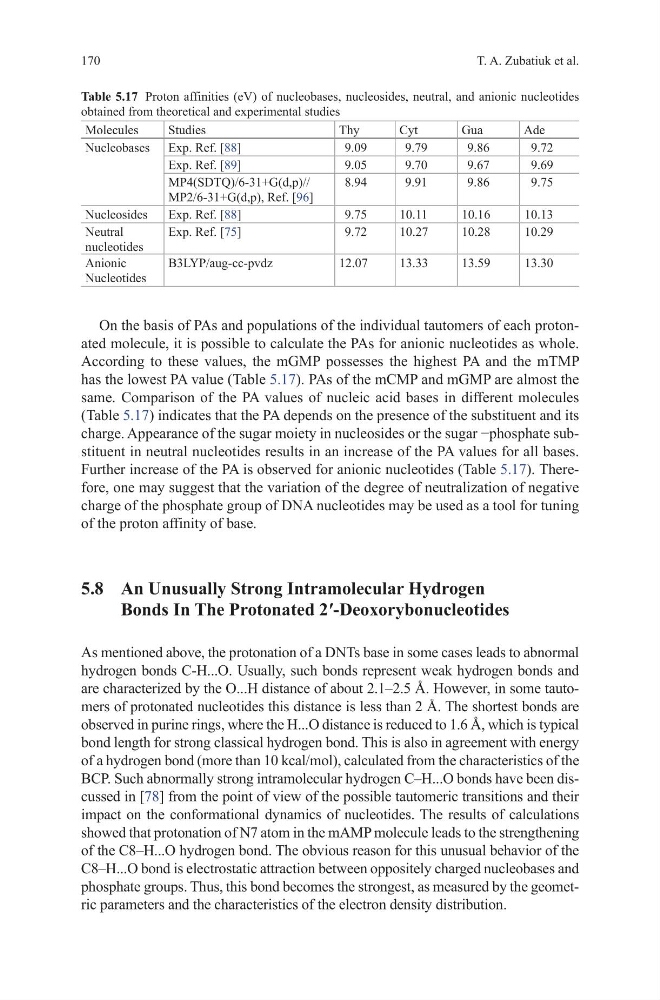
On the basis of PAs and populations of the individual tautomers of each protonated molecule, it is possible to calculate the PAs for anionic nucleotides as whole.
According to these values, the mGMP possesses the highest PA and the mTMP
has the lowest PA value (Table 5.17). PAs of the mCMP and mGMP are almost the
same. Comparison of the PA values of nucleic acid bases in different molecules
(Table 5.17) indicates that the PA depends on the presence of the substituent and its
charge. Appearance of the sugar moiety in nucleosides or the sugar −phosphate substituent in neutral nucleotides results in an increase of the PA values for all bases.
Further increase of the PA is observed for anionic nucleotides (Table 5.17). Therefore, one may suggest that the variation of the degree of neutralization of negative
charge of the phosphate group of DNA nucleotides may be used as a tool for tuning
of the proton affinity of base.
5.8 An Unusually Strong Intramolecular Hydrogen
Bonds In The Protonated 2′-Deoxorybonucleotides
As mentioned above, the protonation of a DNTs base in some cases leads to abnormal
hydrogen bonds C-H...O. Usually, such bonds represent weak hydrogen bonds and
are characterized by the O...H distance of about 2.1–2.5 Å. However, in some tautomers of protonated nucleotides this distance is less than 2 Å. The shortest bonds are
observed in purine rings, where the H...O distance is reduced to 1.6 Å, which is typical
bond length for strong classical hydrogen bond. This is also in agreement with energy
of a hydrogen bond (more than 10 kcal/mol), calculated from the characteristics of the
BCP. Such abnormally strong intramolecular hydrogen C–H...O bonds have been discussed in [78] from the point of view of the possible tautomeric transitions and their
impact on the conformational dynamics of nucleotides. The results of calculations
showed that protonation of N7 atom in the mAMP molecule leads to the strengthening
of the C8–H...O hydrogen bond. The obvious reason for this unusual behavior of the
C8–H...O bond is electrostatic attraction between oppositely charged nucleobases and
phosphate groups. Thus, this bond becomes the strongest, as measured by the geometric parameters and the characteristics of the electron density distribution.
Table 5.17 Proton affinities (eV) of nucleobases, nucleosides, neutral, and anionic nucleotides
obtained from theoretical and experimental studies
Molecules
Studies
Thy
Cyt
Gua
Ade
Nucleobases Exp. Ref. [88]
9.09
9.79
9.86
9.72
Exp. Ref. [89]
9.05
9.70
9.67
9.69
MP4(SDTQ)/6-31+G(d,p)//
MP2/6-31+G(d,p), Ref. [96]
8.94
9.91
9.86
9.75
Nucleosides
Exp. Ref. [88]
9.75
10.11
10.16
10.13
Neutral
nucleotides
Exp. Ref. [75]
9.72
10.27
10.28
10.29
Anionic
Nucleotides
B3LYP/aug-cc-pvdz
12.07
13.33
13.59
13.30
T. A. Zubatiuk et al.
On the basis of PAs and populations of the individual tautomers of each protonated molecule, it is possible to calculate the PAs for anionic nucleotides as whole.
According to these values, the mGMP possesses the highest PA and the mTMP
has the lowest PA value (Table 5.17). PAs of the mCMP and mGMP are almost the
same. Comparison of the PA values of nucleic acid bases in different molecules
(Table 5.17) indicates that the PA depends on the presence of the substituent and its
charge. Appearance of the sugar moiety in nucleosides or the sugar −phosphate substituent in neutral nucleotides results in an increase of the PA values for all bases.
Further increase of the PA is observed for anionic nucleotides (Table 5.17). Therefore, one may suggest that the variation of the degree of neutralization of negative
charge of the phosphate group of DNA nucleotides may be used as a tool for tuning
of the proton affinity of base.
5.8 An Unusually Strong Intramolecular Hydrogen
Bonds In The Protonated 2′-Deoxorybonucleotides
As mentioned above, the protonation of a DNTs base in some cases leads to abnormal
hydrogen bonds C-H...O. Usually, such bonds represent weak hydrogen bonds and
are characterized by the O...H distance of about 2.1–2.5 Å. However, in some tautomers of protonated nucleotides this distance is less than 2 Å. The shortest bonds are
observed in purine rings, where the H...O distance is reduced to 1.6 Å, which is typical
bond length for strong classical hydrogen bond. This is also in agreement with energy
of a hydrogen bond (more than 10 kcal/mol), calculated from the characteristics of the
BCP. Such abnormally strong intramolecular hydrogen C–H...O bonds have been discussed in [78] from the point of view of the possible tautomeric transitions and their
impact on the conformational dynamics of nucleotides. The results of calculations
showed that protonation of N7 atom in the mAMP molecule leads to the strengthening
of the C8–H...O hydrogen bond. The obvious reason for this unusual behavior of the
C8–H...O bond is electrostatic attraction between oppositely charged nucleobases and
phosphate groups. Thus, this bond becomes the strongest, as measured by the geometric parameters and the characteristics of the electron density distribution.
Table 5.17 Proton affinities (eV) of nucleobases, nucleosides, neutral, and anionic nucleotides
obtained from theoretical and experimental studies
Molecules
Studies
Thy
Cyt
Gua
Ade
Nucleobases Exp. Ref. [88]
9.09
9.79
9.86
9.72
Exp. Ref. [89]
9.05
9.70
9.67
9.69
MP4(SDTQ)/6-31+G(d,p)//
MP2/6-31+G(d,p), Ref. [96]
8.94
9.91
9.86
9.75
Nucleosides
Exp. Ref. [88]
9.75
10.11
10.16
10.13
Neutral
nucleotides
Exp. Ref. [75]
9.72
10.27
10.28
10.29
Anionic
Nucleotides
B3LYP/aug-cc-pvdz
12.07
13.33
13.59
13.30