

169
5 Molecular Structures, Relative Stability, and Proton Affinities of Nucleotides
mGMP. However, its population is reduced by more than half. The protonation of
the nitrogen atoms in the gas phase always yields one dominant conformer. Protonation of the oxygen atom of the carbonyl group leads to a mixture of two conformers. The exception is only in the case of tautomers H7 and H11 for mTMP mGMP.
The appearance of the polar environment leads to a mixture of conformers for all
possible tautomers.
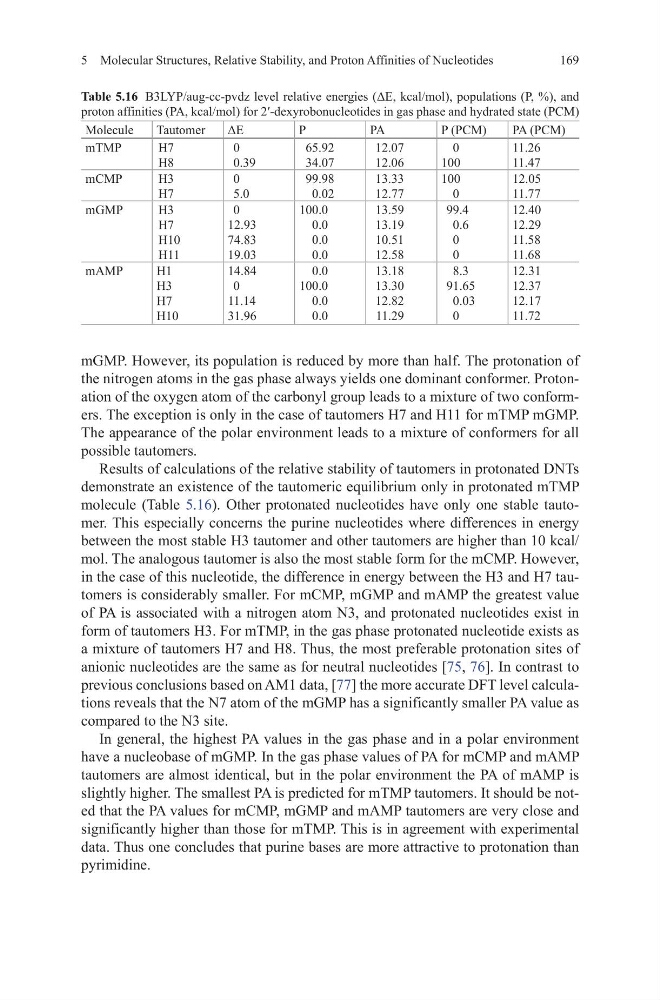
Results of calculations of the relative stability of tautomers in protonated DNTs
demonstrate an existence of the tautomeric equilibrium only in protonated mTMP
molecule (Table 5.16). Other protonated nucleotides have only one stable tautomer. This especially concerns the purine nucleotides where differences in energy
between the most stable H3 tautomer and other tautomers are higher than 10 kcal/
mol. The analogous tautomer is also the most stable form for the mCMP. However,
in the case of this nucleotide, the difference in energy between the H3 and H7 tautomers is considerably smaller. For mCMP, mGMP and mAMP the greatest value
of PA is associated with a nitrogen atom N3, and protonated nucleotides exist in
form of tautomers H3. For mTMP, in the gas phase protonated nucleotide exists as
a mixture of tautomers H7 and H8. Thus, the most preferable protonation sites of
anionic nucleotides are the same as for neutral nucleotides [75, 76]. In contrast to
previous conclusions based on AM1 data, [77] the more accurate DFT level calculations reveals that the N7 atom of the mGMP has a significantly smaller PA value as
compared to the N3 site.
In general, the highest PA values in the gas phase and in a polar environment
have a nucleobase of mGMP. In the gas phase values of PA for mCMP and mAMP
tautomers are almost identical, but in the polar environment the PA of mAMP is
slightly higher. The smallest PA is predicted for mTMP tautomers. It should be noted that the PA values for mCMP, mGMP and mAMP tautomers are very close and
significantly higher than those for mTMP. This is in agreement with experimental
data. Thus one concludes that purine bases are more attractive to protonation than
pyrimidine.
Table 5.16 B3LYP/aug-cc-pvdz level relative energies (ΔE, kcal/mol), populations (P, %), and
proton affinities (PA, kcal/mol) for 2′-dexyrobonucleotides in gas phase and hydrated state (PCM)
Molecule
Tautomer
ΔE
P
PA
P (PCM)
PA (PCM)
mTMP
H7
H8
0
0.39
65.92
34.07
12.07
12.06
0
100
11.26
11.47
mCMP
H3
H7
0
5.0
99.98
0.02
13.33
12.77
100
0
12.05
11.77
mGMP
H3
H7
H10
H11
0
12.93
74.83
19.03
100.0
0.0
0.0
0.0
13.59
13.19
10.51
12.58
99.4
0.6
0
0
12.40
12.29
11.58
11.68
mAMP
H1
H3
H7
H10
14.84
0
11.14
31.96
0.0
100.0
0.0
0.0
13.18
13.30
12.82
11.29
8.3
91.65
0.03
0
12.31
12.37
12.17
11.72
5 Molecular Structures, Relative Stability, and Proton Affinities of Nucleotides
mGMP. However, its population is reduced by more than half. The protonation of
the nitrogen atoms in the gas phase always yields one dominant conformer. Protonation of the oxygen atom of the carbonyl group leads to a mixture of two conformers. The exception is only in the case of tautomers H7 and H11 for mTMP mGMP.
The appearance of the polar environment leads to a mixture of conformers for all
possible tautomers.
Results of calculations of the relative stability of tautomers in protonated DNTs
demonstrate an existence of the tautomeric equilibrium only in protonated mTMP
molecule (Table 5.16). Other protonated nucleotides have only one stable tautomer. This especially concerns the purine nucleotides where differences in energy
between the most stable H3 tautomer and other tautomers are higher than 10 kcal/
mol. The analogous tautomer is also the most stable form for the mCMP. However,
in the case of this nucleotide, the difference in energy between the H3 and H7 tautomers is considerably smaller. For mCMP, mGMP and mAMP the greatest value
of PA is associated with a nitrogen atom N3, and protonated nucleotides exist in
form of tautomers H3. For mTMP, in the gas phase protonated nucleotide exists as
a mixture of tautomers H7 and H8. Thus, the most preferable protonation sites of
anionic nucleotides are the same as for neutral nucleotides [75, 76]. In contrast to
previous conclusions based on AM1 data, [77] the more accurate DFT level calculations reveals that the N7 atom of the mGMP has a significantly smaller PA value as
compared to the N3 site.
In general, the highest PA values in the gas phase and in a polar environment
have a nucleobase of mGMP. In the gas phase values of PA for mCMP and mAMP
tautomers are almost identical, but in the polar environment the PA of mAMP is
slightly higher. The smallest PA is predicted for mTMP tautomers. It should be noted that the PA values for mCMP, mGMP and mAMP tautomers are very close and
significantly higher than those for mTMP. This is in agreement with experimental
data. Thus one concludes that purine bases are more attractive to protonation than
pyrimidine.
Table 5.16 B3LYP/aug-cc-pvdz level relative energies (ΔE, kcal/mol), populations (P, %), and
proton affinities (PA, kcal/mol) for 2′-dexyrobonucleotides in gas phase and hydrated state (PCM)
Molecule
Tautomer
ΔE
P
PA
P (PCM)
PA (PCM)
mTMP
H7
H8
0
0.39
65.92
34.07
12.07
12.06
0
100
11.26
11.47
mCMP
H3
H7
0
5.0
99.98
0.02
13.33
12.77
100
0
12.05
11.77
mGMP
H3
H7
H10
H11
0
12.93
74.83
19.03
100.0
0.0
0.0
0.0
13.59
13.19
10.51
12.58
99.4
0.6
0
0
12.40
12.29
11.58
11.68
mAMP
H1
H3
H7
H10
14.84
0
11.14
31.96
0.0
100.0
0.0
0.0
13.18
13.30
12.82
11.29
8.3
91.65
0.03
0
12.31
12.37
12.17
11.72