

173
5 Molecular Structures, Relative Stability, and Proton Affinities of Nucleotides
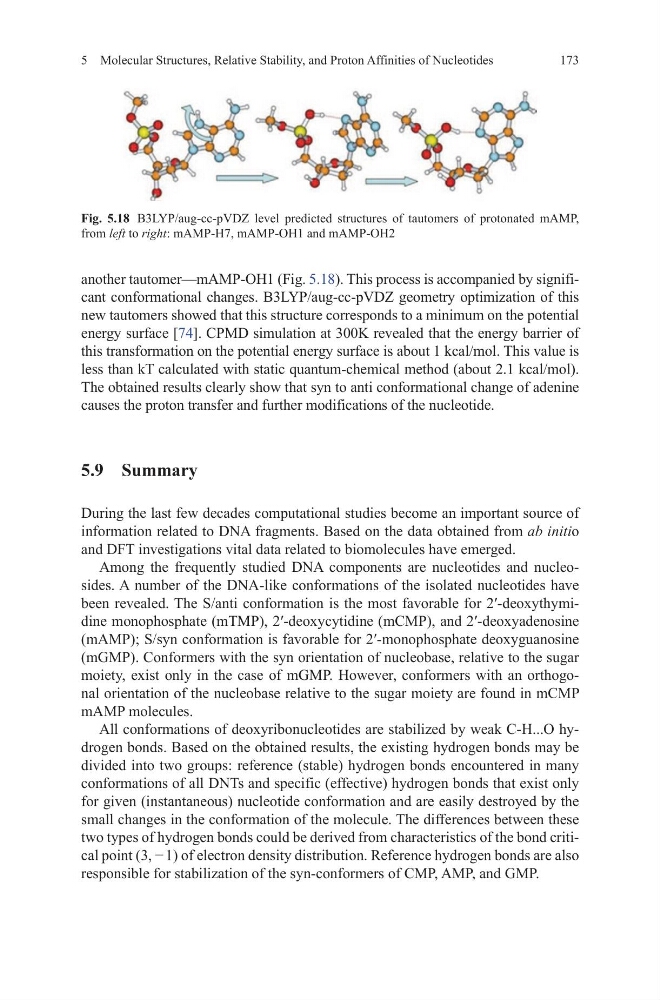
another tautomer—mAMP-OH1 (Fig. 5.18). This process is accompanied by significant conformational changes. B3LYP/aug-cc-pVDZ geometry optimization of this
new tautomers showed that this structure corresponds to a minimum on the potential
energy surface [74]. CPMD simulation at 300K revealed that the energy barrier of
this transformation on the potential energy surface is about 1 kcal/mol. This value is
less than kT calculated with static quantum-chemical method (about 2.1 kcal/mol).
The obtained results clearly show that syn to anti conformational change of adenine
causes the proton transfer and further modifications of the nucleotide.
5.9 Summary
During the last few decades computational studies become an important source of
information related to DNA fragments. Based on the data obtained from ab initio
and DFT investigations vital data related to biomolecules have emerged.
Among the frequently studied DNA components are nucleotides and nucleosides. A number of the DNA-like conformations of the isolated nucleotides have
been revealed. The S/anti conformation is the most favorable for 2′-deoxythymidine monophosphate (mTMP), 2′-deoxycytidine (mCMP), and 2′-deoxyadenosine
(mAMP); S/syn conformation is favorable for 2′-monophosphate deoxyguanosine
(mGMP). Conformers with the syn orientation of nucleobase, relative to the sugar
moiety, exist only in the case of mGMP. However, conformers with an orthogonal orientation of the nucleobase relative to the sugar moiety are found in mCMP
mAMP molecules.
All conformations of deoxyribonucleotides are stabilized by weak C-H...O hydrogen bonds. Based on the obtained results, the existing hydrogen bonds may be
divided into two groups: reference (stable) hydrogen bonds encountered in many
conformations of all DNTs and specific (effective) hydrogen bonds that exist only
for given (instantaneous) nucleotide conformation and are easily destroyed by the
small changes in the conformation of the molecule. The differences between these
two types of hydrogen bonds could be derived from characteristics of the bond critical point (3, − 1) of electron density distribution. Reference hydrogen bonds are also
responsible for stabilization of the syn-conformers of CMP, AMP, and GMP.
Fig. 5.18 B3LYP/aug-cc-pVDZ level predicted structures of tautomers of protonated mAMP,
from left to right: mAMP-H7, mAMP-OH1 and mAMP-OH2
5 Molecular Structures, Relative Stability, and Proton Affinities of Nucleotides
another tautomer—mAMP-OH1 (Fig. 5.18). This process is accompanied by significant conformational changes. B3LYP/aug-cc-pVDZ geometry optimization of this
new tautomers showed that this structure corresponds to a minimum on the potential
energy surface [74]. CPMD simulation at 300K revealed that the energy barrier of
this transformation on the potential energy surface is about 1 kcal/mol. This value is
less than kT calculated with static quantum-chemical method (about 2.1 kcal/mol).
The obtained results clearly show that syn to anti conformational change of adenine
causes the proton transfer and further modifications of the nucleotide.
5.9 Summary
During the last few decades computational studies become an important source of
information related to DNA fragments. Based on the data obtained from ab initio
and DFT investigations vital data related to biomolecules have emerged.
Among the frequently studied DNA components are nucleotides and nucleosides. A number of the DNA-like conformations of the isolated nucleotides have
been revealed. The S/anti conformation is the most favorable for 2′-deoxythymidine monophosphate (mTMP), 2′-deoxycytidine (mCMP), and 2′-deoxyadenosine
(mAMP); S/syn conformation is favorable for 2′-monophosphate deoxyguanosine
(mGMP). Conformers with the syn orientation of nucleobase, relative to the sugar
moiety, exist only in the case of mGMP. However, conformers with an orthogonal orientation of the nucleobase relative to the sugar moiety are found in mCMP
mAMP molecules.
All conformations of deoxyribonucleotides are stabilized by weak C-H...O hydrogen bonds. Based on the obtained results, the existing hydrogen bonds may be
divided into two groups: reference (stable) hydrogen bonds encountered in many
conformations of all DNTs and specific (effective) hydrogen bonds that exist only
for given (instantaneous) nucleotide conformation and are easily destroyed by the
small changes in the conformation of the molecule. The differences between these
two types of hydrogen bonds could be derived from characteristics of the bond critical point (3, − 1) of electron density distribution. Reference hydrogen bonds are also
responsible for stabilization of the syn-conformers of CMP, AMP, and GMP.
Fig. 5.18 B3LYP/aug-cc-pVDZ level predicted structures of tautomers of protonated mAMP,
from left to right: mAMP-H7, mAMP-OH1 and mAMP-OH2