

165
5 Molecular Structures, Relative Stability, and Proton Affinities of Nucleotides
an opposite charge assistance in hydrogen bonding may lead to transformation of
usually weak C–H…X hydrogen bonds into very strong bonds. Such situation is
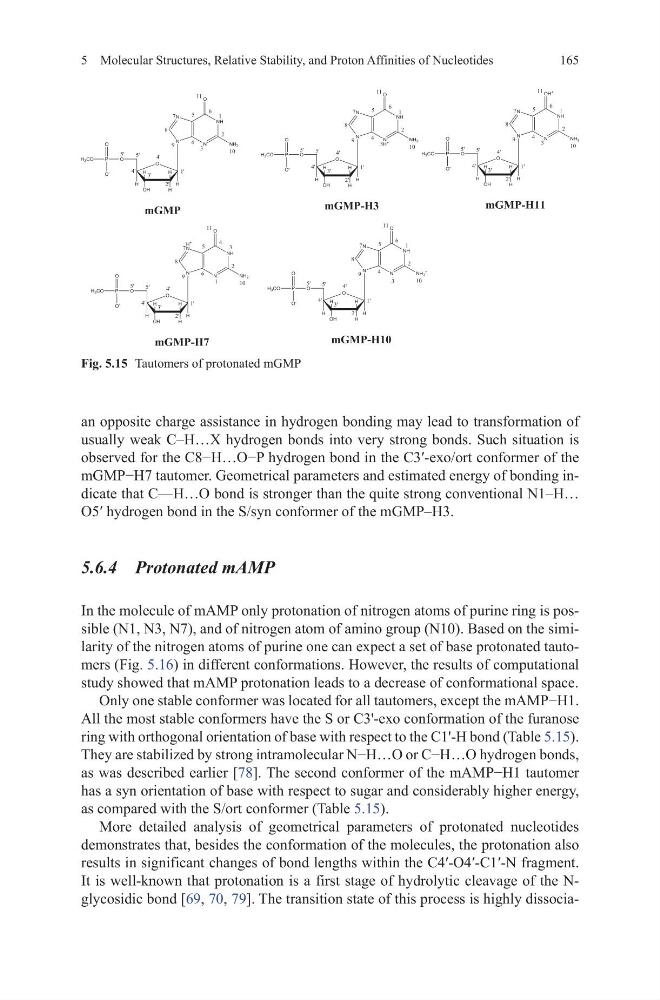
observed for the C8−H…O−P hydrogen bond in the C3′-exo/ort conformer of the
mGMP−H7 tautomer. Geometrical parameters and estimated energy of bonding indicate that C—H…O bond is stronger than the quite strong conventional N1–H…
O5′ hydrogen bond in the S/syn conformer of the mGMP–H3.
5.6.4 Protonated mAMP
In the molecule of mAMP only protonation of nitrogen atoms of purine ring is possible (N1, N3, N7), and of nitrogen atom of amino group (N10). Based on the similarity of the nitrogen atoms of purine one can expect a set of base protonated tautomers (Fig. 5.16) in different conformations. However, the results of computational
study showed that mAMP protonation leads to a decrease of conformational space.
Only one stable conformer was located for all tautomers, except the mAMP−H1.
All the most stable conformers have the S or C3'-exo conformation of the furanose
ring with orthogonal orientation of base with respect to the C1'-H bond (Table 5.15).
They are stabilized by strong intramolecular N−H…O or C−H…O hydrogen bonds,
as was described earlier [78]. The second conformer of the mAMP−H1 tautomer
has a syn orientation of base with respect to sugar and considerably higher energy,
as compared with the S/ort conformer (Table 5.15).
More detailed analysis of geometrical parameters of protonated nucleotides
demonstrates that, besides the conformation of the molecules, the protonation also
results in significant changes of bond lengths within the C4′-O4′-C1′-N fragment.
It is well-known that protonation is a first stage of hydrolytic cleavage of the Nglycosidic bond [69, 70, 79]. The transition state of this process is highly dissociaFig. 5.15 Tautomers of protonated mGMP
5 Molecular Structures, Relative Stability, and Proton Affinities of Nucleotides
an opposite charge assistance in hydrogen bonding may lead to transformation of
usually weak C–H…X hydrogen bonds into very strong bonds. Such situation is
observed for the C8−H…O−P hydrogen bond in the C3′-exo/ort conformer of the
mGMP−H7 tautomer. Geometrical parameters and estimated energy of bonding indicate that C—H…O bond is stronger than the quite strong conventional N1–H…
O5′ hydrogen bond in the S/syn conformer of the mGMP–H3.
5.6.4 Protonated mAMP
In the molecule of mAMP only protonation of nitrogen atoms of purine ring is possible (N1, N3, N7), and of nitrogen atom of amino group (N10). Based on the similarity of the nitrogen atoms of purine one can expect a set of base protonated tautomers (Fig. 5.16) in different conformations. However, the results of computational
study showed that mAMP protonation leads to a decrease of conformational space.
Only one stable conformer was located for all tautomers, except the mAMP−H1.
All the most stable conformers have the S or C3'-exo conformation of the furanose
ring with orthogonal orientation of base with respect to the C1'-H bond (Table 5.15).
They are stabilized by strong intramolecular N−H…O or C−H…O hydrogen bonds,
as was described earlier [78]. The second conformer of the mAMP−H1 tautomer
has a syn orientation of base with respect to sugar and considerably higher energy,
as compared with the S/ort conformer (Table 5.15).
More detailed analysis of geometrical parameters of protonated nucleotides
demonstrates that, besides the conformation of the molecules, the protonation also
results in significant changes of bond lengths within the C4′-O4′-C1′-N fragment.
It is well-known that protonation is a first stage of hydrolytic cleavage of the Nglycosidic bond [69, 70, 79]. The transition state of this process is highly dissociaFig. 5.15 Tautomers of protonated mGMP