

164
T. A. Zubatiuk et al.
5.6.3 Protonated mGMP
In the molecule of 2′-deoxyguanosine number of possible sites of protonation is 4.
This includes two nitrogen atoms in the purine ring (N3, N7), the nitrogen atom of
the amino group (N10) and the carbonyl oxygen (O11). According to the stability
of mGMP conformers with syn orientation of the base respectively to the furanose
ring, one can expect a significant conformational variety of tautomers for protonated mGMP (Fig. 5.15). Interestingly, in the case of mGMP, protonation leads to
complete disappearance of conformers with anti orientation of the guanine moiety
(Table 5.15). Minima on the potential energy surface are found only for conformers
with syn and orthogonal orientation of the base.
Besides that, all stable conformers of protonated mdGMP possess S or C3′-exo
conformation of the furanose ring in contrast to a non-protonated nucleotide (Table 5.15). The number of stable conformers is limited to one (H3 and H10 tautomers) or two (H7 and H11 tautomers).
One may suppose that the significant decrease of conformational space of protonated mGMP is caused by the formation of strong intramolecular hydrogen bonds.
Especially strong hydrogen bonding is observed between the amino and phosphate
group in mGMP−H3 and mGMP−H11 tautomers. Geometrical parameters and
energy of the N−H…O bonds in these conformers allows suggesting almost free
transition of the hydrogen atom between interacting heteroatoms. However, only
one minimum on the potential energy surface corresponding to the location of the
hydrogen atom at the nitrogen of the amino group was found.
The C3′-exo/ort conformers of the mGMP−H7 and mGMP−H10 tautomers are
stabilized only by the C−H…O hydrogen bonds. However, their strength is increased significantly by electrostatic interactions between the nucleobase and phosphate group possessing opposite charges. Earlier, it was demonstrated [74, 78] that
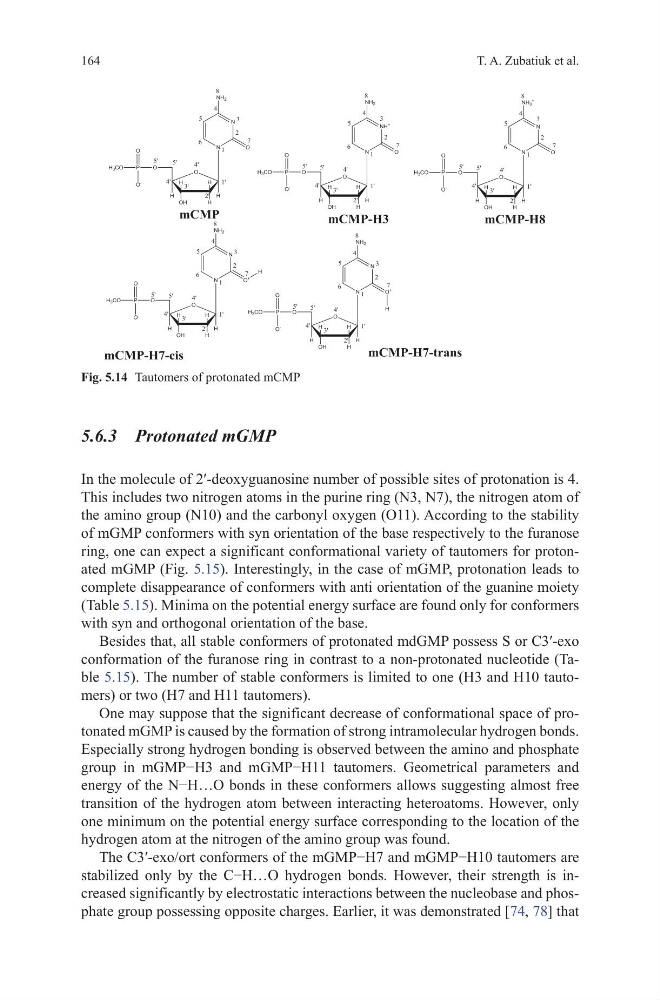
Fig. 5.14 Tautomers of protonated mCMP
T. A. Zubatiuk et al.
5.6.3 Protonated mGMP
In the molecule of 2′-deoxyguanosine number of possible sites of protonation is 4.
This includes two nitrogen atoms in the purine ring (N3, N7), the nitrogen atom of
the amino group (N10) and the carbonyl oxygen (O11). According to the stability
of mGMP conformers with syn orientation of the base respectively to the furanose
ring, one can expect a significant conformational variety of tautomers for protonated mGMP (Fig. 5.15). Interestingly, in the case of mGMP, protonation leads to
complete disappearance of conformers with anti orientation of the guanine moiety
(Table 5.15). Minima on the potential energy surface are found only for conformers
with syn and orthogonal orientation of the base.
Besides that, all stable conformers of protonated mdGMP possess S or C3′-exo
conformation of the furanose ring in contrast to a non-protonated nucleotide (Table 5.15). The number of stable conformers is limited to one (H3 and H10 tautomers) or two (H7 and H11 tautomers).
One may suppose that the significant decrease of conformational space of protonated mGMP is caused by the formation of strong intramolecular hydrogen bonds.
Especially strong hydrogen bonding is observed between the amino and phosphate
group in mGMP−H3 and mGMP−H11 tautomers. Geometrical parameters and
energy of the N−H…O bonds in these conformers allows suggesting almost free
transition of the hydrogen atom between interacting heteroatoms. However, only
one minimum on the potential energy surface corresponding to the location of the
hydrogen atom at the nitrogen of the amino group was found.
The C3′-exo/ort conformers of the mGMP−H7 and mGMP−H10 tautomers are
stabilized only by the C−H…O hydrogen bonds. However, their strength is increased significantly by electrostatic interactions between the nucleobase and phosphate group possessing opposite charges. Earlier, it was demonstrated [74, 78] that
Fig. 5.14 Tautomers of protonated mCMP