

166
T. A. Zubatiuk et al.
tive with substantial elongation of the C1′−N bond [79–81]. Therefore, increase of
the N-glycosidic bond length due to protonation creates favorable conditions for
disruption of this bond. It should be noted that this process has been investigated
mainly for the purine nucleotides because it represents the first step in the base
excision repair pathway [82, 83]. In agreement with previous findings, [19, 20, 52,
53] the length of the N-glycosidic bond C1′−N in non-protonated purine nucleotides is smaller than that for pyrimidine ones (average values are 1.464 and 1.482
Å, respectively). This is caused by the nature of the base [18]. The same situation
is observed in protonated species. The average length of the C1′-N bond in the purine nucleotides (1.481 Å) remains shorter than that in the pyrimidine nucleotides
(1.519 Å). However, in all cases, the protonation results in significant elongation of
this bond, causing its weakening. This effect is more pronounced in the pyrimidine
nucleotides than in the mAMP and mGMP (differences between average values
of the C1′−N bond lengths are Δℓ = 0.037 Å for pyrimidine and Δℓ = 0.017 Å for
purine nucleotides). Results of our calculations [84] demonstrate that weakening
of the N-glycosidic bond is more pronounced in the pyrimidine nucleotides than in
the mAMP and mGMP. This means that cleavage of the N-glycosidic bond in the
pyrimidine nucleotides should be even easier than in the purine ones, especially
taking into account C1′−N bond`s length.
5.7 Proton Affinity of Nucleobases
in 2′-Deoxyribonucleotides
Experimental [85–92] and theoretical [92–96] studies of PAs of nucleobases in the
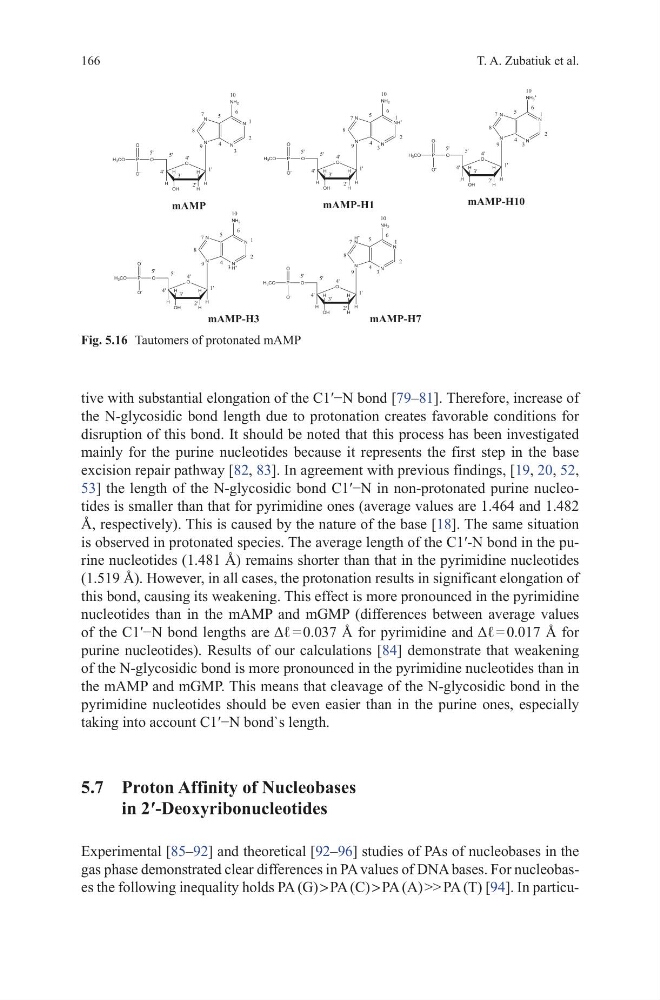
gas phase demonstrated clear differences in PA values of DNA bases. For nucleobases the following inequality holds PA (G) > PA (C) > PA (A) >> PA (T) [94]. In particuFig. 5.16 Tautomers of protonated mAMP
T. A. Zubatiuk et al.
tive with substantial elongation of the C1′−N bond [79–81]. Therefore, increase of
the N-glycosidic bond length due to protonation creates favorable conditions for
disruption of this bond. It should be noted that this process has been investigated
mainly for the purine nucleotides because it represents the first step in the base
excision repair pathway [82, 83]. In agreement with previous findings, [19, 20, 52,
53] the length of the N-glycosidic bond C1′−N in non-protonated purine nucleotides is smaller than that for pyrimidine ones (average values are 1.464 and 1.482
Å, respectively). This is caused by the nature of the base [18]. The same situation
is observed in protonated species. The average length of the C1′-N bond in the purine nucleotides (1.481 Å) remains shorter than that in the pyrimidine nucleotides
(1.519 Å). However, in all cases, the protonation results in significant elongation of
this bond, causing its weakening. This effect is more pronounced in the pyrimidine
nucleotides than in the mAMP and mGMP (differences between average values
of the C1′−N bond lengths are Δℓ = 0.037 Å for pyrimidine and Δℓ = 0.017 Å for
purine nucleotides). Results of our calculations [84] demonstrate that weakening
of the N-glycosidic bond is more pronounced in the pyrimidine nucleotides than in
the mAMP and mGMP. This means that cleavage of the N-glycosidic bond in the
pyrimidine nucleotides should be even easier than in the purine ones, especially
taking into account C1′−N bond`s length.
5.7 Proton Affinity of Nucleobases
in 2′-Deoxyribonucleotides
Experimental [85–92] and theoretical [92–96] studies of PAs of nucleobases in the
gas phase demonstrated clear differences in PA values of DNA bases. For nucleobases the following inequality holds PA (G) > PA (C) > PA (A) >> PA (T) [94]. In particuFig. 5.16 Tautomers of protonated mAMP