

127
gives a possibility to optimize the known inhibitory compounds towards enhanced
affinity and selectivity in relation to desirable polymerases. One should note that
this paradigm shift reflects the common tendency in development of new drugs,
herbicides, fungicides and other biologically active compounds.
The next development of pol inhibitors can be associated with search of allosteric binding sites on the DNA polymerases. These compounds have to be a priori
more selective than ones binding into active site of enzyme. Unfortunately, among
the all known pol inhibitors only MK886—inhibitor of Y family pols—can pretend
to be really allosteric. This state of facts is a result of absence of appropriate information about allosteric sites’ localization. However, it can be corrected via analysis
of correlated motions in proteins calculated from molecular dynamics trajectories.
This approach lets to reveal behavior coordination between spatially distant parts of
macromolecule. The ligand bound to one from such “coordinated” parts appropriately causes the structural changes in another. Using this approach it’s possible to
reveal the all sites on protein surface, their changes can significantly influence on
spatial organization of enzyme active site.
Acknowledgements Author would like to sincere gratitude to Prof. Leonid Gorb, Prof. Alexei
Kolezhuk, Oleg Lytuga, Tamara Limanska and Fedor Lavrik for their invaluable aid in preparing
of this article.
References
1. Berdis AJ (2009) Mechanisms of DNA polymerases. Chem Rev 109(7):2862–2879
2. Bebenek K, Kunkel TA (2004) Functions of DNA polymerases. Adv Protein Chem 69:137–65
3. Hübscher U, Spadari S, Villani G, Maga G (2010) DNA polymerases: discovery, characterization and functions in cellular DNA transactions. World Scientific, New Jersey
4. Haracska L, Johnson RE, Prakash L, Prakash S (2005) Trf4 and Trf5 proteins of Saccharomyces cerevisiae exhibit poly(A) RNA polymerase activity but no DNA polymerase activity. Mol
Cell Biol 25(22):10183–10189
4 DNA Dependent DNA Polymerases as Targets for Low-Weight …
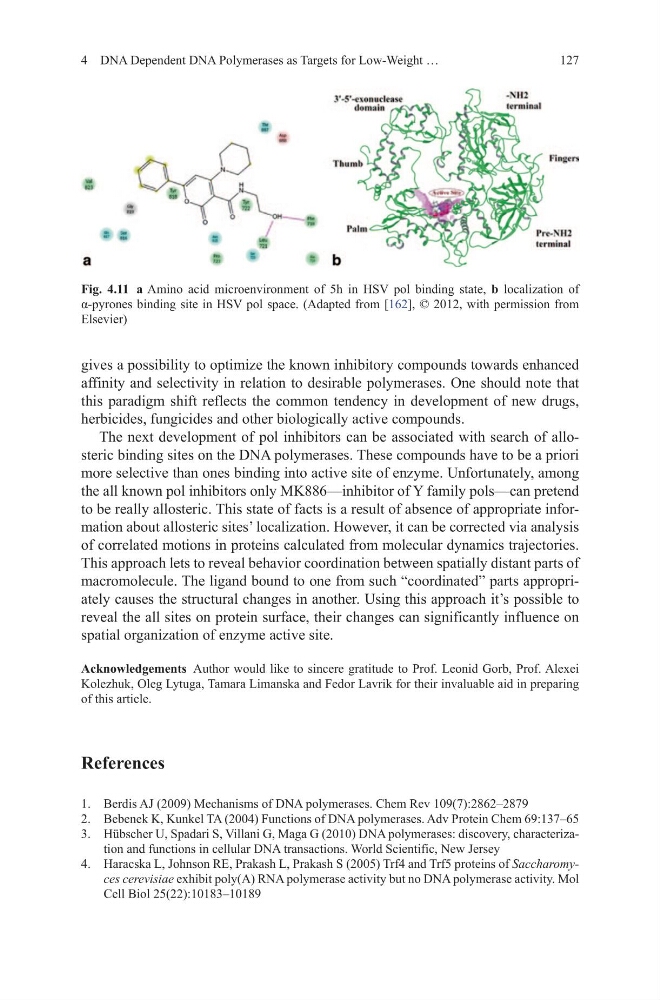
Fig. 4.11 a Amino acid microenvironment of 5h in HSV pol binding state, b localization of
α-pyrones binding site in HSV pol space. (Adapted from [162], © 2012, with permission from
Elsevier)
gives a possibility to optimize the known inhibitory compounds towards enhanced
affinity and selectivity in relation to desirable polymerases. One should note that
this paradigm shift reflects the common tendency in development of new drugs,
herbicides, fungicides and other biologically active compounds.
The next development of pol inhibitors can be associated with search of allosteric binding sites on the DNA polymerases. These compounds have to be a priori
more selective than ones binding into active site of enzyme. Unfortunately, among
the all known pol inhibitors only MK886—inhibitor of Y family pols—can pretend
to be really allosteric. This state of facts is a result of absence of appropriate information about allosteric sites’ localization. However, it can be corrected via analysis
of correlated motions in proteins calculated from molecular dynamics trajectories.
This approach lets to reveal behavior coordination between spatially distant parts of
macromolecule. The ligand bound to one from such “coordinated” parts appropriately causes the structural changes in another. Using this approach it’s possible to
reveal the all sites on protein surface, their changes can significantly influence on
spatial organization of enzyme active site.
Acknowledgements Author would like to sincere gratitude to Prof. Leonid Gorb, Prof. Alexei
Kolezhuk, Oleg Lytuga, Tamara Limanska and Fedor Lavrik for their invaluable aid in preparing
of this article.
References
1. Berdis AJ (2009) Mechanisms of DNA polymerases. Chem Rev 109(7):2862–2879
2. Bebenek K, Kunkel TA (2004) Functions of DNA polymerases. Adv Protein Chem 69:137–65
3. Hübscher U, Spadari S, Villani G, Maga G (2010) DNA polymerases: discovery, characterization and functions in cellular DNA transactions. World Scientific, New Jersey
4. Haracska L, Johnson RE, Prakash L, Prakash S (2005) Trf4 and Trf5 proteins of Saccharomyces cerevisiae exhibit poly(A) RNA polymerase activity but no DNA polymerase activity. Mol
Cell Biol 25(22):10183–10189
4 DNA Dependent DNA Polymerases as Targets for Low-Weight …
Fig. 4.11 a Amino acid microenvironment of 5h in HSV pol binding state, b localization of
α-pyrones binding site in HSV pol space. (Adapted from [162], © 2012, with permission from
Elsevier)