

126
Assays in the squamous cancer cell line SCC25 have shown that the developed
compounds exhibit cytotoxicity and antiproliferative activity in the nanomolar
range of concentrations [160]. Thus, they can be considered as promising antitumor
drugs.
In further investigations, the BuP-OH was used as an initial compound for the
design of new pol α inhibitors [161]. Activity of new BuP-OH derivates was evaluated in silico (by docking into the enzyme active site and molecular dynamics of
obtained complexes), after that the predicted hits were assayed in vitro on the culture of NHK and SCC-25 cells. It was demonstrated that 2 new derivates OxBu and
OxHex are able to efficiently inhibit the grow of neoplastic cells without registered
effects on normal keratocytes. Thus, results of these investigations confirm the productivity of drug design approach including the computational procedure of drug
affinity evaluation.
Computational approaches also have started to apply for design low-weight
molecular inhibitor of bacterial and viral polymerases. So, Karampuri et al. [162]
reported about design of new inhibitors of HSV pol on the base of α-pyrone (4-oxodihydroquinoline-3-carboxamide). Drug prototypes were constructed on the base of
Lipinski rules and undergone in conformation search procedure, after that their low
energy conformation were docked into spatial structure of HSV DNA polymerase
[162]. It was found that designed compounds 5h (Fig. 4.13a) is more active against
HSV than well-known acyclovir and is more selective in relation to HSV-1 compared to HSV-2. (Fig. 4.11).
4.6 Conclusions
Initial stage of development of DNA polymerases’ inhibitors can be characterized
as a pre-structural. The absolute majority of known pol inhibitors were either discovered among natural metabolites from plants and fungi or among synthesized
analogs of dNTP. However, currently we can observe the principal paradigm shift in
this field. Inclusion of computational approaches into procedures of structural analysis and rational design let to perform the target-directed development of new pol
inhibitors. Clear comprehension of structural insights of pol–inhibitor interactions
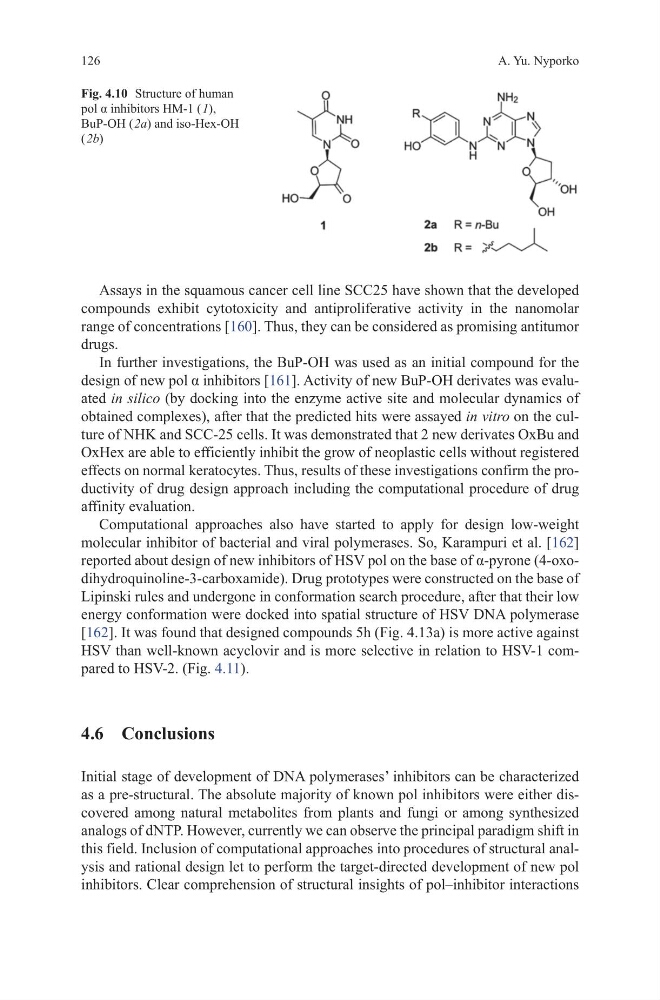
Fig. 4.10 Structure of human
pol α inhibitors HM-1 ( 1),
BuP-OH ( 2a) and iso-Hex-OH
( 2b)
A. Yu. Nyporko
Assays in the squamous cancer cell line SCC25 have shown that the developed
compounds exhibit cytotoxicity and antiproliferative activity in the nanomolar
range of concentrations [160]. Thus, they can be considered as promising antitumor
drugs.
In further investigations, the BuP-OH was used as an initial compound for the
design of new pol α inhibitors [161]. Activity of new BuP-OH derivates was evaluated in silico (by docking into the enzyme active site and molecular dynamics of
obtained complexes), after that the predicted hits were assayed in vitro on the culture of NHK and SCC-25 cells. It was demonstrated that 2 new derivates OxBu and
OxHex are able to efficiently inhibit the grow of neoplastic cells without registered
effects on normal keratocytes. Thus, results of these investigations confirm the productivity of drug design approach including the computational procedure of drug
affinity evaluation.
Computational approaches also have started to apply for design low-weight
molecular inhibitor of bacterial and viral polymerases. So, Karampuri et al. [162]
reported about design of new inhibitors of HSV pol on the base of α-pyrone (4-oxodihydroquinoline-3-carboxamide). Drug prototypes were constructed on the base of
Lipinski rules and undergone in conformation search procedure, after that their low
energy conformation were docked into spatial structure of HSV DNA polymerase
[162]. It was found that designed compounds 5h (Fig. 4.13a) is more active against
HSV than well-known acyclovir and is more selective in relation to HSV-1 compared to HSV-2. (Fig. 4.11).
4.6 Conclusions
Initial stage of development of DNA polymerases’ inhibitors can be characterized
as a pre-structural. The absolute majority of known pol inhibitors were either discovered among natural metabolites from plants and fungi or among synthesized
analogs of dNTP. However, currently we can observe the principal paradigm shift in
this field. Inclusion of computational approaches into procedures of structural analysis and rational design let to perform the target-directed development of new pol
inhibitors. Clear comprehension of structural insights of pol–inhibitor interactions
Fig. 4.10 Structure of human
pol α inhibitors HM-1 ( 1),
BuP-OH ( 2a) and iso-Hex-OH
( 2b)
A. Yu. Nyporko