

98
4.2.1 Common Peculiarities of DNA-Dependent DNA
Polymerases
The available data on the spatial organization of DNA polymerases from different
families testifies that, independently of their detailed domain structures, all polymerases, whose structures are known presently, appear to share a common overall
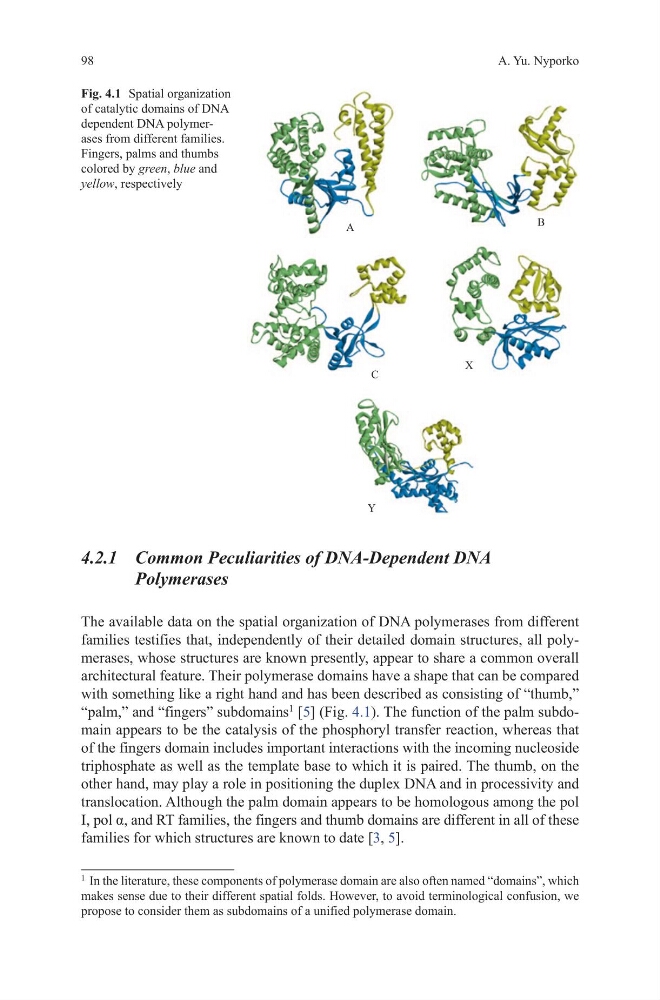
architectural feature. Their polymerase domains have a shape that can be compared
with something like a right hand and has been described as consisting of “thumb,”
“palm,” and “fingers” subdomains
1
[5] (Fig. 4.1). The function of the palm subdomain appears to be the catalysis of the phosphoryl transfer reaction, whereas that
of the fingers domain includes important interactions with the incoming nucleoside
triphosphate as well as the template base to which it is paired. The thumb, on the
other hand, may play a role in positioning the duplex DNA and in processivity and
translocation. Although the palm domain appears to be homologous among the pol
I, pol α, and RT families, the fingers and thumb domains are different in all of these
families for which structures are known to date [3, 5].
1
In the literature, these components of polymerase domain are also often named “domains”, which
makes sense due to their different spatial folds. However, to avoid terminological confusion, we
propose to consider them as subdomains of a unified polymerase domain.
A
B
C
X
Y
Fig. 4.1 Spatial organization
of catalytic domains of DNA
dependent DNA polymerases from different families.
Fingers, palms and thumbs
colored by green, blue and
yellow, respectively
A. Yu. Nyporko
4.2.1 Common Peculiarities of DNA-Dependent DNA
Polymerases
The available data on the spatial organization of DNA polymerases from different
families testifies that, independently of their detailed domain structures, all polymerases, whose structures are known presently, appear to share a common overall
architectural feature. Their polymerase domains have a shape that can be compared
with something like a right hand and has been described as consisting of “thumb,”
“palm,” and “fingers” subdomains
1
[5] (Fig. 4.1). The function of the palm subdomain appears to be the catalysis of the phosphoryl transfer reaction, whereas that
of the fingers domain includes important interactions with the incoming nucleoside
triphosphate as well as the template base to which it is paired. The thumb, on the
other hand, may play a role in positioning the duplex DNA and in processivity and
translocation. Although the palm domain appears to be homologous among the pol
I, pol α, and RT families, the fingers and thumb domains are different in all of these
families for which structures are known to date [3, 5].
1
In the literature, these components of polymerase domain are also often named “domains”, which
makes sense due to their different spatial folds. However, to avoid terminological confusion, we
propose to consider them as subdomains of a unified polymerase domain.
A
B
C
X
Y
Fig. 4.1 Spatial organization
of catalytic domains of DNA
dependent DNA polymerases from different families.
Fingers, palms and thumbs
colored by green, blue and
yellow, respectively
A. Yu. Nyporko