

99
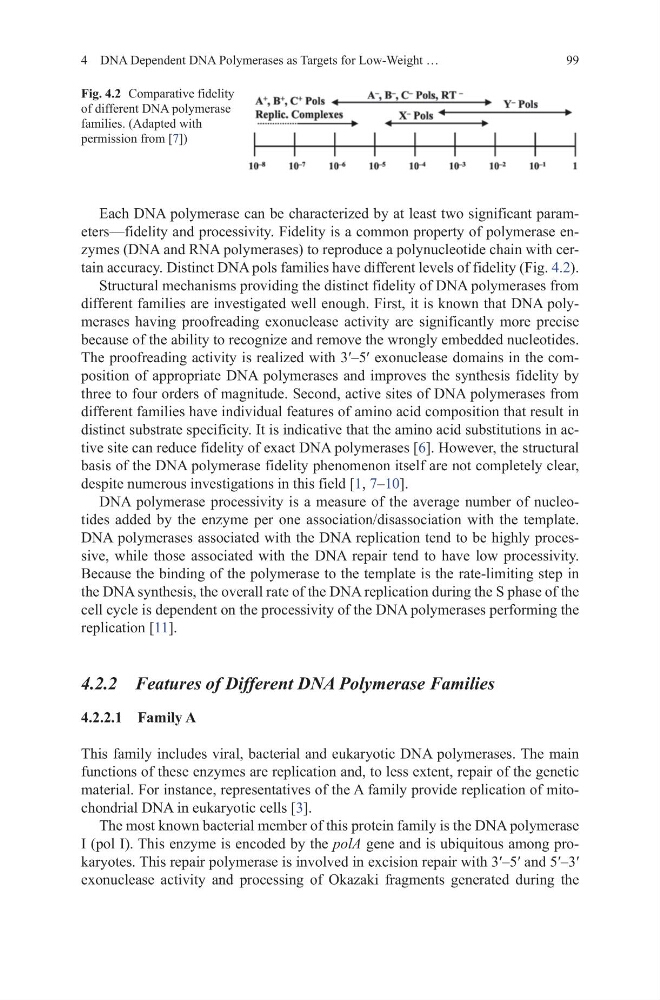
Each DNA polymerase can be characterized by at least two significant parameters—fidelity and processivity. Fidelity is a common property of polymerase enzymes (DNA and RNA polymerases) to reproduce a polynucleotide chain with certain accuracy. Distinct DNA pols families have different levels of fidelity (Fig. 4.2).
Structural mechanisms providing the distinct fidelity of DNA polymerases from
different families are investigated well enough. First, it is known that DNA polymerases having proofreading exonuclease activity are significantly more precise
because of the ability to recognize and remove the wrongly embedded nucleotides.
The proofreading activity is realized with 3′–5′ exonuclease domains in the composition of appropriate DNA polymerases and improves the synthesis fidelity by
three to four orders of magnitude. Second, active sites of DNA polymerases from
different families have individual features of amino acid composition that result in
distinct substrate specificity. It is indicative that the amino acid substitutions in active site can reduce fidelity of exact DNA polymerases [6]. However, the structural
basis of the DNA polymerase fidelity phenomenon itself are not completely clear,
despite numerous investigations in this field [1, 7–10].
DNA polymerase processivity is a measure of the average number of nucleotides added by the enzyme per one association/disassociation with the template.
DNA polymerases associated with the DNA replication tend to be highly processive, while those associated with the DNA repair tend to have low processivity.
Because the binding of the polymerase to the template is the rate-limiting step in
the DNA synthesis, the overall rate of the DNA replication during the S phase of the
cell cycle is dependent on the processivity of the DNA polymerases performing the
replication [11].
4.2.2 Features of Different DNA Polymerase Families
4.2.2.1 Family A
This family includes viral, bacterial and eukaryotic DNA polymerases. The main
functions of these enzymes are replication and, to less extent, repair of the genetic
material. For instance, representatives of the A family provide replication of mitochondrial DNA in eukaryotic cells [3].
The most known bacterial member of this protein family is the DNA polymerase
I (pol I). This enzyme is encoded by the polA gene and is ubiquitous among prokaryotes. This repair polymerase is involved in excision repair with 3′–5′ and 5′–3′
exonuclease activity and processing of Okazaki fragments generated during the
Fig. 4.2 Comparative fidelity
of different DNA polymerase
families. (Adapted with
permission from [7])
4 DNA Dependent DNA Polymerases as Targets for Low-Weight …
Each DNA polymerase can be characterized by at least two significant parameters—fidelity and processivity. Fidelity is a common property of polymerase enzymes (DNA and RNA polymerases) to reproduce a polynucleotide chain with certain accuracy. Distinct DNA pols families have different levels of fidelity (Fig. 4.2).
Structural mechanisms providing the distinct fidelity of DNA polymerases from
different families are investigated well enough. First, it is known that DNA polymerases having proofreading exonuclease activity are significantly more precise
because of the ability to recognize and remove the wrongly embedded nucleotides.
The proofreading activity is realized with 3′–5′ exonuclease domains in the composition of appropriate DNA polymerases and improves the synthesis fidelity by
three to four orders of magnitude. Second, active sites of DNA polymerases from
different families have individual features of amino acid composition that result in
distinct substrate specificity. It is indicative that the amino acid substitutions in active site can reduce fidelity of exact DNA polymerases [6]. However, the structural
basis of the DNA polymerase fidelity phenomenon itself are not completely clear,
despite numerous investigations in this field [1, 7–10].
DNA polymerase processivity is a measure of the average number of nucleotides added by the enzyme per one association/disassociation with the template.
DNA polymerases associated with the DNA replication tend to be highly processive, while those associated with the DNA repair tend to have low processivity.
Because the binding of the polymerase to the template is the rate-limiting step in
the DNA synthesis, the overall rate of the DNA replication during the S phase of the
cell cycle is dependent on the processivity of the DNA polymerases performing the
replication [11].
4.2.2 Features of Different DNA Polymerase Families
4.2.2.1 Family A
This family includes viral, bacterial and eukaryotic DNA polymerases. The main
functions of these enzymes are replication and, to less extent, repair of the genetic
material. For instance, representatives of the A family provide replication of mitochondrial DNA in eukaryotic cells [3].
The most known bacterial member of this protein family is the DNA polymerase
I (pol I). This enzyme is encoded by the polA gene and is ubiquitous among prokaryotes. This repair polymerase is involved in excision repair with 3′–5′ and 5′–3′
exonuclease activity and processing of Okazaki fragments generated during the
Fig. 4.2 Comparative fidelity
of different DNA polymerase
families. (Adapted with
permission from [7])
4 DNA Dependent DNA Polymerases as Targets for Low-Weight …