

52
4 Combinatorial Studies in the Li–Co–Mn–O System
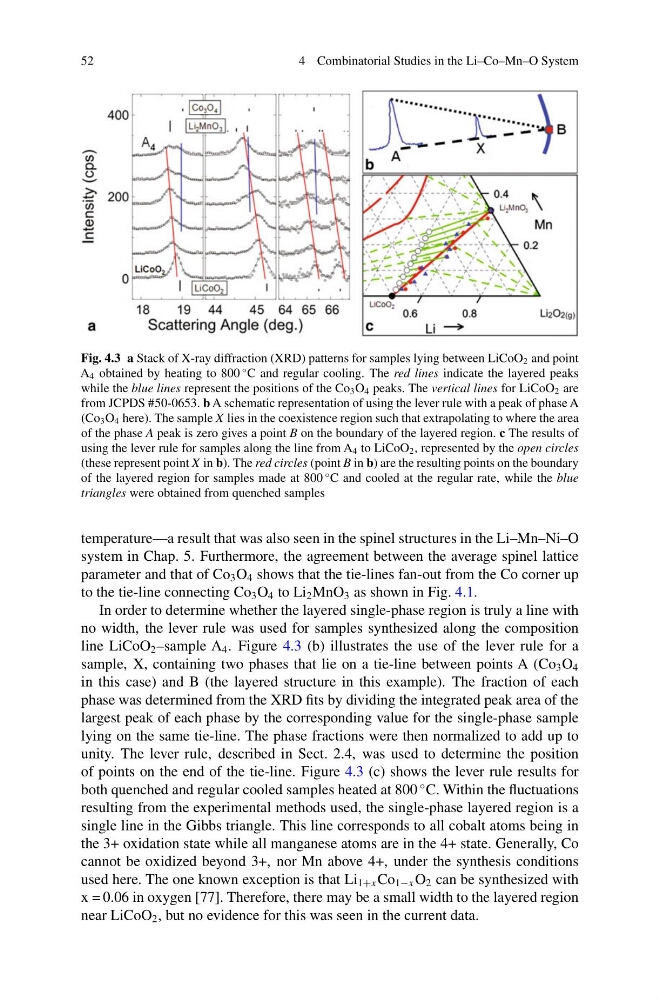
Fig. 4.3 a Stack of X-ray diffraction (XRD) patterns for samples lying between LiCoO 2 and point
A 4 obtained by heating to 800
◦ C and regular cooling. The red lines indicate the layered peaks
while the blue lines represent the positions of the Co 3 O 4 peaks. The vertical lines for LiCoO 2 are
from JCPDS #50-0653. b A schematic representation of using the lever rule with a peak of phase A
(Co 3 O 4 here). The sample X lies in the coexistence region such that extrapolating to where the area
of the phase A peak is zero gives a point B on the boundary of the layered region. c The results of
using the lever rule for samples along the line from A 4 to LiCoO 2 , represented by the open circles
(these represent point X in b). The red circles (point B in b) are the resulting points on the boundary
of the layered region for samples made at 800
◦ C and cooled at the regular rate, while the blue
triangles were obtained from quenched samples
temperature—a result that was also seen in the spinel structures in the Li–Mn–Ni–O
system in Chap. 5. Furthermore, the agreement between the average spinel lattice
parameter and that of Co 3 O 4 shows that the tie-lines fan-out from the Co corner up
to the tie-line connecting Co 3 O 4 to Li 2 MnO 3 as shown in Fig. 4.1.
In order to determine whether the layered single-phase region is truly a line with
no width, the lever rule was used for samples synthesized along the composition
line LiCoO 2 –sample A 4 . Figure 4.3 (b) illustrates the use of the lever rule for a
sample, X, containing two phases that lie on a tie-line between points A (Co 3 O 4
in this case) and B (the layered structure in this example). The fraction of each
phase was determined from the XRD fits by dividing the integrated peak area of the
largest peak of each phase by the corresponding value for the single-phase sample
lying on the same tie-line. The phase fractions were then normalized to add up to
unity. The lever rule, described in Sect. 2.4, was used to determine the position
of points on the end of the tie-line. Figure 4.3 (c) shows the lever rule results for
both quenched and regular cooled samples heated at 800
◦ C. Within the fluctuations
resulting from the experimental methods used, the single-phase layered region is a
single line in the Gibbs triangle. This line corresponds to all cobalt atoms being in
the 3+ oxidation state while all manganese atoms are in the 4+ state. Generally, Co
cannot be oxidized beyond 3+, nor Mn above 4+, under the synthesis conditions
used here. The one known exception is that Li 1+x Co 1−x O 2 can be synthesized with
x = 0.06 in oxygen [77]. Therefore, there may be a small width to the layered region
near LiCoO 2 , but no evidence for this was seen in the current data.
4 Combinatorial Studies in the Li–Co–Mn–O System
Fig. 4.3 a Stack of X-ray diffraction (XRD) patterns for samples lying between LiCoO 2 and point
A 4 obtained by heating to 800
◦ C and regular cooling. The red lines indicate the layered peaks
while the blue lines represent the positions of the Co 3 O 4 peaks. The vertical lines for LiCoO 2 are
from JCPDS #50-0653. b A schematic representation of using the lever rule with a peak of phase A
(Co 3 O 4 here). The sample X lies in the coexistence region such that extrapolating to where the area
of the phase A peak is zero gives a point B on the boundary of the layered region. c The results of
using the lever rule for samples along the line from A 4 to LiCoO 2 , represented by the open circles
(these represent point X in b). The red circles (point B in b) are the resulting points on the boundary
of the layered region for samples made at 800
◦ C and cooled at the regular rate, while the blue
triangles were obtained from quenched samples
temperature—a result that was also seen in the spinel structures in the Li–Mn–Ni–O
system in Chap. 5. Furthermore, the agreement between the average spinel lattice
parameter and that of Co 3 O 4 shows that the tie-lines fan-out from the Co corner up
to the tie-line connecting Co 3 O 4 to Li 2 MnO 3 as shown in Fig. 4.1.
In order to determine whether the layered single-phase region is truly a line with
no width, the lever rule was used for samples synthesized along the composition
line LiCoO 2 –sample A 4 . Figure 4.3 (b) illustrates the use of the lever rule for a
sample, X, containing two phases that lie on a tie-line between points A (Co 3 O 4
in this case) and B (the layered structure in this example). The fraction of each
phase was determined from the XRD fits by dividing the integrated peak area of the
largest peak of each phase by the corresponding value for the single-phase sample
lying on the same tie-line. The phase fractions were then normalized to add up to
unity. The lever rule, described in Sect. 2.4, was used to determine the position
of points on the end of the tie-line. Figure 4.3 (c) shows the lever rule results for
both quenched and regular cooled samples heated at 800
◦ C. Within the fluctuations
resulting from the experimental methods used, the single-phase layered region is a
single line in the Gibbs triangle. This line corresponds to all cobalt atoms being in
the 3+ oxidation state while all manganese atoms are in the 4+ state. Generally, Co
cannot be oxidized beyond 3+, nor Mn above 4+, under the synthesis conditions
used here. The one known exception is that Li 1+x Co 1−x O 2 can be synthesized with
x = 0.06 in oxygen [77]. Therefore, there may be a small width to the layered region
near LiCoO 2 , but no evidence for this was seen in the current data.