

3.3 X-Ray Diffraction (XRD) Results of Lithium Loss
45
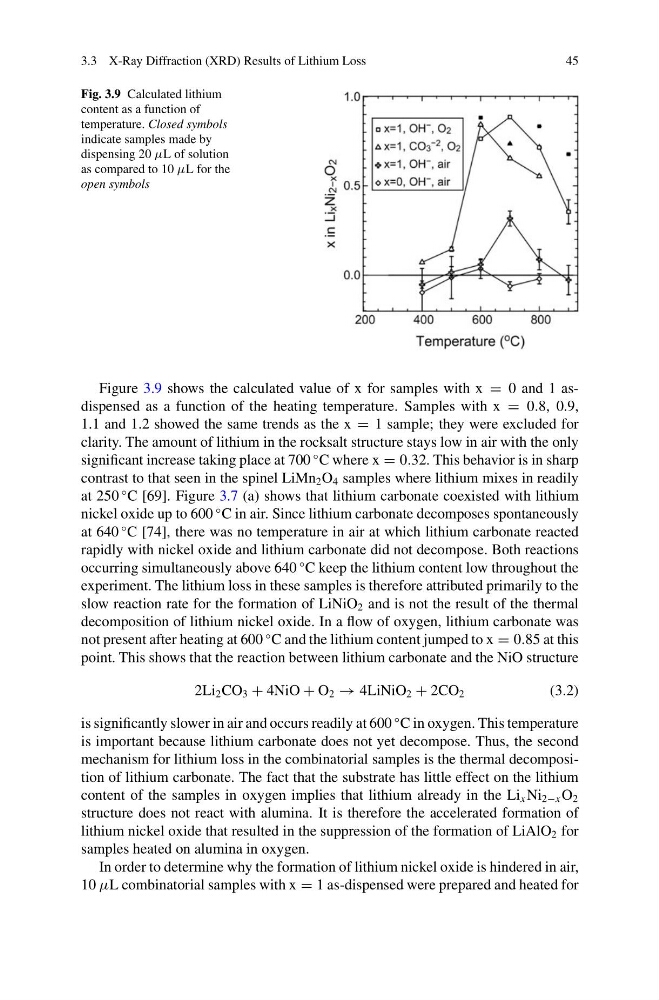
Fig. 3.9 Calculated lithium
content as a function of
temperature. Closed symbols
indicate samples made by
dispensing 20 μL of solution
as compared to 10 μL for the
open symbols
Figure 3.9 shows the calculated value of x for samples with x = 0 and 1 asdispensed as a function of the heating temperature. Samples with x = 0.8, 0.9,
1.1 and 1.2 showed the same trends as the x = 1 sample; they were excluded for
clarity. The amount of lithium in the rocksalt structure stays low in air with the only
significant increase taking place at 700
◦ C where x = 0.32. This behavior is in sharp
contrast to that seen in the spinel LiMn 2 O 4 samples where lithium mixes in readily
at 250
◦ C [69]. Figure 3.7 (a) shows that lithium carbonate coexisted with lithium
nickel oxide up to 600
◦ C in air. Since lithium carbonate decomposes spontaneously
at 640
◦ C [74], there was no temperature in air at which lithium carbonate reacted
rapidly with nickel oxide and lithium carbonate did not decompose. Both reactions
occurring simultaneously above 640
◦ C keep the lithium content low throughout the
experiment. The lithium loss in these samples is therefore attributed primarily to the
slow reaction rate for the formation of LiNiO 2 and is not the result of the thermal
decomposition of lithium nickel oxide. In a flow of oxygen, lithium carbonate was
not present after heating at 600
◦ C and the lithium content jumped to x = 0.85 at this
point. This shows that the reaction between lithium carbonate and the NiO structure
2Li 2 CO 3 + 4NiO + O 2 → 4LiNiO 2 + 2CO 2
(3.2)
is significantly slower in air and occurs readily at 600
◦ C in oxygen. This temperature
is important because lithium carbonate does not yet decompose. Thus, the second
mechanism for lithium loss in the combinatorial samples is the thermal decomposition of lithium carbonate. The fact that the substrate has little effect on the lithium
content of the samples in oxygen implies that lithium already in the Li x Ni 2−x O 2
structure does not react with alumina. It is therefore the accelerated formation of
lithium nickel oxide that resulted in the suppression of the formation of LiAlO 2 for
samples heated on alumina in oxygen.
In order to determine why the formation of lithium nickel oxide is hindered in air,
10 μL combinatorial samples with x = 1 as-dispensed were prepared and heated for
45
Fig. 3.9 Calculated lithium
content as a function of
temperature. Closed symbols
indicate samples made by
dispensing 20 μL of solution
as compared to 10 μL for the
open symbols
Figure 3.9 shows the calculated value of x for samples with x = 0 and 1 asdispensed as a function of the heating temperature. Samples with x = 0.8, 0.9,
1.1 and 1.2 showed the same trends as the x = 1 sample; they were excluded for
clarity. The amount of lithium in the rocksalt structure stays low in air with the only
significant increase taking place at 700
◦ C where x = 0.32. This behavior is in sharp
contrast to that seen in the spinel LiMn 2 O 4 samples where lithium mixes in readily
at 250
◦ C [69]. Figure 3.7 (a) shows that lithium carbonate coexisted with lithium
nickel oxide up to 600
◦ C in air. Since lithium carbonate decomposes spontaneously
at 640
◦ C [74], there was no temperature in air at which lithium carbonate reacted
rapidly with nickel oxide and lithium carbonate did not decompose. Both reactions
occurring simultaneously above 640
◦ C keep the lithium content low throughout the
experiment. The lithium loss in these samples is therefore attributed primarily to the
slow reaction rate for the formation of LiNiO 2 and is not the result of the thermal
decomposition of lithium nickel oxide. In a flow of oxygen, lithium carbonate was
not present after heating at 600
◦ C and the lithium content jumped to x = 0.85 at this
point. This shows that the reaction between lithium carbonate and the NiO structure
2Li 2 CO 3 + 4NiO + O 2 → 4LiNiO 2 + 2CO 2
(3.2)
is significantly slower in air and occurs readily at 600
◦ C in oxygen. This temperature
is important because lithium carbonate does not yet decompose. Thus, the second
mechanism for lithium loss in the combinatorial samples is the thermal decomposition of lithium carbonate. The fact that the substrate has little effect on the lithium
content of the samples in oxygen implies that lithium already in the Li x Ni 2−x O 2
structure does not react with alumina. It is therefore the accelerated formation of
lithium nickel oxide that resulted in the suppression of the formation of LiAlO 2 for
samples heated on alumina in oxygen.
In order to determine why the formation of lithium nickel oxide is hindered in air,
10 μL combinatorial samples with x = 1 as-dispensed were prepared and heated for