

46
3 Optimization of the Synthesis of Combinatorial Samples
Table 3.2 Average Li 2 CO 3 crystallite size and microstrain. Values were stable over the heating
temperature range in which lithium carbonate is present. The uncertainty is half the range in the
values
Precipitator
Atmosphere
Size (nm)
Strain (10
−3 )
Temperature (
◦ C)
OH
−
Air
22 ± 1
0.14 ± 0.04
300, 400, 500, 600
CO
2−
3
Air
51 ± 4
0.30 ± 0.01
400 (2 samples)
CO
2−
3
O 2
13 ± 4
0.0
a
300, 400, 500
a The fitting software converged to a strain of 0 which indicates that the machine broadening
dominated
3 h at 600
◦ C. Three were heated in a tube furnace in a flow of 5.5 % O 2 , 94.5 % N 2 ,
and XRD showed that the lithium content in these samples was x = 0.91 ± 0.03.
When pure oxygen was used, the result was x = 0.95 ± 0.01, such that the amount
of oxygen played a small role here implying that there must have been constituents
other than oxygen and nitrogen that primarily hindered the synthesis of LiNiO 2 when
heated in air. Other samples were heated in a tube furnace without the caps on the
ends of the tube thereby allowing the escape of carbon dioxide produced during the
decomposition of the stearic acid. The XRD scans of these samples showed that
lithium carbonate was still present and the lithium content in the lithium nickel oxide
structures was x = 0.68 ± 0.02. In a closed box furnace, the result was x = 0.59 ±
0.02 and lithium carbonate was also evident in the scans. This shows that the presence
of carbon dioxide slowed down the reaction between lithium carbonate and nickel
oxide as one would expect since it is a product of the synthesis. However, venting
the excess carbon dioxide had a relatively small effect on the lithium content of the
samples, suggesting that another gas such as water vapor may also play a role here.
Samples made with double the volume of solution (solid symbols in Fig. 3.9) have
higher lithium content after heating, with this effect being more pronounced at higher
temperatures. These observations reinforce how sensitive these samples were to surface area. Larger dispense volumes do provide other means to reduce the lithium loss,
but 20 μL is the practical limit for samples made with the solution-dispensing robot.
Another means of reducing the lithium loss was found by first heating the samples
to 600
◦ C before heating to the desired temperature. To illustrate this, 20 μL samples
of the x = 1.2 as-dispensed compositions were prepared by heating at 850
◦ C for 3 h
in oxygen. The resulting XRD scan showed x = 0.83, while repeating the process
with the addition of a 3 h heating step at 600
◦ C before heating to 850
◦ C gave a lithium
content of 0.88. Though this effect may be diminished at 800
◦ C, there should still be
some benefit to heating at 600
◦ C in order to ensure that as much lithium as possible
enters the nickel oxide structure at a temperature where the thermal decomposition
reaction is slow and lithium carbonate does not decompose.
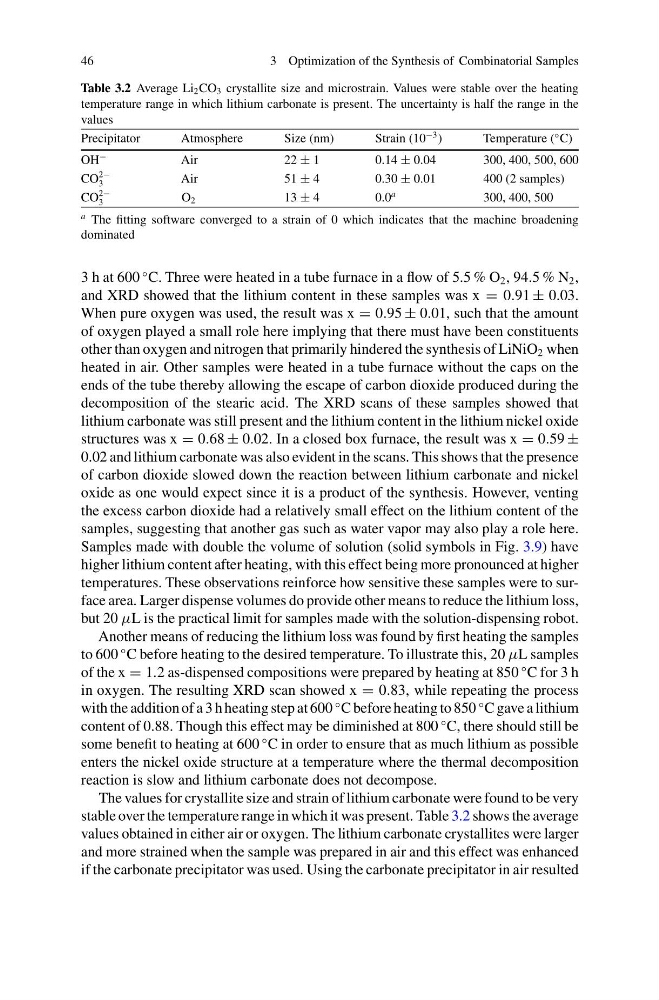
The values for crystallite size and strain of lithium carbonate were found to be very
stable over the temperature range in which it was present. Table 3.2 shows the average
values obtained in either air or oxygen. The lithium carbonate crystallites were larger
and more strained when the sample was prepared in air and this effect was enhanced
if the carbonate precipitator was used. Using the carbonate precipitator in air resulted
3 Optimization of the Synthesis of Combinatorial Samples
Table 3.2 Average Li 2 CO 3 crystallite size and microstrain. Values were stable over the heating
temperature range in which lithium carbonate is present. The uncertainty is half the range in the
values
Precipitator
Atmosphere
Size (nm)
Strain (10
−3 )
Temperature (
◦ C)
OH
−
Air
22 ± 1
0.14 ± 0.04
300, 400, 500, 600
CO
2−
3
Air
51 ± 4
0.30 ± 0.01
400 (2 samples)
CO
2−
3
O 2
13 ± 4
0.0
a
300, 400, 500
a The fitting software converged to a strain of 0 which indicates that the machine broadening
dominated
3 h at 600
◦ C. Three were heated in a tube furnace in a flow of 5.5 % O 2 , 94.5 % N 2 ,
and XRD showed that the lithium content in these samples was x = 0.91 ± 0.03.
When pure oxygen was used, the result was x = 0.95 ± 0.01, such that the amount
of oxygen played a small role here implying that there must have been constituents
other than oxygen and nitrogen that primarily hindered the synthesis of LiNiO 2 when
heated in air. Other samples were heated in a tube furnace without the caps on the
ends of the tube thereby allowing the escape of carbon dioxide produced during the
decomposition of the stearic acid. The XRD scans of these samples showed that
lithium carbonate was still present and the lithium content in the lithium nickel oxide
structures was x = 0.68 ± 0.02. In a closed box furnace, the result was x = 0.59 ±
0.02 and lithium carbonate was also evident in the scans. This shows that the presence
of carbon dioxide slowed down the reaction between lithium carbonate and nickel
oxide as one would expect since it is a product of the synthesis. However, venting
the excess carbon dioxide had a relatively small effect on the lithium content of the
samples, suggesting that another gas such as water vapor may also play a role here.
Samples made with double the volume of solution (solid symbols in Fig. 3.9) have
higher lithium content after heating, with this effect being more pronounced at higher
temperatures. These observations reinforce how sensitive these samples were to surface area. Larger dispense volumes do provide other means to reduce the lithium loss,
but 20 μL is the practical limit for samples made with the solution-dispensing robot.
Another means of reducing the lithium loss was found by first heating the samples
to 600
◦ C before heating to the desired temperature. To illustrate this, 20 μL samples
of the x = 1.2 as-dispensed compositions were prepared by heating at 850
◦ C for 3 h
in oxygen. The resulting XRD scan showed x = 0.83, while repeating the process
with the addition of a 3 h heating step at 600
◦ C before heating to 850
◦ C gave a lithium
content of 0.88. Though this effect may be diminished at 800
◦ C, there should still be
some benefit to heating at 600
◦ C in order to ensure that as much lithium as possible
enters the nickel oxide structure at a temperature where the thermal decomposition
reaction is slow and lithium carbonate does not decompose.
The values for crystallite size and strain of lithium carbonate were found to be very
stable over the temperature range in which it was present. Table 3.2 shows the average
values obtained in either air or oxygen. The lithium carbonate crystallites were larger
and more strained when the sample was prepared in air and this effect was enhanced
if the carbonate precipitator was used. Using the carbonate precipitator in air resulted