

3.3 X-Ray Diffraction (XRD) Results of Lithium Loss
41
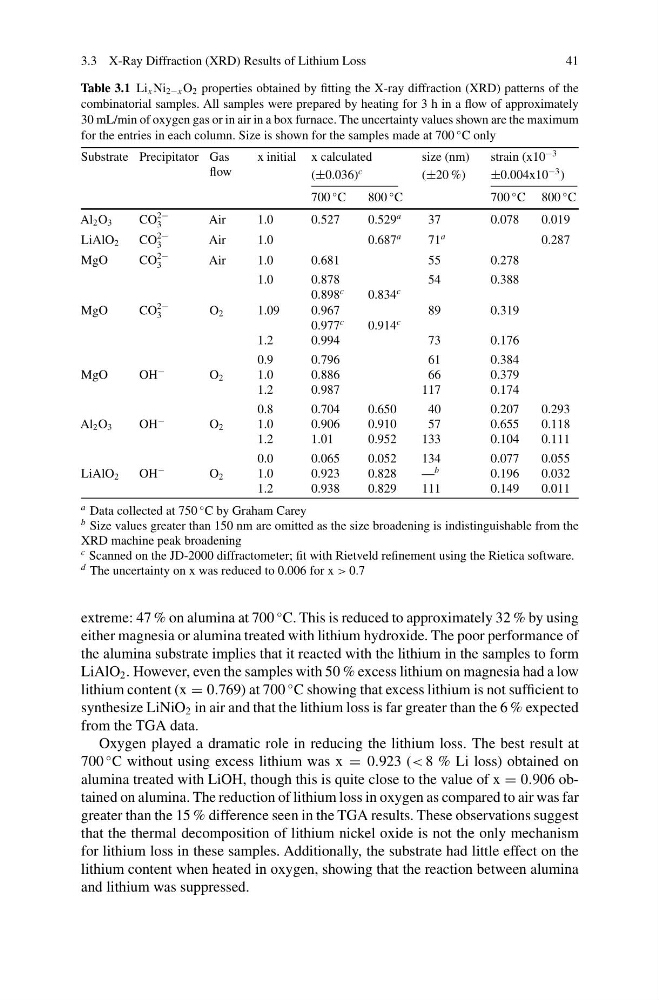
Table 3.1 Li x Ni 2−x O 2 properties obtained by fitting the X-ray diffraction (XRD) patterns of the
combinatorial samples. All samples were prepared by heating for 3 h in a flow of approximately
30 mL/min of oxygen gas or in air in a box furnace. The uncertainty values shown are the maximum
for the entries in each column. Size is shown for the samples made at 700
◦ C only
Substrate Precipitator Gas
flow
x initial x calculated
size (nm)
strain (x10
−3
(±0.036)
c
(±20 %)
±0.004x10
−3 )
700
◦ C
800
◦ C
700
◦ C 800
◦ C
Al 2 O 3
CO
2−
3
Air
1.0
0.527
0.529
a
37
0.078
0.019
LiAlO 2
CO
2−
3
Air
1.0
0.687
a
71
a
0.287
MgO
CO
2−
3
Air
1.0
0.681
55
0.278
1.0
0.878
54
0.388
0.898
c
0.834
c
MgO
CO
2−
3
O 2
1.09
0.967
89
0.319
0.977
c
0.914
c
1.2
0.994
73
0.176
0.9
0.796
61
0.384
MgO
OH
−
O 2
1.0
0.886
66
0.379
1.2
0.987
117
0.174
0.8
0.704
0.650
40
0.207
0.293
Al 2 O 3
OH
−
O 2
1.0
0.906
0.910
57
0.655
0.118
1.2
1.01
0.952
133
0.104
0.111
0.0
0.065
0.052
134
0.077
0.055
LiAlO 2
OH
−
O 2
1.0
0.923
0.828
—
b
0.196
0.032
1.2
0.938
0.829
111
0.149
0.011
a Data collected at 750
◦ C by Graham Carey
b Size values greater than 150 nm are omitted as the size broadening is indistinguishable from the
XRD machine peak broadening
c Scanned on the JD-2000 diffractometer; fit with Rietveld refinement using the Rietica software.
d The uncertainty on x was reduced to 0.006 for x > 0.7
extreme: 47 % on alumina at 700
◦ C. This is reduced to approximately 32 % by using
either magnesia or alumina treated with lithium hydroxide. The poor performance of
the alumina substrate implies that it reacted with the lithium in the samples to form
LiAlO 2 . However, even the samples with 50 % excess lithium on magnesia had a low
lithium content (x = 0.769) at 700
◦ C showing that excess lithium is not sufficient to
synthesize LiNiO 2 in air and that the lithium loss is far greater than the 6 % expected
from the TGA data.
Oxygen played a dramatic role in reducing the lithium loss. The best result at
700
◦ C without using excess lithium was x = 0.923 (< 8 % Li loss) obtained on
alumina treated with LiOH, though this is quite close to the value of x = 0.906 obtained on alumina. The reduction of lithium loss in oxygen as compared to air was far
greater than the 15 % difference seen in the TGA results. These observations suggest
that the thermal decomposition of lithium nickel oxide is not the only mechanism
for lithium loss in these samples. Additionally, the substrate had little effect on the
lithium content when heated in oxygen, showing that the reaction between alumina
and lithium was suppressed.
41
Table 3.1 Li x Ni 2−x O 2 properties obtained by fitting the X-ray diffraction (XRD) patterns of the
combinatorial samples. All samples were prepared by heating for 3 h in a flow of approximately
30 mL/min of oxygen gas or in air in a box furnace. The uncertainty values shown are the maximum
for the entries in each column. Size is shown for the samples made at 700
◦ C only
Substrate Precipitator Gas
flow
x initial x calculated
size (nm)
strain (x10
−3
(±0.036)
c
(±20 %)
±0.004x10
−3 )
700
◦ C
800
◦ C
700
◦ C 800
◦ C
Al 2 O 3
CO
2−
3
Air
1.0
0.527
0.529
a
37
0.078
0.019
LiAlO 2
CO
2−
3
Air
1.0
0.687
a
71
a
0.287
MgO
CO
2−
3
Air
1.0
0.681
55
0.278
1.0
0.878
54
0.388
0.898
c
0.834
c
MgO
CO
2−
3
O 2
1.09
0.967
89
0.319
0.977
c
0.914
c
1.2
0.994
73
0.176
0.9
0.796
61
0.384
MgO
OH
−
O 2
1.0
0.886
66
0.379
1.2
0.987
117
0.174
0.8
0.704
0.650
40
0.207
0.293
Al 2 O 3
OH
−
O 2
1.0
0.906
0.910
57
0.655
0.118
1.2
1.01
0.952
133
0.104
0.111
0.0
0.065
0.052
134
0.077
0.055
LiAlO 2
OH
−
O 2
1.0
0.923
0.828
—
b
0.196
0.032
1.2
0.938
0.829
111
0.149
0.011
a Data collected at 750
◦ C by Graham Carey
b Size values greater than 150 nm are omitted as the size broadening is indistinguishable from the
XRD machine peak broadening
c Scanned on the JD-2000 diffractometer; fit with Rietveld refinement using the Rietica software.
d The uncertainty on x was reduced to 0.006 for x > 0.7
extreme: 47 % on alumina at 700
◦ C. This is reduced to approximately 32 % by using
either magnesia or alumina treated with lithium hydroxide. The poor performance of
the alumina substrate implies that it reacted with the lithium in the samples to form
LiAlO 2 . However, even the samples with 50 % excess lithium on magnesia had a low
lithium content (x = 0.769) at 700
◦ C showing that excess lithium is not sufficient to
synthesize LiNiO 2 in air and that the lithium loss is far greater than the 6 % expected
from the TGA data.
Oxygen played a dramatic role in reducing the lithium loss. The best result at
700
◦ C without using excess lithium was x = 0.923 (< 8 % Li loss) obtained on
alumina treated with LiOH, though this is quite close to the value of x = 0.906 obtained on alumina. The reduction of lithium loss in oxygen as compared to air was far
greater than the 15 % difference seen in the TGA results. These observations suggest
that the thermal decomposition of lithium nickel oxide is not the only mechanism
for lithium loss in these samples. Additionally, the substrate had little effect on the
lithium content when heated in oxygen, showing that the reaction between alumina
and lithium was suppressed.