

2.12 Monte Carlo Simulations
33
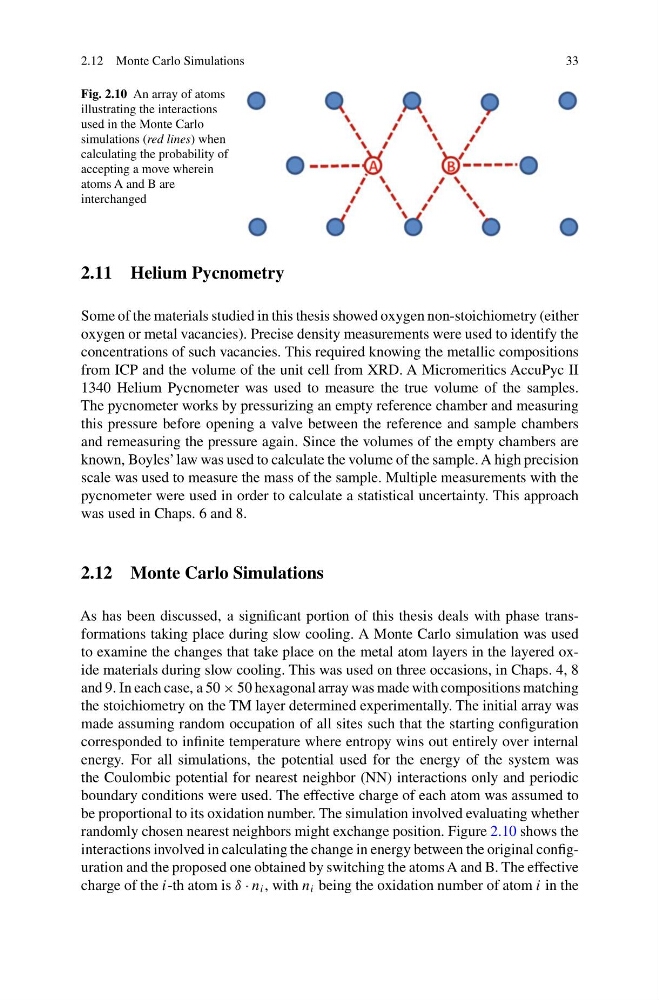
Fig. 2.10 An array of atoms
illustrating the interactions
used in the Monte Carlo
simulations (red lines) when
calculating the probability of
accepting a move wherein
atoms A and B are
interchanged
2.11 Helium Pycnometry
Some of the materials studied in this thesis showed oxygen non-stoichiometry (either
oxygen or metal vacancies). Precise density measurements were used to identify the
concentrations of such vacancies. This required knowing the metallic compositions
from ICP and the volume of the unit cell from XRD. A Micromeritics AccuPyc II
1340 Helium Pycnometer was used to measure the true volume of the samples.
The pycnometer works by pressurizing an empty reference chamber and measuring
this pressure before opening a valve between the reference and sample chambers
and remeasuring the pressure again. Since the volumes of the empty chambers are
known, Boyles’ law was used to calculate the volume of the sample. A high precision
scale was used to measure the mass of the sample. Multiple measurements with the
pycnometer were used in order to calculate a statistical uncertainty. This approach
was used in Chaps. 6 and 8.
2.12 Monte Carlo Simulations
As has been discussed, a significant portion of this thesis deals with phase transformations taking place during slow cooling. A Monte Carlo simulation was used
to examine the changes that take place on the metal atom layers in the layered oxide materials during slow cooling. This was used on three occasions, in Chaps. 4, 8
and 9. In each case, a 50 × 50 hexagonal array was made with compositions matching
the stoichiometry on the TM layer determined experimentally. The initial array was
made assuming random occupation of all sites such that the starting configuration
corresponded to infinite temperature where entropy wins out entirely over internal
energy. For all simulations, the potential used for the energy of the system was
the Coulombic potential for nearest neighbor (NN) interactions only and periodic
boundary conditions were used. The effective charge of each atom was assumed to
be proportional to its oxidation number. The simulation involved evaluating whether
randomly chosen nearest neighbors might exchange position. Figure 2.10 shows the
interactions involved in calculating the change in energy between the original configuration and the proposed one obtained by switching the atoms A and B. The effective
charge of the i-th atom is δ · n i , with n i being the oxidation number of atom i in the
33
Fig. 2.10 An array of atoms
illustrating the interactions
used in the Monte Carlo
simulations (red lines) when
calculating the probability of
accepting a move wherein
atoms A and B are
interchanged
2.11 Helium Pycnometry
Some of the materials studied in this thesis showed oxygen non-stoichiometry (either
oxygen or metal vacancies). Precise density measurements were used to identify the
concentrations of such vacancies. This required knowing the metallic compositions
from ICP and the volume of the unit cell from XRD. A Micromeritics AccuPyc II
1340 Helium Pycnometer was used to measure the true volume of the samples.
The pycnometer works by pressurizing an empty reference chamber and measuring
this pressure before opening a valve between the reference and sample chambers
and remeasuring the pressure again. Since the volumes of the empty chambers are
known, Boyles’ law was used to calculate the volume of the sample. A high precision
scale was used to measure the mass of the sample. Multiple measurements with the
pycnometer were used in order to calculate a statistical uncertainty. This approach
was used in Chaps. 6 and 8.
2.12 Monte Carlo Simulations
As has been discussed, a significant portion of this thesis deals with phase transformations taking place during slow cooling. A Monte Carlo simulation was used
to examine the changes that take place on the metal atom layers in the layered oxide materials during slow cooling. This was used on three occasions, in Chaps. 4, 8
and 9. In each case, a 50 × 50 hexagonal array was made with compositions matching
the stoichiometry on the TM layer determined experimentally. The initial array was
made assuming random occupation of all sites such that the starting configuration
corresponded to infinite temperature where entropy wins out entirely over internal
energy. For all simulations, the potential used for the energy of the system was
the Coulombic potential for nearest neighbor (NN) interactions only and periodic
boundary conditions were used. The effective charge of each atom was assumed to
be proportional to its oxidation number. The simulation involved evaluating whether
randomly chosen nearest neighbors might exchange position. Figure 2.10 shows the
interactions involved in calculating the change in energy between the original configuration and the proposed one obtained by switching the atoms A and B. The effective
charge of the i-th atom is δ · n i , with n i being the oxidation number of atom i in the