

34
2 Experimental and Theoretical Considerations
original structure and n
i that of the atom in the structure after the proposed change.
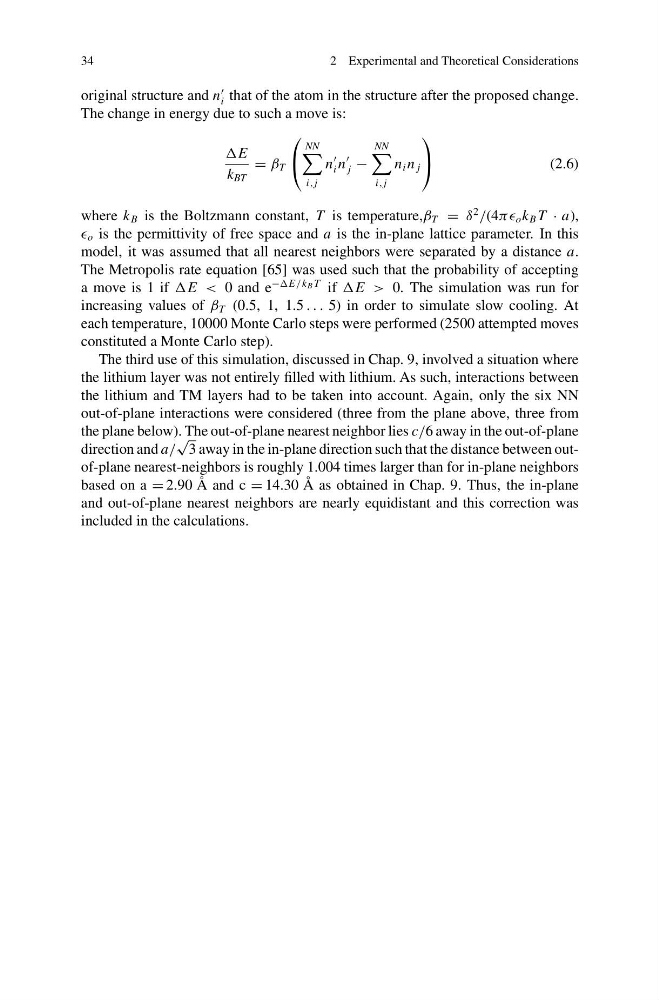
The change in energy due to such a move is:
E
k BT
= β T
⎛
⎝
NN
i,j
n
i n
j −
NN
i,j
n i n j
⎞
⎠
(2.6)
where k B is the Boltzmann constant, T is temperature,β T = δ
2 /(4ππ o k B T · a),
o is the permittivity of free space and a is the in-plane lattice parameter. In this
model, it was assumed that all nearest neighbors were separated by a distance a.
The Metropolis rate equation [65] was used such that the probability of accepting
a move is 1 if < 0 and e
− B T if > 0. The simulation was run for
increasing values of β T (0.5, 1, 1.5 . . . 5) in order to simulate slow cooling. At
each temperature, 10000 Monte Carlo steps were performed (2500 attempted moves
constituted a Monte Carlo step).
The third use of this simulation, discussed in Chap. 9, involved a situation where
the lithium layer was not entirely filled with lithium. As such, interactions between
the lithium and TM layers had to be taken into account. Again, only the six NN
out-of-plane interactions were considered (three from the plane above, three from
the plane below). The out-of-plane nearest neighbor lies c/6 away in the out-of-plane
direction and a/
√
3 away in the in-plane direction such that the distance between outof-plane nearest-neighbors is roughly 1.004 times larger than for in-plane neighbors
based on a = 2.90 Å and c = 14.30 Å as obtained in Chap. 9. Thus, the in-plane
and out-of-plane nearest neighbors are nearly equidistant and this correction was
included in the calculations.
2 Experimental and Theoretical Considerations
original structure and n
i that of the atom in the structure after the proposed change.
The change in energy due to such a move is:
E
k BT
= β T
⎛
⎝
NN
i,j
n
i n
j −
NN
i,j
n i n j
⎞
⎠
(2.6)
where k B is the Boltzmann constant, T is temperature,β T = δ
2 /(4ππ o k B T · a),
o is the permittivity of free space and a is the in-plane lattice parameter. In this
model, it was assumed that all nearest neighbors were separated by a distance a.
The Metropolis rate equation [65] was used such that the probability of accepting
a move is 1 if < 0 and e
− B T if > 0. The simulation was run for
increasing values of β T (0.5, 1, 1.5 . . . 5) in order to simulate slow cooling. At
each temperature, 10000 Monte Carlo steps were performed (2500 attempted moves
constituted a Monte Carlo step).
The third use of this simulation, discussed in Chap. 9, involved a situation where
the lithium layer was not entirely filled with lithium. As such, interactions between
the lithium and TM layers had to be taken into account. Again, only the six NN
out-of-plane interactions were considered (three from the plane above, three from
the plane below). The out-of-plane nearest neighbor lies c/6 away in the out-of-plane
direction and a/
√
3 away in the in-plane direction such that the distance between outof-plane nearest-neighbors is roughly 1.004 times larger than for in-plane neighbors
based on a = 2.90 Å and c = 14.30 Å as obtained in Chap. 9. Thus, the in-plane
and out-of-plane nearest neighbors are nearly equidistant and this correction was
included in the calculations.