

1.2 Layered and Spinel Structures
3
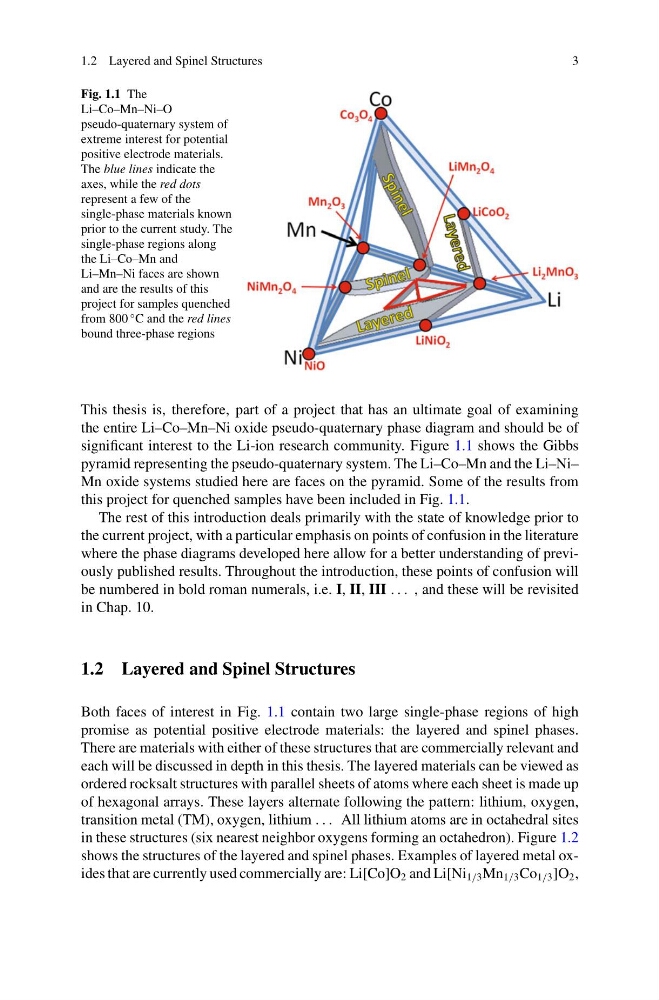
Fig. 1.1 The
Li–Co–Mn–Ni–O
pseudo-quaternary system of
extreme interest for potential
positive electrode materials.
The blue lines indicate the
axes, while the red dots
represent a few of the
single-phase materials known
prior to the current study. The
single-phase regions along
the Li–Co–Mn and
Li–Mn–Ni faces are shown
and are the results of this
project for samples quenched
from 800
◦ C and the red lines
bound three-phase regions
This thesis is, therefore, part of a project that has an ultimate goal of examining
the entire Li–Co–Mn–Ni oxide pseudo-quaternary phase diagram and should be of
significant interest to the Li-ion research community. Figure 1.1 shows the Gibbs
pyramid representing the pseudo-quaternary system. The Li–Co–Mn and the Li–Ni–
Mn oxide systems studied here are faces on the pyramid. Some of the results from
this project for quenched samples have been included in Fig. 1.1.
The rest of this introduction deals primarily with the state of knowledge prior to
the current project, with a particular emphasis on points of confusion in the literature
where the phase diagrams developed here allow for a better understanding of previously published results. Throughout the introduction, these points of confusion will
be numbered in bold roman numerals, i.e. I, II, III . . . , and these will be revisited
in Chap. 10.
1.2 Layered and Spinel Structures
Both faces of interest in Fig. 1.1 contain two large single-phase regions of high
promise as potential positive electrode materials: the layered and spinel phases.
There are materials with either of these structures that are commercially relevant and
each will be discussed in depth in this thesis. The layered materials can be viewed as
ordered rocksalt structures with parallel sheets of atoms where each sheet is made up
of hexagonal arrays. These layers alternate following the pattern: lithium, oxygen,
transition metal (TM), oxygen, lithium . . . All lithium atoms are in octahedral sites
in these structures (six nearest neighbor oxygens forming an octahedron). Figure 1.2
shows the structures of the layered and spinel phases. Examples of layered metal oxides that are currently used commercially are: Li[Co]O 2 and Li[Ni 1/3 Mn 1/3 Co 1/3 ]O 2 ,
3
Fig. 1.1 The
Li–Co–Mn–Ni–O
pseudo-quaternary system of
extreme interest for potential
positive electrode materials.
The blue lines indicate the
axes, while the red dots
represent a few of the
single-phase materials known
prior to the current study. The
single-phase regions along
the Li–Co–Mn and
Li–Mn–Ni faces are shown
and are the results of this
project for samples quenched
from 800
◦ C and the red lines
bound three-phase regions
This thesis is, therefore, part of a project that has an ultimate goal of examining
the entire Li–Co–Mn–Ni oxide pseudo-quaternary phase diagram and should be of
significant interest to the Li-ion research community. Figure 1.1 shows the Gibbs
pyramid representing the pseudo-quaternary system. The Li–Co–Mn and the Li–Ni–
Mn oxide systems studied here are faces on the pyramid. Some of the results from
this project for quenched samples have been included in Fig. 1.1.
The rest of this introduction deals primarily with the state of knowledge prior to
the current project, with a particular emphasis on points of confusion in the literature
where the phase diagrams developed here allow for a better understanding of previously published results. Throughout the introduction, these points of confusion will
be numbered in bold roman numerals, i.e. I, II, III . . . , and these will be revisited
in Chap. 10.
1.2 Layered and Spinel Structures
Both faces of interest in Fig. 1.1 contain two large single-phase regions of high
promise as potential positive electrode materials: the layered and spinel phases.
There are materials with either of these structures that are commercially relevant and
each will be discussed in depth in this thesis. The layered materials can be viewed as
ordered rocksalt structures with parallel sheets of atoms where each sheet is made up
of hexagonal arrays. These layers alternate following the pattern: lithium, oxygen,
transition metal (TM), oxygen, lithium . . . All lithium atoms are in octahedral sites
in these structures (six nearest neighbor oxygens forming an octahedron). Figure 1.2
shows the structures of the layered and spinel phases. Examples of layered metal oxides that are currently used commercially are: Li[Co]O 2 and Li[Ni 1/3 Mn 1/3 Co 1/3 ]O 2 ,