

2
1 Introduction
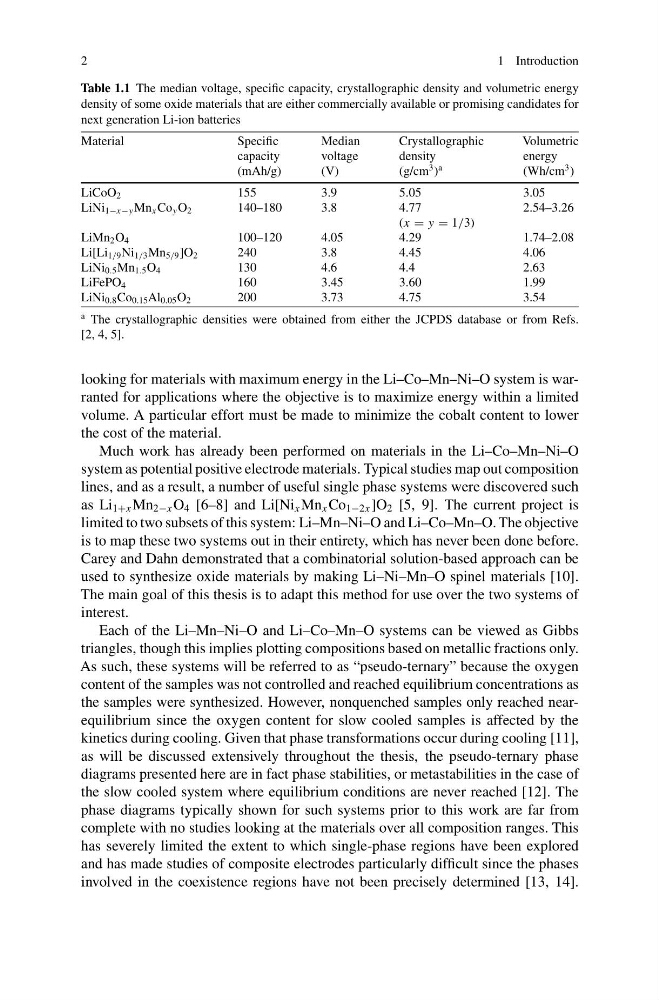
Table 1.1 The median voltage, specific capacity, crystallographic density and volumetric energy
density of some oxide materials that are either commercially available or promising candidates for
next generation Li-ion batteries
Material
Specific
Median
Crystallographic
Volumetric
capacity
voltage
density
energy
(mAh/g)
(V)
(g/cm
3 )
a
(Wh/cm
3 )
LiCoO 2
155
3.9
5.05
3.05
LiNi 1−x−y Mn x Co y O 2
140–180
3.8
4.77
2.54–3.26
(x = y = 1/3)
LiMn 2 O 4
100–120
4.05
4.29
1.74–2.08
Li[Li 1/9 Ni 1/3 Mn 5/9 ]O 2
240
3.8
4.45
4.06
LiNi 0.5 Mn 1.5 O 4
130
4.6
4.4
2.63
LiFePO 4
160
3.45
3.60
1.99
LiNi 0.8 Co 0.15 Al 0.05 O 2
200
3.73
4.75
3.54
a The crystallographic densities were obtained from either the JCPDS database or from Refs.
[2, 4, 5].
looking for materials with maximum energy in the Li–Co–Mn–Ni–O system is warranted for applications where the objective is to maximize energy within a limited
volume. A particular effort must be made to minimize the cobalt content to lower
the cost of the material.
Much work has already been performed on materials in the Li–Co–Mn–Ni–O
system as potential positive electrode materials. Typical studies map out composition
lines, and as a result, a number of useful single phase systems were discovered such
as Li 1+x Mn 2−x O 4 [6–8] and Li[Ni x Mn x Co 1−2x ]O 2 [5, 9]. The current project is
limited to two subsets of this system: Li–Mn–Ni–O and Li–Co–Mn–O. The objective
is to map these two systems out in their entirety, which has never been done before.
Carey and Dahn demonstrated that a combinatorial solution-based approach can be
used to synthesize oxide materials by making Li–Ni–Mn–O spinel materials [10].
The main goal of this thesis is to adapt this method for use over the two systems of
interest.
Each of the Li–Mn–Ni–O and Li–Co–Mn–O systems can be viewed as Gibbs
triangles, though this implies plotting compositions based on metallic fractions only.
As such, these systems will be referred to as “pseudo-ternary” because the oxygen
content of the samples was not controlled and reached equilibrium concentrations as
the samples were synthesized. However, nonquenched samples only reached nearequilibrium since the oxygen content for slow cooled samples is affected by the
kinetics during cooling. Given that phase transformations occur during cooling [11],
as will be discussed extensively throughout the thesis, the pseudo-ternary phase
diagrams presented here are in fact phase stabilities, or metastabilities in the case of
the slow cooled system where equilibrium conditions are never reached [12]. The
phase diagrams typically shown for such systems prior to this work are far from
complete with no studies looking at the materials over all composition ranges. This
has severely limited the extent to which single-phase regions have been explored
and has made studies of composite electrodes particularly difficult since the phases
involved in the coexistence regions have not been precisely determined [13, 14].
1 Introduction
Table 1.1 The median voltage, specific capacity, crystallographic density and volumetric energy
density of some oxide materials that are either commercially available or promising candidates for
next generation Li-ion batteries
Material
Specific
Median
Crystallographic
Volumetric
capacity
voltage
density
energy
(mAh/g)
(V)
(g/cm
3 )
a
(Wh/cm
3 )
LiCoO 2
155
3.9
5.05
3.05
LiNi 1−x−y Mn x Co y O 2
140–180
3.8
4.77
2.54–3.26
(x = y = 1/3)
LiMn 2 O 4
100–120
4.05
4.29
1.74–2.08
Li[Li 1/9 Ni 1/3 Mn 5/9 ]O 2
240
3.8
4.45
4.06
LiNi 0.5 Mn 1.5 O 4
130
4.6
4.4
2.63
LiFePO 4
160
3.45
3.60
1.99
LiNi 0.8 Co 0.15 Al 0.05 O 2
200
3.73
4.75
3.54
a The crystallographic densities were obtained from either the JCPDS database or from Refs.
[2, 4, 5].
looking for materials with maximum energy in the Li–Co–Mn–Ni–O system is warranted for applications where the objective is to maximize energy within a limited
volume. A particular effort must be made to minimize the cobalt content to lower
the cost of the material.
Much work has already been performed on materials in the Li–Co–Mn–Ni–O
system as potential positive electrode materials. Typical studies map out composition
lines, and as a result, a number of useful single phase systems were discovered such
as Li 1+x Mn 2−x O 4 [6–8] and Li[Ni x Mn x Co 1−2x ]O 2 [5, 9]. The current project is
limited to two subsets of this system: Li–Mn–Ni–O and Li–Co–Mn–O. The objective
is to map these two systems out in their entirety, which has never been done before.
Carey and Dahn demonstrated that a combinatorial solution-based approach can be
used to synthesize oxide materials by making Li–Ni–Mn–O spinel materials [10].
The main goal of this thesis is to adapt this method for use over the two systems of
interest.
Each of the Li–Mn–Ni–O and Li–Co–Mn–O systems can be viewed as Gibbs
triangles, though this implies plotting compositions based on metallic fractions only.
As such, these systems will be referred to as “pseudo-ternary” because the oxygen
content of the samples was not controlled and reached equilibrium concentrations as
the samples were synthesized. However, nonquenched samples only reached nearequilibrium since the oxygen content for slow cooled samples is affected by the
kinetics during cooling. Given that phase transformations occur during cooling [11],
as will be discussed extensively throughout the thesis, the pseudo-ternary phase
diagrams presented here are in fact phase stabilities, or metastabilities in the case of
the slow cooled system where equilibrium conditions are never reached [12]. The
phase diagrams typically shown for such systems prior to this work are far from
complete with no studies looking at the materials over all composition ranges. This
has severely limited the extent to which single-phase regions have been explored
and has made studies of composite electrodes particularly difficult since the phases
involved in the coexistence regions have not been precisely determined [13, 14].