

4
1 Introduction
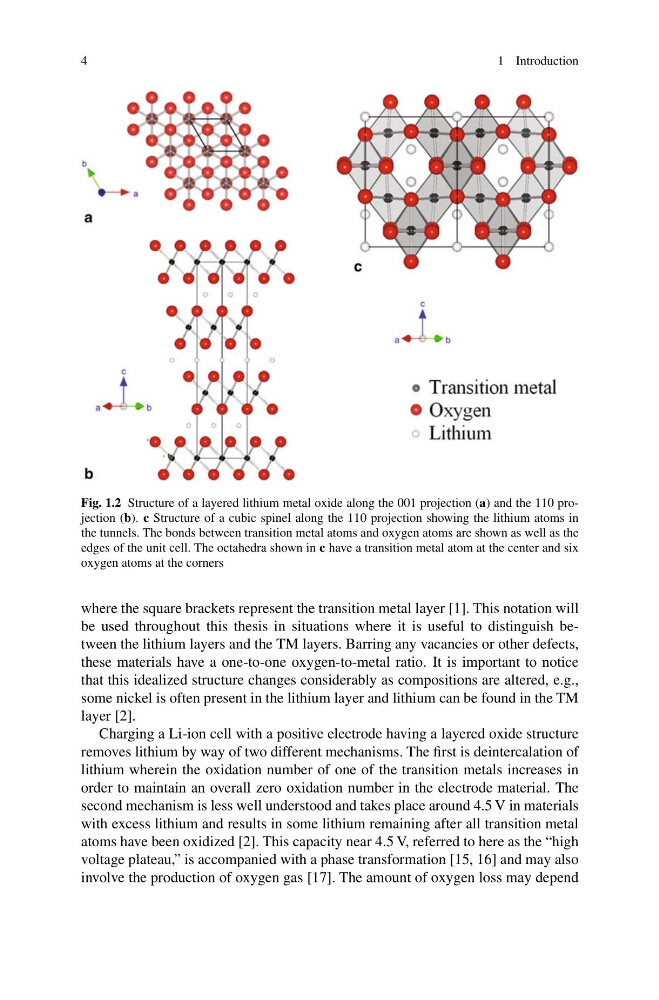
Fig. 1.2 Structure of a layered lithium metal oxide along the 001 projection (a) and the 110 projection (b). c Structure of a cubic spinel along the 110 projection showing the lithium atoms in
the tunnels. The bonds between transition metal atoms and oxygen atoms are shown as well as the
edges of the unit cell. The octahedra shown in c have a transition metal atom at the center and six
oxygen atoms at the corners
where the square brackets represent the transition metal layer [1]. This notation will
be used throughout this thesis in situations where it is useful to distinguish between the lithium layers and the TM layers. Barring any vacancies or other defects,
these materials have a one-to-one oxygen-to-metal ratio. It is important to notice
that this idealized structure changes considerably as compositions are altered, e.g.,
some nickel is often present in the lithium layer and lithium can be found in the TM
layer [2].
Charging a Li-ion cell with a positive electrode having a layered oxide structure
removes lithium by way of two different mechanisms. The first is deintercalation of
lithium wherein the oxidation number of one of the transition metals increases in
order to maintain an overall zero oxidation number in the electrode material. The
second mechanism is less well understood and takes place around 4.5 V in materials
with excess lithium and results in some lithium remaining after all transition metal
atoms have been oxidized [2]. This capacity near 4.5 V, referred to here as the “high
voltage plateau,” is accompanied with a phase transformation [15, 16] and may also
involve the production of oxygen gas [17]. The amount of oxygen loss may depend
1 Introduction
Fig. 1.2 Structure of a layered lithium metal oxide along the 001 projection (a) and the 110 projection (b). c Structure of a cubic spinel along the 110 projection showing the lithium atoms in
the tunnels. The bonds between transition metal atoms and oxygen atoms are shown as well as the
edges of the unit cell. The octahedra shown in c have a transition metal atom at the center and six
oxygen atoms at the corners
where the square brackets represent the transition metal layer [1]. This notation will
be used throughout this thesis in situations where it is useful to distinguish between the lithium layers and the TM layers. Barring any vacancies or other defects,
these materials have a one-to-one oxygen-to-metal ratio. It is important to notice
that this idealized structure changes considerably as compositions are altered, e.g.,
some nickel is often present in the lithium layer and lithium can be found in the TM
layer [2].
Charging a Li-ion cell with a positive electrode having a layered oxide structure
removes lithium by way of two different mechanisms. The first is deintercalation of
lithium wherein the oxidation number of one of the transition metals increases in
order to maintain an overall zero oxidation number in the electrode material. The
second mechanism is less well understood and takes place around 4.5 V in materials
with excess lithium and results in some lithium remaining after all transition metal
atoms have been oxidized [2]. This capacity near 4.5 V, referred to here as the “high
voltage plateau,” is accompanied with a phase transformation [15, 16] and may also
involve the production of oxygen gas [17]. The amount of oxygen loss may depend