

9.4 Monte Carlo Simulation Results
123
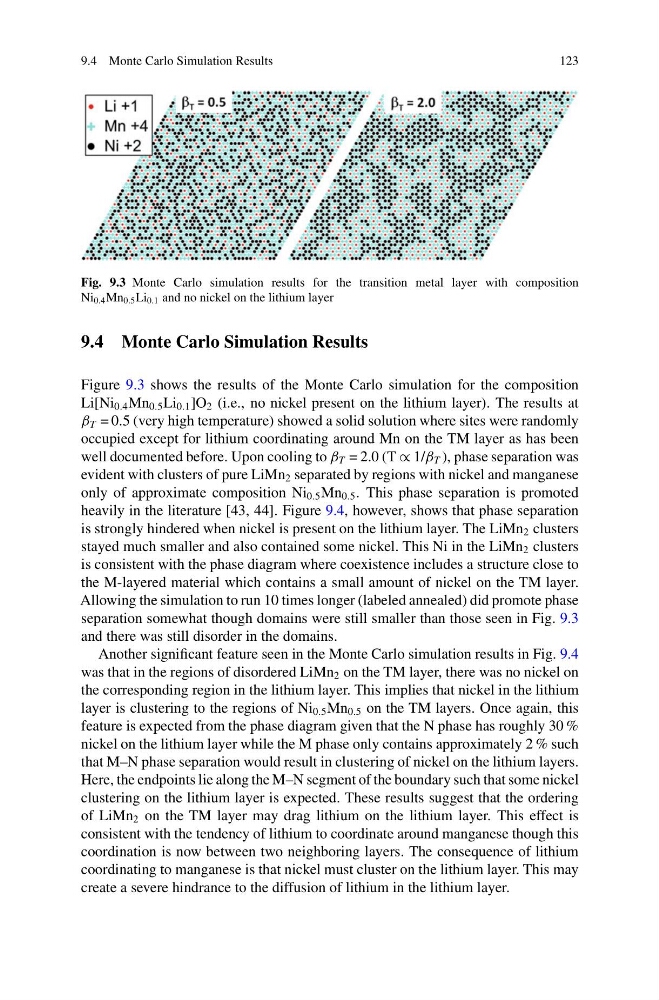
Fig. 9.3 Monte Carlo simulation results for the transition metal layer with composition
Ni 0.4 Mn 0.5 Li 0.1 and no nickel on the lithium layer
9.4 Monte Carlo Simulation Results
Figure 9.3 shows the results of the Monte Carlo simulation for the composition
Li[Ni 0.4 Mn 0.5 Li 0.1 ]O 2 (i.e., no nickel present on the lithium layer). The results at
β T = 0.5 (very high temperature) showed a solid solution where sites were randomly
occupied except for lithium coordinating around Mn on the TM layer as has been
well documented before. Upon cooling to β T = 2.0 (T ∝ 1/β T ), phase separation was
evident with clusters of pure LiMn 2 separated by regions with nickel and manganese
only of approximate composition Ni 0.5 Mn 0.5 . This phase separation is promoted
heavily in the literature [43, 44]. Figure 9.4, however, shows that phase separation
is strongly hindered when nickel is present on the lithium layer. The LiMn 2 clusters
stayed much smaller and also contained some nickel. This Ni in the LiMn 2 clusters
is consistent with the phase diagram where coexistence includes a structure close to
the M-layered material which contains a small amount of nickel on the TM layer.
Allowing the simulation to run 10 times longer (labeled annealed) did promote phase
separation somewhat though domains were still smaller than those seen in Fig. 9.3
and there was still disorder in the domains.
Another significant feature seen in the Monte Carlo simulation results in Fig. 9.4
was that in the regions of disordered LiMn 2 on the TM layer, there was no nickel on
the corresponding region in the lithium layer. This implies that nickel in the lithium
layer is clustering to the regions of Ni 0.5 Mn 0.5 on the TM layers. Once again, this
feature is expected from the phase diagram given that the N phase has roughly 30 %
nickel on the lithium layer while the M phase only contains approximately 2 % such
that M–N phase separation would result in clustering of nickel on the lithium layers.
Here, the endpoints lie along the M–N segment of the boundary such that some nickel
clustering on the lithium layer is expected. These results suggest that the ordering
of LiMn 2 on the TM layer may drag lithium on the lithium layer. This effect is
consistent with the tendency of lithium to coordinate around manganese though this
coordination is now between two neighboring layers. The consequence of lithium
coordinating to manganese is that nickel must cluster on the lithium layer. This may
create a severe hindrance to the diffusion of lithium in the lithium layer.
123
Fig. 9.3 Monte Carlo simulation results for the transition metal layer with composition
Ni 0.4 Mn 0.5 Li 0.1 and no nickel on the lithium layer
9.4 Monte Carlo Simulation Results
Figure 9.3 shows the results of the Monte Carlo simulation for the composition
Li[Ni 0.4 Mn 0.5 Li 0.1 ]O 2 (i.e., no nickel present on the lithium layer). The results at
β T = 0.5 (very high temperature) showed a solid solution where sites were randomly
occupied except for lithium coordinating around Mn on the TM layer as has been
well documented before. Upon cooling to β T = 2.0 (T ∝ 1/β T ), phase separation was
evident with clusters of pure LiMn 2 separated by regions with nickel and manganese
only of approximate composition Ni 0.5 Mn 0.5 . This phase separation is promoted
heavily in the literature [43, 44]. Figure 9.4, however, shows that phase separation
is strongly hindered when nickel is present on the lithium layer. The LiMn 2 clusters
stayed much smaller and also contained some nickel. This Ni in the LiMn 2 clusters
is consistent with the phase diagram where coexistence includes a structure close to
the M-layered material which contains a small amount of nickel on the TM layer.
Allowing the simulation to run 10 times longer (labeled annealed) did promote phase
separation somewhat though domains were still smaller than those seen in Fig. 9.3
and there was still disorder in the domains.
Another significant feature seen in the Monte Carlo simulation results in Fig. 9.4
was that in the regions of disordered LiMn 2 on the TM layer, there was no nickel on
the corresponding region in the lithium layer. This implies that nickel in the lithium
layer is clustering to the regions of Ni 0.5 Mn 0.5 on the TM layers. Once again, this
feature is expected from the phase diagram given that the N phase has roughly 30 %
nickel on the lithium layer while the M phase only contains approximately 2 % such
that M–N phase separation would result in clustering of nickel on the lithium layers.
Here, the endpoints lie along the M–N segment of the boundary such that some nickel
clustering on the lithium layer is expected. These results suggest that the ordering
of LiMn 2 on the TM layer may drag lithium on the lithium layer. This effect is
consistent with the tendency of lithium to coordinate around manganese though this
coordination is now between two neighboring layers. The consequence of lithium
coordinating to manganese is that nickel must cluster on the lithium layer. This may
create a severe hindrance to the diffusion of lithium in the lithium layer.