

114
8 Layered Materials with Metal Site Vacancies
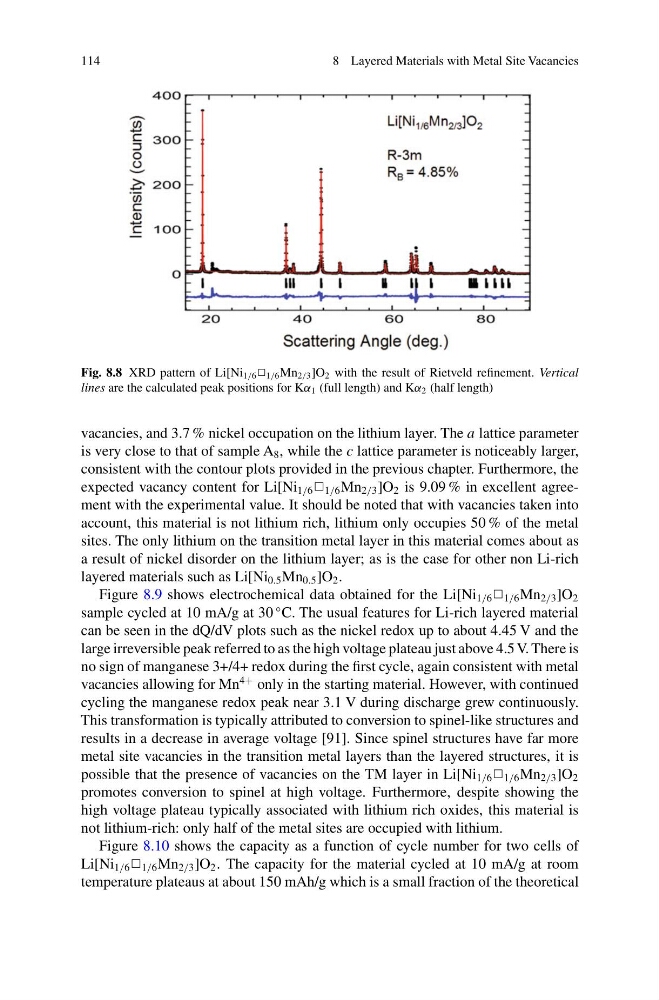
Fig. 8.8 XRD pattern of Li[Ni 1/6 P 1/6 Mn 2/3 ]O 2 with the result of Rietveld refinement. Vertical
lines are the calculated peak positions for Kα 1 (full length) and Kα 2 (half length)
vacancies, and 3.7 % nickel occupation on the lithium layer. The a lattice parameter
is very close to that of sample A 8 , while the c lattice parameter is noticeably larger,
consistent with the contour plots provided in the previous chapter. Furthermore, the
expected vacancy content for Li[Ni 1/6 P 1/6 Mn 2/3 ]O 2 is 9.09 % in excellent agreement with the experimental value. It should be noted that with vacancies taken into
account, this material is not lithium rich, lithium only occupies 50 % of the metal
sites. The only lithium on the transition metal layer in this material comes about as
a result of nickel disorder on the lithium layer; as is the case for other non Li-rich
layered materials such as Li[Ni 0.5 Mn 0.5 ]O 2 .
Figure 8.9 shows electrochemical data obtained for the Li[Ni 1/6 P 1/6 Mn 2/3 ]O 2
sample cycled at 10 mA/g at 30
◦ C. The usual features for Li-rich layered material
can be seen in the dQ/dV plots such as the nickel redox up to about 4.45 V and the
large irreversible peak referred to as the high voltage plateau just above 4.5 V. There is
no sign of manganese 3+/4+ redox during the first cycle, again consistent with metal
vacancies allowing for Mn
4+ only in the starting material. However, with continued
cycling the manganese redox peak near 3.1 V during discharge grew continuously.
This transformation is typically attributed to conversion to spinel-like structures and
results in a decrease in average voltage [91]. Since spinel structures have far more
metal site vacancies in the transition metal layers than the layered structures, it is
possible that the presence of vacancies on the TM layer in Li[Ni 1/6 P 1/6 Mn 2/3 ]O 2
promotes conversion to spinel at high voltage. Furthermore, despite showing the
high voltage plateau typically associated with lithium rich oxides, this material is
not lithium-rich: only half of the metal sites are occupied with lithium.
Figure 8.10 shows the capacity as a function of cycle number for two cells of
Li[Ni 1/6 P 1/6 Mn 2/3 ]O 2 . The capacity for the material cycled at 10 mA/g at room
temperature plateaus at about 150 mAh/g which is a small fraction of the theoretical
8 Layered Materials with Metal Site Vacancies
Fig. 8.8 XRD pattern of Li[Ni 1/6 P 1/6 Mn 2/3 ]O 2 with the result of Rietveld refinement. Vertical
lines are the calculated peak positions for Kα 1 (full length) and Kα 2 (half length)
vacancies, and 3.7 % nickel occupation on the lithium layer. The a lattice parameter
is very close to that of sample A 8 , while the c lattice parameter is noticeably larger,
consistent with the contour plots provided in the previous chapter. Furthermore, the
expected vacancy content for Li[Ni 1/6 P 1/6 Mn 2/3 ]O 2 is 9.09 % in excellent agreement with the experimental value. It should be noted that with vacancies taken into
account, this material is not lithium rich, lithium only occupies 50 % of the metal
sites. The only lithium on the transition metal layer in this material comes about as
a result of nickel disorder on the lithium layer; as is the case for other non Li-rich
layered materials such as Li[Ni 0.5 Mn 0.5 ]O 2 .
Figure 8.9 shows electrochemical data obtained for the Li[Ni 1/6 P 1/6 Mn 2/3 ]O 2
sample cycled at 10 mA/g at 30
◦ C. The usual features for Li-rich layered material
can be seen in the dQ/dV plots such as the nickel redox up to about 4.45 V and the
large irreversible peak referred to as the high voltage plateau just above 4.5 V. There is
no sign of manganese 3+/4+ redox during the first cycle, again consistent with metal
vacancies allowing for Mn
4+ only in the starting material. However, with continued
cycling the manganese redox peak near 3.1 V during discharge grew continuously.
This transformation is typically attributed to conversion to spinel-like structures and
results in a decrease in average voltage [91]. Since spinel structures have far more
metal site vacancies in the transition metal layers than the layered structures, it is
possible that the presence of vacancies on the TM layer in Li[Ni 1/6 P 1/6 Mn 2/3 ]O 2
promotes conversion to spinel at high voltage. Furthermore, despite showing the
high voltage plateau typically associated with lithium rich oxides, this material is
not lithium-rich: only half of the metal sites are occupied with lithium.
Figure 8.10 shows the capacity as a function of cycle number for two cells of
Li[Ni 1/6 P 1/6 Mn 2/3 ]O 2 . The capacity for the material cycled at 10 mA/g at room
temperature plateaus at about 150 mAh/g which is a small fraction of the theoretical