

8.4 Vacancy Measurements
109
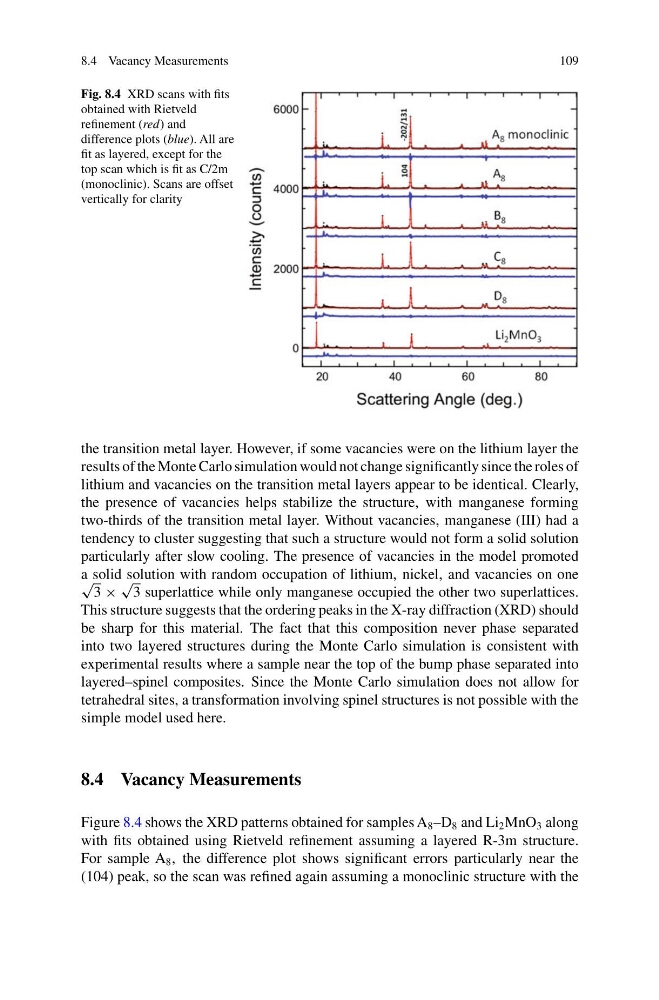
Fig. 8.4 XRD scans with fits
obtained with Rietveld
refinement (red) and
difference plots (blue). All are
fit as layered, except for the
top scan which is fit as C/2m
(monoclinic). Scans are offset
vertically for clarity
the transition metal layer. However, if some vacancies were on the lithium layer the
results of the Monte Carlo simulation would not change significantly since the roles of
lithium and vacancies on the transition metal layers appear to be identical. Clearly,
the presence of vacancies helps stabilize the structure, with manganese forming
two-thirds of the transition metal layer. Without vacancies, manganese (III) had a
tendency to cluster suggesting that such a structure would not form a solid solution
particularly after slow cooling. The presence of vacancies in the model promoted
a solid solution with random occupation of lithium, nickel, and vacancies on one
√
3 ×
√
3 superlattice while only manganese occupied the other two superlattices.
This structure suggests that the ordering peaks in the X-ray diffraction (XRD) should
be sharp for this material. The fact that this composition never phase separated
into two layered structures during the Monte Carlo simulation is consistent with
experimental results where a sample near the top of the bump phase separated into
layered–spinel composites. Since the Monte Carlo simulation does not allow for
tetrahedral sites, a transformation involving spinel structures is not possible with the
simple model used here.
8.4 Vacancy Measurements
Figure 8.4 shows the XRD patterns obtained for samples A 8 –D 8 and Li 2 MnO 3 along
with fits obtained using Rietveld refinement assuming a layered R-3m structure.
For sample A 8 , the difference plot shows significant errors particularly near the
(104) peak, so the scan was refined again assuming a monoclinic structure with the
109
Fig. 8.4 XRD scans with fits
obtained with Rietveld
refinement (red) and
difference plots (blue). All are
fit as layered, except for the
top scan which is fit as C/2m
(monoclinic). Scans are offset
vertically for clarity
the transition metal layer. However, if some vacancies were on the lithium layer the
results of the Monte Carlo simulation would not change significantly since the roles of
lithium and vacancies on the transition metal layers appear to be identical. Clearly,
the presence of vacancies helps stabilize the structure, with manganese forming
two-thirds of the transition metal layer. Without vacancies, manganese (III) had a
tendency to cluster suggesting that such a structure would not form a solid solution
particularly after slow cooling. The presence of vacancies in the model promoted
a solid solution with random occupation of lithium, nickel, and vacancies on one
√
3 ×
√
3 superlattice while only manganese occupied the other two superlattices.
This structure suggests that the ordering peaks in the X-ray diffraction (XRD) should
be sharp for this material. The fact that this composition never phase separated
into two layered structures during the Monte Carlo simulation is consistent with
experimental results where a sample near the top of the bump phase separated into
layered–spinel composites. Since the Monte Carlo simulation does not allow for
tetrahedral sites, a transformation involving spinel structures is not possible with the
simple model used here.
8.4 Vacancy Measurements
Figure 8.4 shows the XRD patterns obtained for samples A 8 –D 8 and Li 2 MnO 3 along
with fits obtained using Rietveld refinement assuming a layered R-3m structure.
For sample A 8 , the difference plot shows significant errors particularly near the
(104) peak, so the scan was refined again assuming a monoclinic structure with the