

108
8 Layered Materials with Metal Site Vacancies
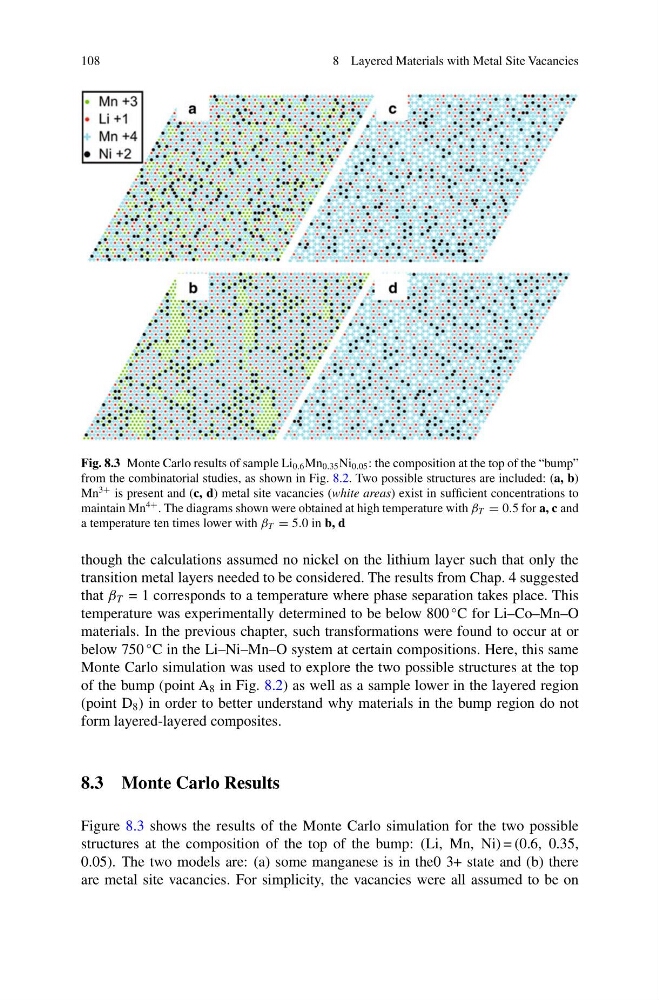
Fig. 8.3 Monte Carlo results of sample Li 0.6 Mn 0.35 Ni 0.05 : the composition at the top of the “bump”
from the combinatorial studies, as shown in Fig. 8.2. Two possible structures are included: (a, b)
Mn
3+ is present and (c, d) metal site vacancies (white areas) exist in sufficient concentrations to
maintain Mn
4+ . The diagrams shown were obtained at high temperature with β T = 0.5 for a, c and
a temperature ten times lower with β T = 5.0 in b, d
though the calculations assumed no nickel on the lithium layer such that only the
transition metal layers needed to be considered. The results from Chap. 4 suggested
that β T = 1 corresponds to a temperature where phase separation takes place. This
temperature was experimentally determined to be below 800
◦ C for Li–Co–Mn–O
materials. In the previous chapter, such transformations were found to occur at or
below 750
◦ C in the Li–Ni–Mn–O system at certain compositions. Here, this same
Monte Carlo simulation was used to explore the two possible structures at the top
of the bump (point A 8 in Fig. 8.2) as well as a sample lower in the layered region
(point D 8 ) in order to better understand why materials in the bump region do not
form layered-layered composites.
8.3 Monte Carlo Results
Figure 8.3 shows the results of the Monte Carlo simulation for the two possible
structures at the composition of the top of the bump: (Li, Mn, Ni) = (0.6, 0.35,
0.05). The two models are: (a) some manganese is in the0 3+ state and (b) there
are metal site vacancies. For simplicity, the vacancies were all assumed to be on
8 Layered Materials with Metal Site Vacancies
Fig. 8.3 Monte Carlo results of sample Li 0.6 Mn 0.35 Ni 0.05 : the composition at the top of the “bump”
from the combinatorial studies, as shown in Fig. 8.2. Two possible structures are included: (a, b)
Mn
3+ is present and (c, d) metal site vacancies (white areas) exist in sufficient concentrations to
maintain Mn
4+ . The diagrams shown were obtained at high temperature with β T = 0.5 for a, c and
a temperature ten times lower with β T = 5.0 in b, d
though the calculations assumed no nickel on the lithium layer such that only the
transition metal layers needed to be considered. The results from Chap. 4 suggested
that β T = 1 corresponds to a temperature where phase separation takes place. This
temperature was experimentally determined to be below 800
◦ C for Li–Co–Mn–O
materials. In the previous chapter, such transformations were found to occur at or
below 750
◦ C in the Li–Ni–Mn–O system at certain compositions. Here, this same
Monte Carlo simulation was used to explore the two possible structures at the top
of the bump (point A 8 in Fig. 8.2) as well as a sample lower in the layered region
(point D 8 ) in order to better understand why materials in the bump region do not
form layered-layered composites.
8.3 Monte Carlo Results
Figure 8.3 shows the results of the Monte Carlo simulation for the two possible
structures at the composition of the top of the bump: (Li, Mn, Ni) = (0.6, 0.35,
0.05). The two models are: (a) some manganese is in the0 3+ state and (b) there
are metal site vacancies. For simplicity, the vacancies were all assumed to be on