

4 Femtosecond Photodissociation Dynamics by Velocity Map Imaging
71
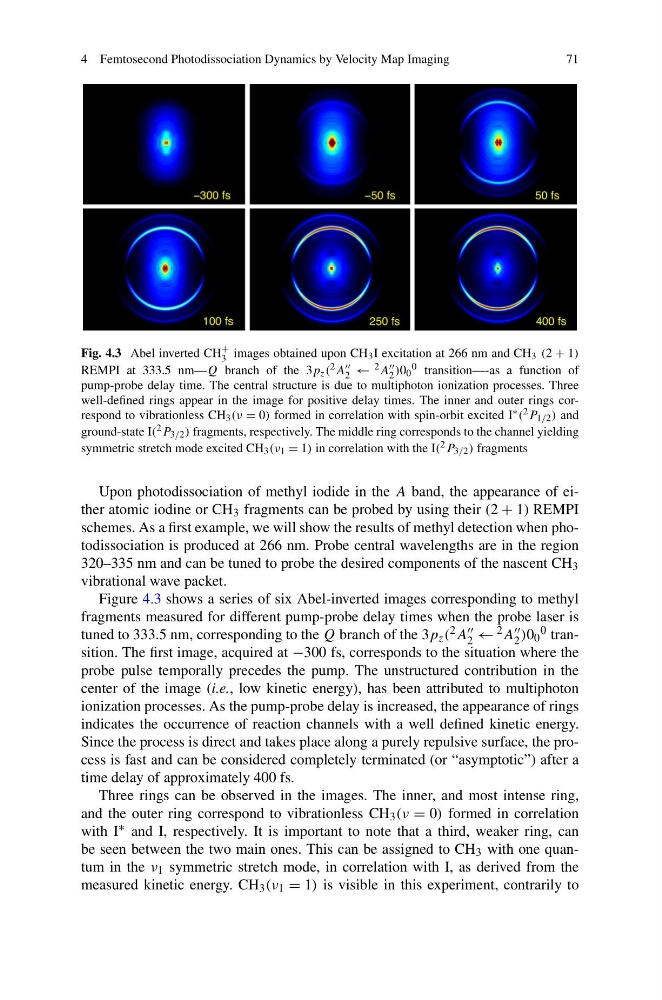
Fig. 4.3 Abel inverted CH
+
3 images obtained upon CH 3 I excitation at 266 nm and CH 3 (2 + 1)
REMPI at 333.5 nm—Q branch of the 3p z ( 2 A
2 ← 2 A
2 )0 0
0 transition—-as a function of
pump-probe delay time. The central structure is due to multiphoton ionization processes. Three
well-defined rings appear in the image for positive delay times. The inner and outer rings correspond to vibrationless CH 3 (ν = 0) formed in correlation with spin-orbit excited I ∗ ( 2 P 1/2 ) and
ground-state I( 2 P 3/2 ) fragments, respectively. The middle ring corresponds to the channel yielding
symmetric stretch mode excited CH 3 (ν 1 = 1) in correlation with the I( 2 P 3/2 ) fragments
Upon photodissociation of methyl iodide in the A band, the appearance of either atomic iodine or CH 3 fragments can be probed by using their (2 + 1) REMPI
schemes. As a first example, we will show the results of methyl detection when photodissociation is produced at 266 nm. Probe central wavelengths are in the region
320–335 nm and can be tuned to probe the desired components of the nascent CH 3
vibrational wave packet.
Figure 4.3 shows a series of six Abel-inverted images corresponding to methyl
fragments measured for different pump-probe delay times when the probe laser is
tuned to 333.5 nm, corresponding to the Q branch of the 3p z ( 2 A
2 ← 2 A
2 )0 0
0 transition. The first image, acquired at −300 fs, corresponds to the situation where the
probe pulse temporally precedes the pump. The unstructured contribution in the
center of the image (i.e., low kinetic energy), has been attributed to multiphoton
ionization processes. As the pump-probe delay is increased, the appearance of rings
indicates the occurrence of reaction channels with a well defined kinetic energy.
Since the process is direct and takes place along a purely repulsive surface, the process is fast and can be considered completely terminated (or “asymptotic”) after a
time delay of approximately 400 fs.
Three rings can be observed in the images. The inner, and most intense ring,
and the outer ring correspond to vibrationless CH 3 (ν = 0) formed in correlation
with I ∗ and I, respectively. It is important to note that a third, weaker ring, can
be seen between the two main ones. This can be assigned to CH 3 with one quantum in the ν 1 symmetric stretch mode, in correlation with I, as derived from the
measured kinetic energy. CH 3 (ν 1 = 1) is visible in this experiment, contrarily to
71
Fig. 4.3 Abel inverted CH
+
3 images obtained upon CH 3 I excitation at 266 nm and CH 3 (2 + 1)
REMPI at 333.5 nm—Q branch of the 3p z ( 2 A
2 ← 2 A
2 )0 0
0 transition—-as a function of
pump-probe delay time. The central structure is due to multiphoton ionization processes. Three
well-defined rings appear in the image for positive delay times. The inner and outer rings correspond to vibrationless CH 3 (ν = 0) formed in correlation with spin-orbit excited I ∗ ( 2 P 1/2 ) and
ground-state I( 2 P 3/2 ) fragments, respectively. The middle ring corresponds to the channel yielding
symmetric stretch mode excited CH 3 (ν 1 = 1) in correlation with the I( 2 P 3/2 ) fragments
Upon photodissociation of methyl iodide in the A band, the appearance of either atomic iodine or CH 3 fragments can be probed by using their (2 + 1) REMPI
schemes. As a first example, we will show the results of methyl detection when photodissociation is produced at 266 nm. Probe central wavelengths are in the region
320–335 nm and can be tuned to probe the desired components of the nascent CH 3
vibrational wave packet.
Figure 4.3 shows a series of six Abel-inverted images corresponding to methyl
fragments measured for different pump-probe delay times when the probe laser is
tuned to 333.5 nm, corresponding to the Q branch of the 3p z ( 2 A
2 ← 2 A
2 )0 0
0 transition. The first image, acquired at −300 fs, corresponds to the situation where the
probe pulse temporally precedes the pump. The unstructured contribution in the
center of the image (i.e., low kinetic energy), has been attributed to multiphoton
ionization processes. As the pump-probe delay is increased, the appearance of rings
indicates the occurrence of reaction channels with a well defined kinetic energy.
Since the process is direct and takes place along a purely repulsive surface, the process is fast and can be considered completely terminated (or “asymptotic”) after a
time delay of approximately 400 fs.
Three rings can be observed in the images. The inner, and most intense ring,
and the outer ring correspond to vibrationless CH 3 (ν = 0) formed in correlation
with I ∗ and I, respectively. It is important to note that a third, weaker ring, can
be seen between the two main ones. This can be assigned to CH 3 with one quantum in the ν 1 symmetric stretch mode, in correlation with I, as derived from the
measured kinetic energy. CH 3 (ν 1 = 1) is visible in this experiment, contrarily to