

72
R. de Nalda et al.
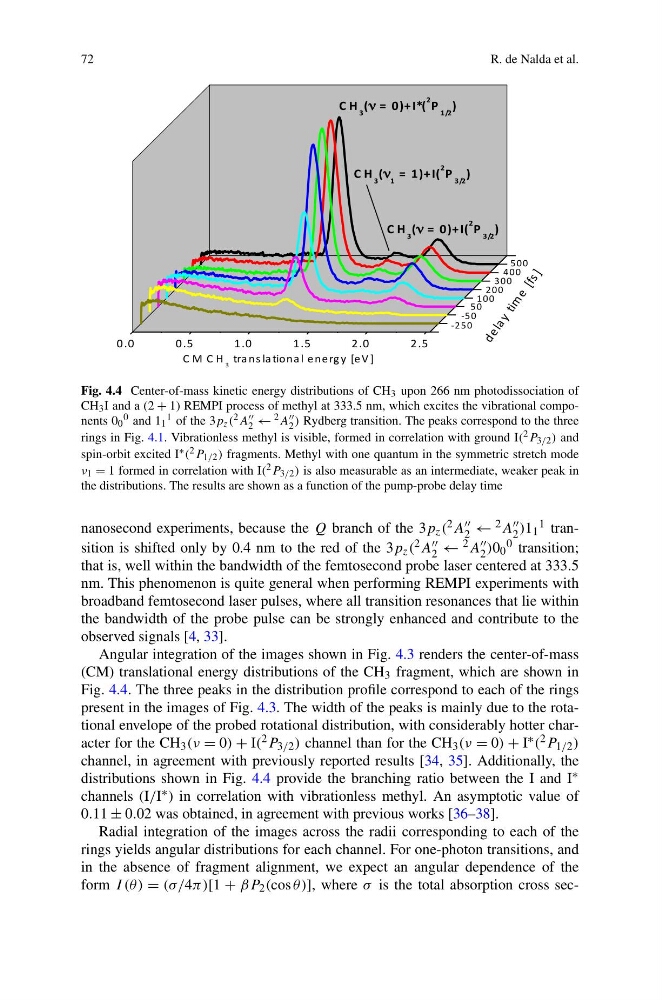
Fig. 4.4 Center-of-mass kinetic energy distributions of CH 3 upon 266 nm photodissociation of
CH 3 I and a (2 + 1) REMPI process of methyl at 333.5 nm, which excites the vibrational components 0 0
0 and 1 1
1 of the 3p z ( 2 A
2 ← 2 A
2 ) Rydberg transition. The peaks correspond to the three
rings in Fig. 4.1. Vibrationless methyl is visible, formed in correlation with ground I( 2 P 3/2 ) and
spin-orbit excited I ∗ ( 2 P 1/2 ) fragments. Methyl with one quantum in the symmetric stretch mode
ν 1 = 1 formed in correlation with I( 2 P 3/2 ) is also measurable as an intermediate, weaker peak in
the distributions. The results are shown as a function of the pump-probe delay time
nanosecond experiments, because the Q branch of the 3p z ( 2 A
2 ← 2 A
2 )1 1
1 transition is shifted only by 0.4 nm to the red of the 3p z ( 2 A
2 ← 2 A
2 )0 0
0 transition;
that is, well within the bandwidth of the femtosecond probe laser centered at 333.5
nm. This phenomenon is quite general when performing REMPI experiments with
broadband femtosecond laser pulses, where all transition resonances that lie within
the bandwidth of the probe pulse can be strongly enhanced and contribute to the
observed signals [4, 33].
Angular integration of the images shown in Fig. 4.3 renders the center-of-mass
(CM) translational energy distributions of the CH 3 fragment, which are shown in
Fig. 4.4. The three peaks in the distribution profile correspond to each of the rings
present in the images of Fig. 4.3. The width of the peaks is mainly due to the rotational envelope of the probed rotational distribution, with considerably hotter character for the CH 3 (ν = 0) + I( 2 P 3/2 ) channel than for the CH 3 (ν = 0) + I ∗ ( 2 P 1/2 )
channel, in agreement with previously reported results [34, 35]. Additionally, the
distributions shown in Fig. 4.4 provide the branching ratio between the I and I ∗
channels (I/I ∗ ) in correlation with vibrationless methyl. An asymptotic value of
0.11 ± 0.02 was obtained, in agreement with previous works [36–38].
Radial integration of the images across the radii corresponding to each of the
rings yields angular distributions for each channel. For one-photon transitions, and
in the absence of fragment alignment, we expect an angular dependence of the
form I (θ) = (σ/4π)[1 + βP 2 (cos θ)], where σ is the total absorption cross sec-
R. de Nalda et al.
Fig. 4.4 Center-of-mass kinetic energy distributions of CH 3 upon 266 nm photodissociation of
CH 3 I and a (2 + 1) REMPI process of methyl at 333.5 nm, which excites the vibrational components 0 0
0 and 1 1
1 of the 3p z ( 2 A
2 ← 2 A
2 ) Rydberg transition. The peaks correspond to the three
rings in Fig. 4.1. Vibrationless methyl is visible, formed in correlation with ground I( 2 P 3/2 ) and
spin-orbit excited I ∗ ( 2 P 1/2 ) fragments. Methyl with one quantum in the symmetric stretch mode
ν 1 = 1 formed in correlation with I( 2 P 3/2 ) is also measurable as an intermediate, weaker peak in
the distributions. The results are shown as a function of the pump-probe delay time
nanosecond experiments, because the Q branch of the 3p z ( 2 A
2 ← 2 A
2 )1 1
1 transition is shifted only by 0.4 nm to the red of the 3p z ( 2 A
2 ← 2 A
2 )0 0
0 transition;
that is, well within the bandwidth of the femtosecond probe laser centered at 333.5
nm. This phenomenon is quite general when performing REMPI experiments with
broadband femtosecond laser pulses, where all transition resonances that lie within
the bandwidth of the probe pulse can be strongly enhanced and contribute to the
observed signals [4, 33].
Angular integration of the images shown in Fig. 4.3 renders the center-of-mass
(CM) translational energy distributions of the CH 3 fragment, which are shown in
Fig. 4.4. The three peaks in the distribution profile correspond to each of the rings
present in the images of Fig. 4.3. The width of the peaks is mainly due to the rotational envelope of the probed rotational distribution, with considerably hotter character for the CH 3 (ν = 0) + I( 2 P 3/2 ) channel than for the CH 3 (ν = 0) + I ∗ ( 2 P 1/2 )
channel, in agreement with previously reported results [34, 35]. Additionally, the
distributions shown in Fig. 4.4 provide the branching ratio between the I and I ∗
channels (I/I ∗ ) in correlation with vibrationless methyl. An asymptotic value of
0.11 ± 0.02 was obtained, in agreement with previous works [36–38].
Radial integration of the images across the radii corresponding to each of the
rings yields angular distributions for each channel. For one-photon transitions, and
in the absence of fragment alignment, we expect an angular dependence of the
form I (θ) = (σ/4π)[1 + βP 2 (cos θ)], where σ is the total absorption cross sec-