

70
R. de Nalda et al.
step [30, 31]. In the C 3v geometry, the different symmetries of the 1 Q 1 (3E) and
3 Q 0 ( 2 A 1 ) states disable any possible crossing. In the reduced symmetry C s geometry, the 3E state splits into 4A and 2A components, whilst the symmetry of the
2A 1 state is lowered to 3A . The avoided crossing between the distorted 3A and
4A states gives rise to a conical intersection. The position of the crossing point reported in the literature is strongly dependent on the level attained in the theoretical
calculations.
An important feature of CH 3 I dissociation in the A band, as evidenced experimentally [32], is that approximately 90 % of the available energy appears as fragments’ kinetic energy, although a substantial vibrational excitation in the umbrella
mode (ν 2 ) of CH 3 has been found. This is expected from the dramatic geometrical
change of CH 3 upon dissociation, from pyramidal to planar. Excitation in the CH 3
symmetric stretch mode (ν 1 ) has been observed too. Methyl fragments in correlation
with the ground state I( 2 P 3/2 ) atom appear with a higher internal energy content,
both vibrational and rotational than those formed in correlation with spin-orbit excited I ∗ ( 2 P 1/2 ).
4.3.1 Reaction Clocking: The Resonant Experiment
This section will describe experiments of the “clocking” type, i.e. where the reaction times for the multiple channels are the observables of interest. In the basic
experiment, a pump laser is employed to promote the parent molecule to a particular excited state. A second laser, tuned to a resonant transition of a particular
photoproduct, is sent to the interaction region after a controllable delay, and ionizes the product fragment of interest. The resonant probe laser opens up an optical
coupling region in the potential energy surface determined by the laser bandwidth,
which allows the clocking of the reaction from the initial wave packet formed in the
Franck–Condon region to the free fragments in the asymptotic region. Since A-band
photofragmentation happens along purely dissociative surfaces, the dynamics are of
“ballistic” nature, and the signal appearance is delayed with respect to the zero of
time, at a delay time that we will call the “clocking” time. The plot of the fragment
ion signal intensity versus the delay between the laser pulses can typically be fitted
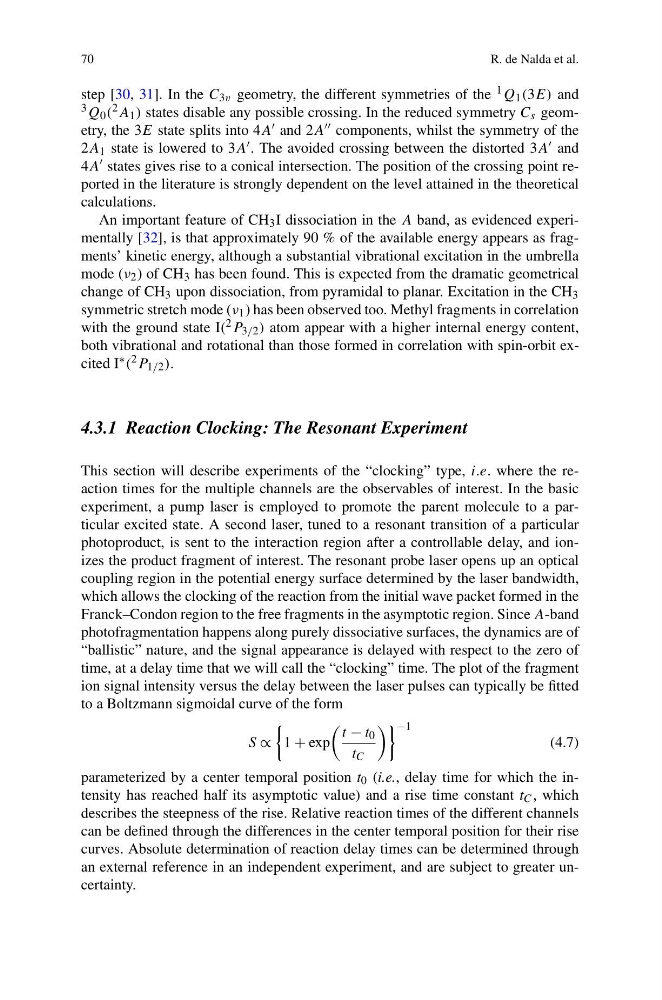
to a Boltzmann sigmoidal curve of the form
S ∝
1 + exp
t − t 0
t C
−1
(4.7)
parameterized by a center temporal position t 0 (i.e., delay time for which the intensity has reached half its asymptotic value) and a rise time constant t C , which
describes the steepness of the rise. Relative reaction times of the different channels
can be defined through the differences in the center temporal position for their rise
curves. Absolute determination of reaction delay times can be determined through
an external reference in an independent experiment, and are subject to greater uncertainty.
R. de Nalda et al.
step [30, 31]. In the C 3v geometry, the different symmetries of the 1 Q 1 (3E) and
3 Q 0 ( 2 A 1 ) states disable any possible crossing. In the reduced symmetry C s geometry, the 3E state splits into 4A and 2A components, whilst the symmetry of the
2A 1 state is lowered to 3A . The avoided crossing between the distorted 3A and
4A states gives rise to a conical intersection. The position of the crossing point reported in the literature is strongly dependent on the level attained in the theoretical
calculations.
An important feature of CH 3 I dissociation in the A band, as evidenced experimentally [32], is that approximately 90 % of the available energy appears as fragments’ kinetic energy, although a substantial vibrational excitation in the umbrella
mode (ν 2 ) of CH 3 has been found. This is expected from the dramatic geometrical
change of CH 3 upon dissociation, from pyramidal to planar. Excitation in the CH 3
symmetric stretch mode (ν 1 ) has been observed too. Methyl fragments in correlation
with the ground state I( 2 P 3/2 ) atom appear with a higher internal energy content,
both vibrational and rotational than those formed in correlation with spin-orbit excited I ∗ ( 2 P 1/2 ).
4.3.1 Reaction Clocking: The Resonant Experiment
This section will describe experiments of the “clocking” type, i.e. where the reaction times for the multiple channels are the observables of interest. In the basic
experiment, a pump laser is employed to promote the parent molecule to a particular excited state. A second laser, tuned to a resonant transition of a particular
photoproduct, is sent to the interaction region after a controllable delay, and ionizes the product fragment of interest. The resonant probe laser opens up an optical
coupling region in the potential energy surface determined by the laser bandwidth,
which allows the clocking of the reaction from the initial wave packet formed in the
Franck–Condon region to the free fragments in the asymptotic region. Since A-band
photofragmentation happens along purely dissociative surfaces, the dynamics are of
“ballistic” nature, and the signal appearance is delayed with respect to the zero of
time, at a delay time that we will call the “clocking” time. The plot of the fragment
ion signal intensity versus the delay between the laser pulses can typically be fitted
to a Boltzmann sigmoidal curve of the form
S ∝
1 + exp
t − t 0
t C
−1
(4.7)
parameterized by a center temporal position t 0 (i.e., delay time for which the intensity has reached half its asymptotic value) and a rise time constant t C , which
describes the steepness of the rise. Relative reaction times of the different channels
can be defined through the differences in the center temporal position for their rise
curves. Absolute determination of reaction delay times can be determined through
an external reference in an independent experiment, and are subject to greater uncertainty.